The great Indian freebie dilemma
How Rs 1.68 lakh crore in populist welfare is reshaping state budgets, crowding out roads and schools, and dividing economists, judges, and politicians alike — and what the data actually says.
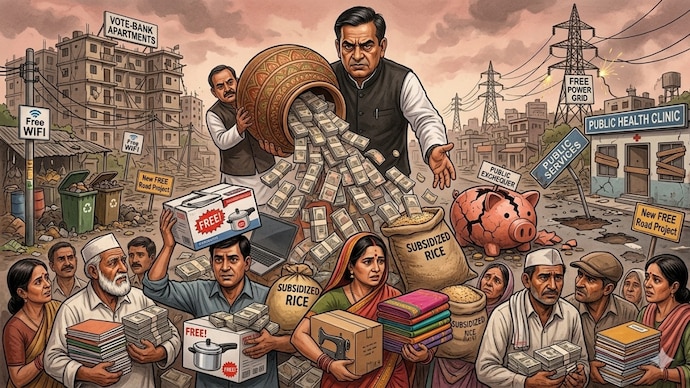
We've seen this before: the government hands out something for free, the Opposition calls it irresponsible, the government calls it welfare, and nobody can agree on where the line is. But since 2022, the scale, speed, and fiscal weight of "freebies" have reached a qualitatively new level. The numbers now demand a reckoning.
In a single budget cycle of FY26, twelve Indian states together budgeted Rs 1,68,040 crore just for unconditional cash transfers to women. That is roughly 0.5 per cent of India's entire GDP, disbursed without any work requirement, training component, or outcome condition. Added to power subsidies, farm loan waivers, free grain, and free transport, the total state subsidy bill has more than doubled since 2018-19 to approximately Rs 4.7 lakh crore.
Meanwhile, state debt has tripled in a decade, interest payments now consume a fifth of revenue in several states, and capital spending on roads, schools, and hospitals is being squeezed.
Yet the story is not as simple as the "revdi culture" critics would have it. Global research has consistently shown that cash transfers, when well-targeted, can lift consumption, stimulate local economies, and improve human capital without destroying the will to work.
Even India's own Economic Survey 2024-25 defended the welfare architecture before the 2025-26 edition reversed course. The debate, in short, is genuinely unresolved and worthy of honest examination.
THE NUMBERS
Rs 4.7 lakh crore: Total state subsidies, FY25 Budget Estimate
Rs 1.68 lakh crore: Women-focused UCT schemes alone, FY26 BE (12 states)
~81 per cent: Combined Centre + State debt as percentage of GDP, FY25
- advertisement
3.3 per cent: States' aggregate fiscal deficit as a percentage of GDP, FY25
Behind these headline numbers sits a more uncomfortable fact: state government debt has tripled in a decade — from Rs 17.57 lakh crore in FY14 to Rs 59.60 lakh crore in FY23, according to the Comptroller and Auditor General of India’s December 2025 decadal audit. The NK Singh Committee's Fiscal Responsibility and Budget Management review (2017) set a combined Centre-State debt ceiling of 60 per cent of GDP as a prudential anchor. India is at roughly 81 per cent. The ceiling has not merely been approached — it has been broken.
TWO INDIAS
Averages hide the worst cases. The most illuminating comparison is not between India and comparable economies, but between Indian states themselves, which operate under the same legal framework but have made radically different fiscal choices.
The contrast is stark. Punjab allocates just 5.5 paise of every budgetary rupee to capital investment — the lowest in the country. Gujarat allocates 25.3 paise. This is not an accident of geography or history: it is the cumulative result of fiscal choices made over a decade. Punjab's debt-to-GSDP ratio of 46 per cent has already exceeded the Reserve Bank of India's own 2022 projection (45 per cent) for FY2027 — two years ahead of schedule.
ARE FREEBIES CROWDING OUT INVESTMENT?
The most serious economic charge against freebie spending is that it displaces capital expenditure. The RBI, Economic Survey 2025-26, and multiple CAG reports have all raised this concern. What does the data show?
A PRS Legislative Research study found that between 2015 and 2022, when state revenue fell short of the budget, states cut capital outlay by 19 per cent on average compared to just eight per cent for revenue expenditure.
Why? Simply, salary payments, pensions, and subsidy commitments are legally or politically non-negotiable. Infrastructure projects are not.
The capex share of total spending tells the same story by state: Punjab at 5.5 per cent, Kerala at 8.5 per cent, versus Gujarat at 25.3 per cent and Odisha at 23.9 per cent. The Economic Survey 2025-26 was unusually direct: it warned that "revenue expenditure is increasingly tilted towards unconditional cash transfers... the ability of States to expand capital expenditure on infrastructure, health, education and human capital is getting constrained."
The CAG's December 2025 audit exposed a deeper problem: in 11 states, borrowings primarily financed day-to-day operations rather than assets. In Andhra Pradesh and Punjab, less than 25 per cent of fresh borrowings went into capital assets. This means that the state was borrowing to pay for subsidies and salaries, while leaving future generations with the debt and without the infrastructure.
OTHER SIDE OF THE COIN
PM-KISAN — Rs 6,000 per year to over 9.35 crore farming households, with cumulative disbursals now exceeding Rs 4.27 lakh crore — is the most studied Indian cash transfer scheme. A 2020 IFPRI study published in the Economic and Political Weekly found that the scheme eased credit constraints, increased investment in seeds and fertilisers, and accelerated technology adoption through Krishi Vigyan Kendras. A NITI Aayog evaluation found that 92 per cent of beneficiaries used funds for agricultural inputs, not consumption alone.
Across 30+ cash transfer programmes globally, there is no consistent evidence that cash transfers increase spending on alcohol, tobacco, or reduce adult labour supply. The most influential randomised controlled trial, Haushofer & Shapiro's 2016 study of GiveDirectly's unconditional transfers in Kenya, found consumption gains of 23 per cent, asset investment gains of 61 per cent, and a measurable improvement in psychological well-being. A 2022 follow-up calculated a local economic multiplier of 2.5-2.7 — meaning each dollar transferred generated $2.5 in local economic activity. No harmful labour-supply effects were found.
THE GOVERNMENT'S OWN COUNTER-ARGUMENT
Before the Economic Survey 2024-25 warned against freebies, its predecessor made the opposite case. It found that social services expenditure rose from Rs 14.8 lakh crore in FY21 to Rs 25.7 lakh crore in FY25, a 15 per cent compounded annual growth rate.
It documented that food subsidy value accounted for seven per cent of rural bottom-quintile household consumption versus just two per cent for the top quintile, calling the PDS and PM-GKAY distribution "progressive" and protective against poverty during inflationary shocks.
POLITICAL PARADOX
In July 2022, Prime Minister Narendra Modi coined the phrase "revdi culture" to describe opposition parties' freebie promises. Less than two years later, the Bharatiya Janata Party governments in Madhya Pradesh and Maharashtra launched Ladli Behna and Ladki Bahin — schemes that are, functionally, identical to what the PM had criticised.
The BJP won both elections.
This is not hypocrisy in the conventional sense. It is a rational response to an electoral incentive structure that punishes fiscal restraint and rewards visible transfers. Yamini Aiyar of the Centre for Policy Research has argued that until India develops mechanisms to make the costs of freebies as salient to voters as the benefits, the political-economy equilibrium will remain stuck. That is an institutional design problem, not merely a party politics problem.
WHAT THE EVIDENCE ACTUALLY CONCLUDES
First, the fiscal cost is real, concentrated, and accelerating in specific states.
Second, the crowding-out of capital expenditure is empirically visible at the state level — the RBI's concern is not alarmist.
Third, and critically, the human-capital and demand-side case for transfers is more robust than the dominant "revdi culture" narrative acknowledges.
The intellectually honest conclusion is this: the fiscal case against unaffordable freebies in debt-stressed states is strong. The productivity case against all cash transfers is much weaker than the debate suggests. And India's definitional failure — no legal boundary between "developmental welfare" and "election freebie" — means this debate will be settled by electoral arithmetic before it is settled by evidence.
We've seen this before: the government hands out something for free, the Opposition calls it irresponsible, the government calls it welfare, and nobody can agree on where the line is. But since 2022, the scale, speed, and fiscal weight of "freebies" have reached a qualitatively new level. The numbers now demand a reckoning.
In a single budget cycle of FY26, twelve Indian states together budgeted Rs 1,68,040 crore just for unconditional cash transfers to women. That is roughly 0.5 per cent of India's entire GDP, disbursed without any work requirement, training component, or outcome condition. Added to power subsidies, farm loan waivers, free grain, and free transport, the total state subsidy bill has more than doubled since 2018-19 to approximately Rs 4.7 lakh crore.
Meanwhile, state debt has tripled in a decade, interest payments now consume a fifth of revenue in several states, and capital spending on roads, schools, and hospitals is being squeezed.
Yet the story is not as simple as the "revdi culture" critics would have it. Global research has consistently shown that cash transfers, when well-targeted, can lift consumption, stimulate local economies, and improve human capital without destroying the will to work.
Even India's own Economic Survey 2024-25 defended the welfare architecture before the 2025-26 edition reversed course. The debate, in short, is genuinely unresolved and worthy of honest examination.
THE NUMBERS
Rs 4.7 lakh crore: Total state subsidies, FY25 Budget Estimate
Rs 1.68 lakh crore: Women-focused UCT schemes alone, FY26 BE (12 states)
~81 per cent: Combined Centre + State debt as percentage of GDP, FY25
3.3 per cent: States' aggregate fiscal deficit as a percentage of GDP, FY25
Behind these headline numbers sits a more uncomfortable fact: state government debt has tripled in a decade — from Rs 17.57 lakh crore in FY14 to Rs 59.60 lakh crore in FY23, according to the Comptroller and Auditor General of India’s December 2025 decadal audit. The NK Singh Committee's Fiscal Responsibility and Budget Management review (2017) set a combined Centre-State debt ceiling of 60 per cent of GDP as a prudential anchor. India is at roughly 81 per cent. The ceiling has not merely been approached — it has been broken.
TWO INDIAS
Averages hide the worst cases. The most illuminating comparison is not between India and comparable economies, but between Indian states themselves, which operate under the same legal framework but have made radically different fiscal choices.
The contrast is stark. Punjab allocates just 5.5 paise of every budgetary rupee to capital investment — the lowest in the country. Gujarat allocates 25.3 paise. This is not an accident of geography or history: it is the cumulative result of fiscal choices made over a decade. Punjab's debt-to-GSDP ratio of 46 per cent has already exceeded the Reserve Bank of India's own 2022 projection (45 per cent) for FY2027 — two years ahead of schedule.
ARE FREEBIES CROWDING OUT INVESTMENT?
The most serious economic charge against freebie spending is that it displaces capital expenditure. The RBI, Economic Survey 2025-26, and multiple CAG reports have all raised this concern. What does the data show?
A PRS Legislative Research study found that between 2015 and 2022, when state revenue fell short of the budget, states cut capital outlay by 19 per cent on average compared to just eight per cent for revenue expenditure.
Why? Simply, salary payments, pensions, and subsidy commitments are legally or politically non-negotiable. Infrastructure projects are not.
The capex share of total spending tells the same story by state: Punjab at 5.5 per cent, Kerala at 8.5 per cent, versus Gujarat at 25.3 per cent and Odisha at 23.9 per cent. The Economic Survey 2025-26 was unusually direct: it warned that "revenue expenditure is increasingly tilted towards unconditional cash transfers... the ability of States to expand capital expenditure on infrastructure, health, education and human capital is getting constrained."
The CAG's December 2025 audit exposed a deeper problem: in 11 states, borrowings primarily financed day-to-day operations rather than assets. In Andhra Pradesh and Punjab, less than 25 per cent of fresh borrowings went into capital assets. This means that the state was borrowing to pay for subsidies and salaries, while leaving future generations with the debt and without the infrastructure.
OTHER SIDE OF THE COIN
PM-KISAN — Rs 6,000 per year to over 9.35 crore farming households, with cumulative disbursals now exceeding Rs 4.27 lakh crore — is the most studied Indian cash transfer scheme. A 2020 IFPRI study published in the Economic and Political Weekly found that the scheme eased credit constraints, increased investment in seeds and fertilisers, and accelerated technology adoption through Krishi Vigyan Kendras. A NITI Aayog evaluation found that 92 per cent of beneficiaries used funds for agricultural inputs, not consumption alone.
Across 30+ cash transfer programmes globally, there is no consistent evidence that cash transfers increase spending on alcohol, tobacco, or reduce adult labour supply. The most influential randomised controlled trial, Haushofer & Shapiro's 2016 study of GiveDirectly's unconditional transfers in Kenya, found consumption gains of 23 per cent, asset investment gains of 61 per cent, and a measurable improvement in psychological well-being. A 2022 follow-up calculated a local economic multiplier of 2.5-2.7 — meaning each dollar transferred generated $2.5 in local economic activity. No harmful labour-supply effects were found.
THE GOVERNMENT'S OWN COUNTER-ARGUMENT
Before the Economic Survey 2024-25 warned against freebies, its predecessor made the opposite case. It found that social services expenditure rose from Rs 14.8 lakh crore in FY21 to Rs 25.7 lakh crore in FY25, a 15 per cent compounded annual growth rate.
It documented that food subsidy value accounted for seven per cent of rural bottom-quintile household consumption versus just two per cent for the top quintile, calling the PDS and PM-GKAY distribution "progressive" and protective against poverty during inflationary shocks.
POLITICAL PARADOX
In July 2022, Prime Minister Narendra Modi coined the phrase "revdi culture" to describe opposition parties' freebie promises. Less than two years later, the Bharatiya Janata Party governments in Madhya Pradesh and Maharashtra launched Ladli Behna and Ladki Bahin — schemes that are, functionally, identical to what the PM had criticised.
The BJP won both elections.
This is not hypocrisy in the conventional sense. It is a rational response to an electoral incentive structure that punishes fiscal restraint and rewards visible transfers. Yamini Aiyar of the Centre for Policy Research has argued that until India develops mechanisms to make the costs of freebies as salient to voters as the benefits, the political-economy equilibrium will remain stuck. That is an institutional design problem, not merely a party politics problem.
WHAT THE EVIDENCE ACTUALLY CONCLUDES
First, the fiscal cost is real, concentrated, and accelerating in specific states.
Second, the crowding-out of capital expenditure is empirically visible at the state level — the RBI's concern is not alarmist.
Third, and critically, the human-capital and demand-side case for transfers is more robust than the dominant "revdi culture" narrative acknowledges.
The intellectually honest conclusion is this: the fiscal case against unaffordable freebies in debt-stressed states is strong. The productivity case against all cash transfers is much weaker than the debate suggests. And India's definitional failure — no legal boundary between "developmental welfare" and "election freebie" — means this debate will be settled by electoral arithmetic before it is settled by evidence.

