Why Chandrayaan-2's Moon water discovery is an Indian gift to the world
Chandrayaan-2 orbiter data has revealed signs of subsurface water-ice in shadowed craters near the Moon's south pole. The finding sharpens the strategic importance of the polar region for future missions, lunar bases and resource use.
When India launched the Chandrayaan-2 mission in 2019, the spotlight largely remained on the lander’s hard landing near the Moon’s south pole. But nearly seven years later, the orbiter is quietly delivering what could become one of the most important discoveries in the new lunar race: strong evidence of subsurface water-ice hidden beneath permanently shadowed craters near the lunar south pole.
The findings, made using the Chandrayaan-2 Orbiter’s Dual Frequency Synthetic Aperture Radar (DFSAR), are not just another scientific milestone. They strike at the heart of why the Moon’s south pole has become the most strategically valuable region beyond Earth.
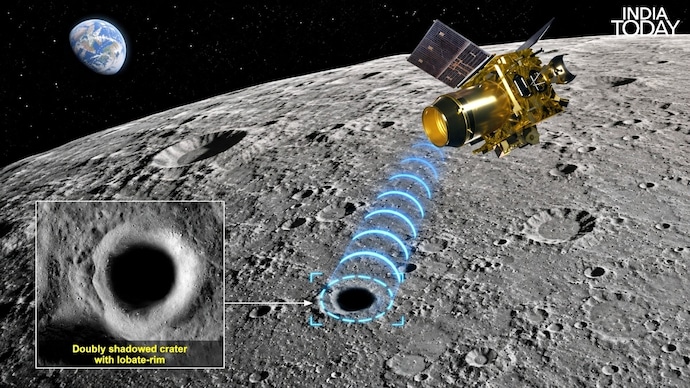
Scientists from the Physical Research Laboratory analysed “doubly shadowed craters,” depressions inside permanently shadowed regions where sunlight never reaches and temperatures plunge to nearly minus 248°C. In these deep-freeze conditions, water-ice can survive for billions of years.
Using advanced radar polarimetry, the team identified signatures consistent with subsurface ice in four craters. One 1.1-km-wide crater inside the Faustini basin showed especially compelling evidence, including radar reflections and unusual lobate rim structures that suggest an impact may have excavated ice-rich material buried underneath.
WHY ITS AN INDIAN GIFT TO THE WORLD
This matters because water on the Moon is no longer just a scientific curiosity. It is the fuel for humanity’s next phase in space.
Water can be converted into drinking supplies, breathable oxygen, and hydrogen fuel for rockets.
Instead of launching every kilogram from Earth at enormous cost, future astronauts could “live off the land” using lunar resources, a concept known as in-situ resource utilisation (ISRU). Whoever masters this first gains a major advantage in long-duration space exploration.
That is precisely why every major space power is targeting the Moon’s South Pole.
NASA plans to return astronauts to the lunar surface under the Artemis programme and eventually establish a sustained human presence near the south pole. The agency sees the region as the ideal location for future Moon bases because shadowed craters may hold accessible ice reserves. At the same time, nearby peaks receive near-continuous sunlight for power generation.
Meanwhile, China National Space Administration, the Chinese space agency, is rapidly advancing plans to land astronauts on the Moon before 2030 and build the International Lunar Research Station with Russia in the 2030s.
China’s long-term ambitions are also heavily focused on the polar region because of its resource potential.
India, too, is no longer thinking of the Moon only in terms of symbolic exploration.
INDIA HAS BIG PLANS ON THE MOON
After the success of Chandrayaan-3, India has announced plans for Chandrayaan-4, a sample return mission that could further investigate polar resources. The government has also laid out an ambitious roadmap that includes landing an Indian astronaut on the Moon by 2040.
In that context, Chandrayaan-2’s discovery becomes geopolitically important. India is not merely participating in the lunar race; it is generating the data that may shape where future missions land and where future lunar infrastructure is built.
The Moon’s south pole is increasingly being viewed as the “oil field” of the space age. In this region, access to water could determine scientific dominance, commercial opportunities, and strategic influence in cislunar space.
And in this emerging contest, India now possesses something extremely valuable: evidence pointing toward where that water may actually exist beneath the lunar surface.
When India launched the Chandrayaan-2 mission in 2019, the spotlight largely remained on the lander’s hard landing near the Moon’s south pole. But nearly seven years later, the orbiter is quietly delivering what could become one of the most important discoveries in the new lunar race: strong evidence of subsurface water-ice hidden beneath permanently shadowed craters near the lunar south pole.
The findings, made using the Chandrayaan-2 Orbiter’s Dual Frequency Synthetic Aperture Radar (DFSAR), are not just another scientific milestone. They strike at the heart of why the Moon’s south pole has become the most strategically valuable region beyond Earth.
Scientists from the Physical Research Laboratory analysed “doubly shadowed craters,” depressions inside permanently shadowed regions where sunlight never reaches and temperatures plunge to nearly minus 248°C. In these deep-freeze conditions, water-ice can survive for billions of years.
Using advanced radar polarimetry, the team identified signatures consistent with subsurface ice in four craters. One 1.1-km-wide crater inside the Faustini basin showed especially compelling evidence, including radar reflections and unusual lobate rim structures that suggest an impact may have excavated ice-rich material buried underneath.
WHY ITS AN INDIAN GIFT TO THE WORLD
This matters because water on the Moon is no longer just a scientific curiosity. It is the fuel for humanity’s next phase in space.
Water can be converted into drinking supplies, breathable oxygen, and hydrogen fuel for rockets.
Instead of launching every kilogram from Earth at enormous cost, future astronauts could “live off the land” using lunar resources, a concept known as in-situ resource utilisation (ISRU). Whoever masters this first gains a major advantage in long-duration space exploration.
That is precisely why every major space power is targeting the Moon’s South Pole.
NASA plans to return astronauts to the lunar surface under the Artemis programme and eventually establish a sustained human presence near the south pole. The agency sees the region as the ideal location for future Moon bases because shadowed craters may hold accessible ice reserves. At the same time, nearby peaks receive near-continuous sunlight for power generation.
Meanwhile, China National Space Administration, the Chinese space agency, is rapidly advancing plans to land astronauts on the Moon before 2030 and build the International Lunar Research Station with Russia in the 2030s.
China’s long-term ambitions are also heavily focused on the polar region because of its resource potential.
India, too, is no longer thinking of the Moon only in terms of symbolic exploration.
INDIA HAS BIG PLANS ON THE MOON
After the success of Chandrayaan-3, India has announced plans for Chandrayaan-4, a sample return mission that could further investigate polar resources. The government has also laid out an ambitious roadmap that includes landing an Indian astronaut on the Moon by 2040.
In that context, Chandrayaan-2’s discovery becomes geopolitically important. India is not merely participating in the lunar race; it is generating the data that may shape where future missions land and where future lunar infrastructure is built.
The Moon’s south pole is increasingly being viewed as the “oil field” of the space age. In this region, access to water could determine scientific dominance, commercial opportunities, and strategic influence in cislunar space.
And in this emerging contest, India now possesses something extremely valuable: evidence pointing toward where that water may actually exist beneath the lunar surface.

