Something that happened in Antarctica a million years ago is now taking effect
A new study says Antarctica became far more climate-sensitive after an ancient shift in ice age cycles. The finding suggests small changes could trigger abrupt ice-sheet responses and worsen sea-level rise.
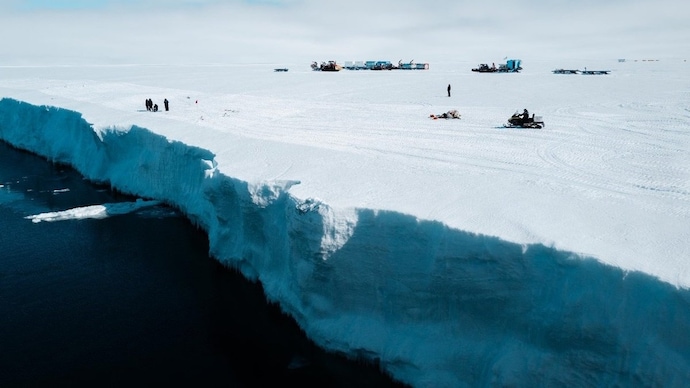
A dramatic shift in Antarctica that began nearly one million years ago may still be shaping the planet’s climate system today, according to a new study that is raising fresh concerns about the future of global sea levels in a warming world.
Researchers from the IBS Center for Climate Physics (ICCP) at Pusan National University in South Korea have discovered that the Antarctic ice sheet became far more sensitive to climate change after a major transformation in Earth’s ice age cycles known as the Mid-Pleistocene Transition.
The findings, published in the journal Nature Geoscience, suggest Antarctica does not respond gradually to climate change.
Instead, once certain thresholds are crossed, the continent’s vast ice sheets can suddenly become much more reactive to even small shifts in temperature and atmospheric carbon dioxide.
Antarctica contains the largest mass of ice on Earth and remains one of the biggest drivers of global sea-level rise. Scientists have long known that around one million years ago Earth’s climate underwent a major transition, with ice ages becoming longer, colder and more intense. But until now, researchers struggled to understand how Antarctica responded to that ancient climate upheaval.
To solve the mystery, scientists combined a detailed paleoclimate simulation reconstructing Earth’s climate over the past three million years with an advanced ice-sheet model developed at Pennsylvania State University.
The simulations were run on one of South Korea’s fastest supercomputers dedicated to climate science.
The results revealed a crucial tipping point.
Researchers identified a critical atmospheric carbon dioxide threshold of around 240 parts per million. Below this level, Antarctic ice sheets suddenly began responding much more dramatically to changes in ocean and air temperatures.
“After this transition, the Antarctic ice sheet reacts much more strongly to changes in climate forcing,” said lead author YUN Kyung-Sook. “This indicates that the system does not evolve gradually but instead becomes more responsive after crossing a particular threshold in the climate system.”
According to the study, several processes worked together to strengthen Antarctic ice growth after the transition. Colder oceans reduced melting beneath floating ice shelves, while lower global sea levels reduced pressure on bedrock beneath the ice, allowing coastal ice sheets to thicken further.
The findings carry major implications for today’s climate crisis.
“Our findings suggest that the Antarctic ice sheet was more sensitive to external forcings than previously assumed,” said Axel Timmermann. “This also raises important questions about its future response to global warming.”
Scientists say the research highlights a worrying possibility: Earth’s ice sheets may not melt slowly and predictably. Instead, they could abruptly shift into entirely new states once climate thresholds are crossed, dramatically accelerating future sea-level rise.
A dramatic shift in Antarctica that began nearly one million years ago may still be shaping the planet’s climate system today, according to a new study that is raising fresh concerns about the future of global sea levels in a warming world.
Researchers from the IBS Center for Climate Physics (ICCP) at Pusan National University in South Korea have discovered that the Antarctic ice sheet became far more sensitive to climate change after a major transformation in Earth’s ice age cycles known as the Mid-Pleistocene Transition.
The findings, published in the journal Nature Geoscience, suggest Antarctica does not respond gradually to climate change.
Instead, once certain thresholds are crossed, the continent’s vast ice sheets can suddenly become much more reactive to even small shifts in temperature and atmospheric carbon dioxide.
Antarctica contains the largest mass of ice on Earth and remains one of the biggest drivers of global sea-level rise. Scientists have long known that around one million years ago Earth’s climate underwent a major transition, with ice ages becoming longer, colder and more intense. But until now, researchers struggled to understand how Antarctica responded to that ancient climate upheaval.
To solve the mystery, scientists combined a detailed paleoclimate simulation reconstructing Earth’s climate over the past three million years with an advanced ice-sheet model developed at Pennsylvania State University.
The simulations were run on one of South Korea’s fastest supercomputers dedicated to climate science.
The results revealed a crucial tipping point.
Researchers identified a critical atmospheric carbon dioxide threshold of around 240 parts per million. Below this level, Antarctic ice sheets suddenly began responding much more dramatically to changes in ocean and air temperatures.
“After this transition, the Antarctic ice sheet reacts much more strongly to changes in climate forcing,” said lead author YUN Kyung-Sook. “This indicates that the system does not evolve gradually but instead becomes more responsive after crossing a particular threshold in the climate system.”
According to the study, several processes worked together to strengthen Antarctic ice growth after the transition. Colder oceans reduced melting beneath floating ice shelves, while lower global sea levels reduced pressure on bedrock beneath the ice, allowing coastal ice sheets to thicken further.
The findings carry major implications for today’s climate crisis.
“Our findings suggest that the Antarctic ice sheet was more sensitive to external forcings than previously assumed,” said Axel Timmermann. “This also raises important questions about its future response to global warming.”
Scientists say the research highlights a worrying possibility: Earth’s ice sheets may not melt slowly and predictably. Instead, they could abruptly shift into entirely new states once climate thresholds are crossed, dramatically accelerating future sea-level rise.

