China discovers alien material inside meteorite that fell on Earth from the Moon
Variations in its crystal structure could help researchers better understand how lunar minerals form and evolve under extreme conditions.
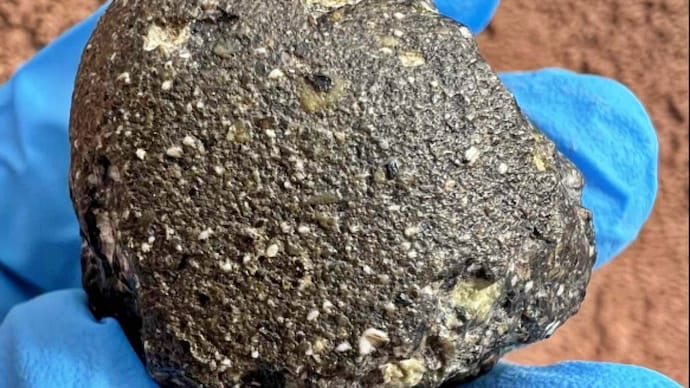
China has announced the discovery of a new mineral from the Moon, marking a significant addition to the growing catalogue of extraterrestrial materials and offering fresh insights into lunar geology.
According to the China Geological Survey, scientists have identified what is now the 11th known lunar mineral, named Cerium-Magnesium Changesite.
The mineral was discovered in a lunar meteorite, the first of its kind to have fallen within China, providing researchers with a rare opportunity to study naturally delivered Moon material on Earth.
The mineral is extremely small, with grain sizes ranging from about 3 to 25 micrometres, and most particles measuring under 10 micrometres. Despite its tiny size, researchers say it holds significant scientific value due to its unique chemical and structural properties.
One of the most striking features of Cerium-Magnesium Changesite is its fluorescent behaviour, meaning it emits light under certain conditions. This property could have practical applications in advanced technologies, particularly in the development of next-generation LED materials.
Scientists also noted that the mineral’s composition, especially its rare earth element ratios, along with its magnesium and iron content, offers valuable clues about the processes that shaped the Moon’s surface and interior.
Variations in its crystal structure could help researchers better understand how lunar minerals form and evolve under extreme conditions.
Beyond planetary science, the discovery may have implications for materials research on Earth. The mineral’s unique structure and composition could serve as a reference for synthesising new materials with tailored properties, potentially benefiting industries ranging from electronics to energy.
China has been steadily expanding its lunar exploration programme, with missions like Chang'e program returning samples and advancing scientific understanding of the Moon.
This latest finding underscores the growing role of international players in uncovering the Moon’s geological history.
As analysis continues, researchers hope the new mineral will not only deepen knowledge of the Moon but also open doors to innovative applications back on Earth, demonstrating once again how space discoveries can have far-reaching impacts.
China has announced the discovery of a new mineral from the Moon, marking a significant addition to the growing catalogue of extraterrestrial materials and offering fresh insights into lunar geology.
According to the China Geological Survey, scientists have identified what is now the 11th known lunar mineral, named Cerium-Magnesium Changesite.
The mineral was discovered in a lunar meteorite, the first of its kind to have fallen within China, providing researchers with a rare opportunity to study naturally delivered Moon material on Earth.
The mineral is extremely small, with grain sizes ranging from about 3 to 25 micrometres, and most particles measuring under 10 micrometres. Despite its tiny size, researchers say it holds significant scientific value due to its unique chemical and structural properties.
One of the most striking features of Cerium-Magnesium Changesite is its fluorescent behaviour, meaning it emits light under certain conditions. This property could have practical applications in advanced technologies, particularly in the development of next-generation LED materials.
Scientists also noted that the mineral’s composition, especially its rare earth element ratios, along with its magnesium and iron content, offers valuable clues about the processes that shaped the Moon’s surface and interior.
Variations in its crystal structure could help researchers better understand how lunar minerals form and evolve under extreme conditions.
Beyond planetary science, the discovery may have implications for materials research on Earth. The mineral’s unique structure and composition could serve as a reference for synthesising new materials with tailored properties, potentially benefiting industries ranging from electronics to energy.
China has been steadily expanding its lunar exploration programme, with missions like Chang'e program returning samples and advancing scientific understanding of the Moon.
This latest finding underscores the growing role of international players in uncovering the Moon’s geological history.
As analysis continues, researchers hope the new mineral will not only deepen knowledge of the Moon but also open doors to innovative applications back on Earth, demonstrating once again how space discoveries can have far-reaching impacts.

