How Nasa is keeping 49-year-old Voyager-1 alive as it flies outside Solar System
On April 17, engineers at Nasa Jet Propulsion Laboratory made a difficult but necessary decision: they shut down one of Voyager 1's long-running science instruments.
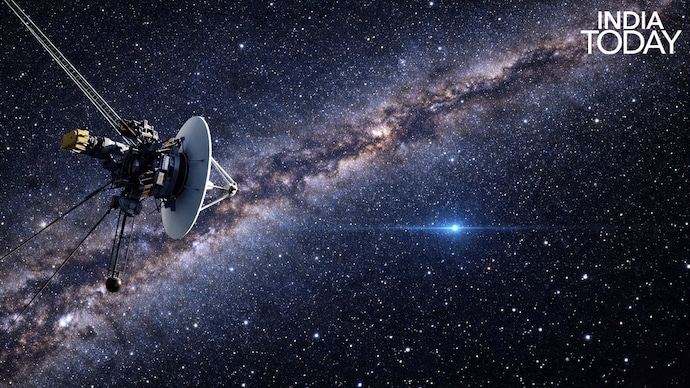
Nearly five decades after its launch in 1977, Voyager 1 continues to send back data from beyond the Solar System, making it humanity’s most distant explorer.
But keeping the ageing spacecraft alive at over 24 billion kilometres from Earth is becoming an increasingly delicate balancing act.
On April 17, engineers at Nasa Jet Propulsion Laboratory made a difficult but necessary decision: they shut down one of Voyager 1’s long-running science instruments, the Low-Energy Charged Particles (LECP) experiment. The move was aimed at conserving power and extending the spacecraft’s life.
HOW IS VOYAGER-1 STILL RUNNING AFTER 49 YEARS?
Voyager 1 runs on a nuclear power system known as a radioisotope thermoelectric generator (RTG), which converts heat from decaying plutonium into electricity. However, this system steadily loses about four watts of power every year.
After nearly 49 years in space, the available energy has dropped to critically low levels.
To cope, engineers have had to carefully ration power, turning off heaters and instruments while ensuring the spacecraft does not get so cold that vital systems fail.
The LECP instrument, which had been operating almost continuously since launch, was next on a pre-planned shutdown list created years ago to prioritise the mission’s most valuable science.
WHAT DID THE NOW SHUT INSTRUMENT ON VOYAGER-1 DID?
The Low-Energy Charged Particles (LECP) experiment played a key role in studying charged particles like ions, electrons, and cosmic rays, helping scientists understand the mysterious interstellar medium, the region beyond the Sun’s influence.
But with only limited power left, keeping every instrument running is no longer possible.
The urgency of the decision increased after an unexpected drop in power during a routine manoeuvre in February. Engineers feared that if levels fell further, Voyager’s automatic fault protection system could shut down systems unpredictably, risking permanent data loss.
Even simple commands take nearly a full day, about 23 hours, to reach Voyager 1, followed by hours for execution. This delay makes every decision high-stakes and requires careful long-term planning.
IS VOYAGER-1 STILL FUNCTIONING?
Despite the shutdown, Voyager 1 is still far from silent. Two science instruments remain active, continuing to measure plasma waves and magnetic fields in a region no other spacecraft has ever explored.
Looking ahead, Nasa engineers are preparing a bold new strategy known as the “Big Bang.”
This plan involves reconfiguring multiple systems at once, switching off some components and replacing them with lower-power alternatives, to stretch the spacecraft’s remaining energy even further.
If successful, the approach could extend Voyager 1’s mission by several more years, and might even allow previously shut-down instruments to be revived.
For now, every watt saved is buying time for a spacecraft that refuses to go quiet, even at the edge of interstellar space.
Nearly five decades after its launch in 1977, Voyager 1 continues to send back data from beyond the Solar System, making it humanity’s most distant explorer.
But keeping the ageing spacecraft alive at over 24 billion kilometres from Earth is becoming an increasingly delicate balancing act.
On April 17, engineers at Nasa Jet Propulsion Laboratory made a difficult but necessary decision: they shut down one of Voyager 1’s long-running science instruments, the Low-Energy Charged Particles (LECP) experiment. The move was aimed at conserving power and extending the spacecraft’s life.
HOW IS VOYAGER-1 STILL RUNNING AFTER 49 YEARS?
Voyager 1 runs on a nuclear power system known as a radioisotope thermoelectric generator (RTG), which converts heat from decaying plutonium into electricity. However, this system steadily loses about four watts of power every year.
After nearly 49 years in space, the available energy has dropped to critically low levels.
To cope, engineers have had to carefully ration power, turning off heaters and instruments while ensuring the spacecraft does not get so cold that vital systems fail.
The LECP instrument, which had been operating almost continuously since launch, was next on a pre-planned shutdown list created years ago to prioritise the mission’s most valuable science.
WHAT DID THE NOW SHUT INSTRUMENT ON VOYAGER-1 DID?
The Low-Energy Charged Particles (LECP) experiment played a key role in studying charged particles like ions, electrons, and cosmic rays, helping scientists understand the mysterious interstellar medium, the region beyond the Sun’s influence.
But with only limited power left, keeping every instrument running is no longer possible.
The urgency of the decision increased after an unexpected drop in power during a routine manoeuvre in February. Engineers feared that if levels fell further, Voyager’s automatic fault protection system could shut down systems unpredictably, risking permanent data loss.
Even simple commands take nearly a full day, about 23 hours, to reach Voyager 1, followed by hours for execution. This delay makes every decision high-stakes and requires careful long-term planning.
IS VOYAGER-1 STILL FUNCTIONING?
Despite the shutdown, Voyager 1 is still far from silent. Two science instruments remain active, continuing to measure plasma waves and magnetic fields in a region no other spacecraft has ever explored.
Looking ahead, Nasa engineers are preparing a bold new strategy known as the “Big Bang.”
This plan involves reconfiguring multiple systems at once, switching off some components and replacing them with lower-power alternatives, to stretch the spacecraft’s remaining energy even further.
If successful, the approach could extend Voyager 1’s mission by several more years, and might even allow previously shut-down instruments to be revived.
For now, every watt saved is buying time for a spacecraft that refuses to go quiet, even at the edge of interstellar space.

