India on weather edge: Thursday to witness scorching heat, intense temperatures
As North India bakes in one of the worst heat spells of the season, the South braces for more storms. India's weather department has warned the country of a day of weather extremes, with multiple alerts issued.
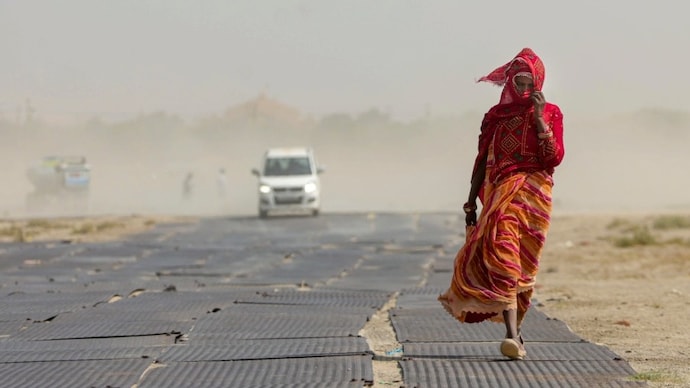
India witnessed another day of weather extremes on Wednesday, with scorching heatwaves baking large parts of the north and central regions even as weather alerts remained in place elsewhere.
Banda in Uttar Pradesh emerged as the hottest place in the country, recording a blistering 48.2 degrees Celsius. Temperatures across West Uttar Pradesh, Himachal Pradesh, and large parts of Madhya Pradesh remained more than 5 degrees above seasonal averages, underscoring the intensity of the ongoing heat spell.
Heatwave to severe heatwave conditions persisted through the day across Haryana, Chandigarh, Delhi, Punjab, East and West Uttar Pradesh, Madhya Pradesh, and Vidarbha, pushing residents to seek relief from the relentless summer temperatures.
Down south and in the islands, it was a different picture entirely.
Kerala saw rain in many places; Andaman & Nicobar Islands and Lakshadweep were drenched, and scattered showers reached Tamil Nadu, parts of Andhra Pradesh, and isolated pockets of West Bengal, Jharkhand, and Bihar.
The lowest minimum temperature recorded today was 19.9°C at Koraput in Odisha.
HOW WILL THE WEATHER BE ON THURSDAY?
The double story continues into Thursday.
Heavy rainfall is very likely at isolated spots across Andaman & Nicobar Islands, Assam and Meghalaya, Kerala, parts of Karnataka, West Bengal and Sikkim, and Tamil Nadu and Puducherry on May 21.
Thunderstorms with gusty winds of 40–50 kmph are expected over a wide belt spanning Bihar, Himachal Pradesh, Jharkhand, Kerala, Konkan & Goa, regions in Maharashtra, Nagaland, Manipur, Mizoram & Tripura, Tamil Nadu, Telangana, and West Bengal & Sikkim.
Violent wind bursts, called thundersqualls, with speeds of 50–60 kmph, are likely over coastal regions of Andhra Pradesh, interior regions of Karnataka, Jammu-Kashmir, and Odisha.
Meanwhile, heatwave to severe heat wave conditions remain very likely on May 21 across the same belt.
Haryana, Chandigarh & Delhi, Punjab, Uttar Pradesh, Madhya Pradesh, and Vidarbha will continue to face scorching temperatures.
Bihar, Chhattisgarh, Coastal Andhra Pradesh, Himachal Pradesh, Odisha, Rajasthan, Telangana, and Uttarakhand are also in the heat wave zone.
"The heat wave conditions are expected to remain in North West India and Central India for almost the next 7 days. These conditions may remain in the Himalayas today and tomorrow, but it is expected to continue on the plains," IMD scientist Naresh Kumar told news agency ANI.
The IMD has also issued a red alert, indicating a very high risk of heat illness and heatstroke, for Punjab, Haryana, Chandigarh, and Delhi for May 20–21 and May 24–26.
"The temperature in Delhi NCR may come close to 47 too," Kumar added. "Keeping that in mind, an orange alert for Delhi-NCR has been issued for the next seven days."
MONSOON CONTINUES TO KNOCK
Amidst all of this, India's most anticipated annual weather event is almost here.
The southwest monsoon, which is the seasonal rain system that brings roughly 70% of the country's annual rainfall and is the lifeblood of Indian agriculture, is expected to set in over Kerala around May 26.
It is currently advancing steadily, and conditions are turning favourable for it to push into the southeast Arabian Sea and parts of the Bay of Bengal in the next 3–4 days.
Once Kerala receives the monsoon, it typically marches northward over the following weeks, eventually covering the entire country by mid-July.
India witnessed another day of weather extremes on Wednesday, with scorching heatwaves baking large parts of the north and central regions even as weather alerts remained in place elsewhere.
Banda in Uttar Pradesh emerged as the hottest place in the country, recording a blistering 48.2 degrees Celsius. Temperatures across West Uttar Pradesh, Himachal Pradesh, and large parts of Madhya Pradesh remained more than 5 degrees above seasonal averages, underscoring the intensity of the ongoing heat spell.
Heatwave to severe heatwave conditions persisted through the day across Haryana, Chandigarh, Delhi, Punjab, East and West Uttar Pradesh, Madhya Pradesh, and Vidarbha, pushing residents to seek relief from the relentless summer temperatures.
Down south and in the islands, it was a different picture entirely.
Kerala saw rain in many places; Andaman & Nicobar Islands and Lakshadweep were drenched, and scattered showers reached Tamil Nadu, parts of Andhra Pradesh, and isolated pockets of West Bengal, Jharkhand, and Bihar.
The lowest minimum temperature recorded today was 19.9°C at Koraput in Odisha.
HOW WILL THE WEATHER BE ON THURSDAY?
The double story continues into Thursday.
Heavy rainfall is very likely at isolated spots across Andaman & Nicobar Islands, Assam and Meghalaya, Kerala, parts of Karnataka, West Bengal and Sikkim, and Tamil Nadu and Puducherry on May 21.
Thunderstorms with gusty winds of 40–50 kmph are expected over a wide belt spanning Bihar, Himachal Pradesh, Jharkhand, Kerala, Konkan & Goa, regions in Maharashtra, Nagaland, Manipur, Mizoram & Tripura, Tamil Nadu, Telangana, and West Bengal & Sikkim.
Violent wind bursts, called thundersqualls, with speeds of 50–60 kmph, are likely over coastal regions of Andhra Pradesh, interior regions of Karnataka, Jammu-Kashmir, and Odisha.
Meanwhile, heatwave to severe heat wave conditions remain very likely on May 21 across the same belt.
Haryana, Chandigarh & Delhi, Punjab, Uttar Pradesh, Madhya Pradesh, and Vidarbha will continue to face scorching temperatures.
Bihar, Chhattisgarh, Coastal Andhra Pradesh, Himachal Pradesh, Odisha, Rajasthan, Telangana, and Uttarakhand are also in the heat wave zone.
"The heat wave conditions are expected to remain in North West India and Central India for almost the next 7 days. These conditions may remain in the Himalayas today and tomorrow, but it is expected to continue on the plains," IMD scientist Naresh Kumar told news agency ANI.
The IMD has also issued a red alert, indicating a very high risk of heat illness and heatstroke, for Punjab, Haryana, Chandigarh, and Delhi for May 20–21 and May 24–26.
"The temperature in Delhi NCR may come close to 47 too," Kumar added. "Keeping that in mind, an orange alert for Delhi-NCR has been issued for the next seven days."
MONSOON CONTINUES TO KNOCK
Amidst all of this, India's most anticipated annual weather event is almost here.
The southwest monsoon, which is the seasonal rain system that brings roughly 70% of the country's annual rainfall and is the lifeblood of Indian agriculture, is expected to set in over Kerala around May 26.
It is currently advancing steadily, and conditions are turning favourable for it to push into the southeast Arabian Sea and parts of the Bay of Bengal in the next 3–4 days.
Once Kerala receives the monsoon, it typically marches northward over the following weeks, eventually covering the entire country by mid-July.

