Planet that could fit over seven Jupiters inside it discovered outside Solar System
The discovery, made using Nasa's James Webb Space Telescope (JWST), is being hailed as a significant leap in our ability to study exoplanets located far away from our world.
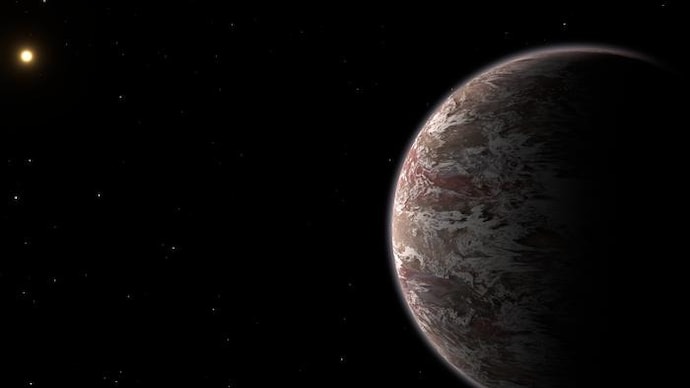
For the first time, scientists have found strong evidence of water-ice clouds on a planet outside our solar system that closely resembles Jupiter.
The findings have been published in The Astrophysical Journal Letters, and the team is already planning follow-up observations and taking another step towards the ultimate goal, which is finding life on another planet.
The discovery, made using Nasa's James Webb Space Telescope (JWST), is being hailed as a significant leap in our ability to study exoplanets, located far away from our worlds, and may one day help us find signs of life beyond Earth.
WHAT IS AN EXOPLANET?
An exoplanet is simply a planet that orbits a star other than our Sun.
There are thousands of them, but studying them up close has always been extremely difficult as they are too far away and too faint.
For decades, scientists could only detect exoplanets indirectly, figuring out their size or mass without ever really "seeing" them.
That changed in 2022 when JWST became fully operational. The telescope gave scientists their first real tool to study the atmospheres of these distant worlds in detail.
As lead researcher, Elisabeth Matthews from the Max Planck Institute for Astronomy, puts it: "JWST is finally allowing us to study solar-system analogue planets in detail. If we were aliens, several light years away, and looking back at the Sun, JWST is the first telescope that would allow us to study Jupiter in detail."
MEET JUPITER'S COUSIN
The planet in question is called Epsilon Indi Ab, located in the southern-sky constellation Indus.
Think of it as a supersized version of Jupiter, about 7.6 times its mass, though roughly the same size. Its surface temperature sits between –70 and +20 degrees Celsius, making it one of the coldest exoplanets ever studied in this way.
To observe Epsilon Indi Ab, scientists used a special instrument on JWST called MIRI, which blocks out the blinding light of the planet's host star. It acts much like shading your eyes from the Sun to see something beside it.
What they found was unexpected. Turns out, the planet had significantly less ammonia gas than predicted. The best explanation the team of scientists could come up with was thick, patchy water-ice clouds, similar to high-altitude cirrus clouds here on Earth, were hiding it from view.
Most existing models used to simulate planetary atmospheres don't account for clouds because they make calculations far more complex.
This discovery is now forcing scientists to rethink those models entirely.
"It's a great problem to have, and it speaks to the immense progress we're making thanks to JWST," said co-author James Mang from the University of Texas at Austin. "What once seemed impossible to detect is now within reach."
For the first time, scientists have found strong evidence of water-ice clouds on a planet outside our solar system that closely resembles Jupiter.
The findings have been published in The Astrophysical Journal Letters, and the team is already planning follow-up observations and taking another step towards the ultimate goal, which is finding life on another planet.
The discovery, made using Nasa's James Webb Space Telescope (JWST), is being hailed as a significant leap in our ability to study exoplanets, located far away from our worlds, and may one day help us find signs of life beyond Earth.
WHAT IS AN EXOPLANET?
An exoplanet is simply a planet that orbits a star other than our Sun.
There are thousands of them, but studying them up close has always been extremely difficult as they are too far away and too faint.
For decades, scientists could only detect exoplanets indirectly, figuring out their size or mass without ever really "seeing" them.
That changed in 2022 when JWST became fully operational. The telescope gave scientists their first real tool to study the atmospheres of these distant worlds in detail.
As lead researcher, Elisabeth Matthews from the Max Planck Institute for Astronomy, puts it: "JWST is finally allowing us to study solar-system analogue planets in detail. If we were aliens, several light years away, and looking back at the Sun, JWST is the first telescope that would allow us to study Jupiter in detail."
MEET JUPITER'S COUSIN
The planet in question is called Epsilon Indi Ab, located in the southern-sky constellation Indus.
Think of it as a supersized version of Jupiter, about 7.6 times its mass, though roughly the same size. Its surface temperature sits between –70 and +20 degrees Celsius, making it one of the coldest exoplanets ever studied in this way.
To observe Epsilon Indi Ab, scientists used a special instrument on JWST called MIRI, which blocks out the blinding light of the planet's host star. It acts much like shading your eyes from the Sun to see something beside it.
What they found was unexpected. Turns out, the planet had significantly less ammonia gas than predicted. The best explanation the team of scientists could come up with was thick, patchy water-ice clouds, similar to high-altitude cirrus clouds here on Earth, were hiding it from view.
Most existing models used to simulate planetary atmospheres don't account for clouds because they make calculations far more complex.
This discovery is now forcing scientists to rethink those models entirely.
"It's a great problem to have, and it speaks to the immense progress we're making thanks to JWST," said co-author James Mang from the University of Texas at Austin. "What once seemed impossible to detect is now within reach."

