Never-before-seen Kali night frog species discovered in Karnataka's Western Ghats
Scientists have identified Nyctibatrachus kali, a new night frog species from Karnataka's Kali river basin. The finding highlights hidden Western Ghats biodiversity and the need to protect pressured habitats.
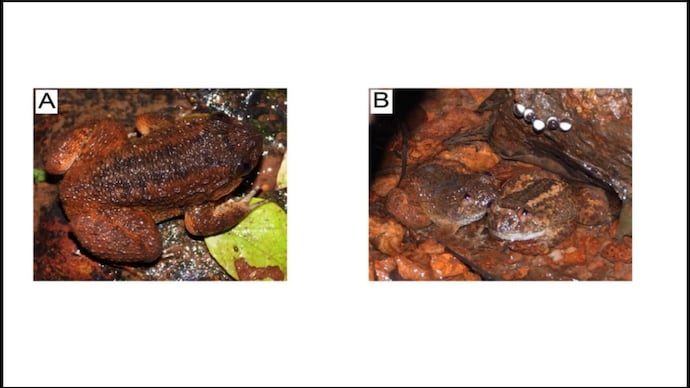
Scientists have discovered a new species of night frog deep within the rainforests of Karnataka’s central Western Ghats, adding to the region’s extraordinary biodiversity and highlighting how much of India’s ecological wealth still remains undocumented.
The newly identified species, named Nyctibatrachus kali, commonly called the Kali night frog, was discovered in the Kali river basin in Uttara Kannada district.
Researchers confirmed it as a distinct species using a combination of morphology, genetics, and bioacoustics, making it a separate evolutionary lineage from other known night frogs.
The discovery once again underlines the ecological significance of the Western Ghats, one of the world’s most important biodiversity hotspots. The mountain chain is home to at least 253 known amphibian species, nearly 94% of which are found nowhere else on Earth.
The genus Nyctibatrachus, commonly known as night frogs, is itself endemic to the Western Ghats, with many species restricted to tiny geographical pockets.
Researchers first encountered the frog during field surveys conducted in 2021 in the Castlerock region within the Kali river catchment. Initially, scientists believed it to be the already known Nyctibatrachus kumbara, or Kumbara night frog, discovered in 2014.
However, detailed investigations revealed otherwise.
The discovery of the Kali night frog was a citizen-led effort in which forest department members also played a role. DNA analysis, acoustic recordings of the frog’s calls, and subtle physical differences eventually confirmed that the species was genetically and acoustically distinct.
Scientists say the discovery demonstrates how modern technology is reshaping biodiversity research. According to co-author Preeti Hebbar, older methods relied mainly on physical appearance to identify frog species. But many amphibians are now recognised as “cryptic species,” organisms that look nearly identical externally but differ genetically and acoustically.
The finding also carries conservation implications.
Researchers warn that important biodiversity may exist even in landscapes already facing developmental pressures.
The Kali night frog was discovered in a region where concerns have been raised over railway expansion and habitat disturbance. Scientists say identifying such species early is crucial because unrecognised habitats often fail to receive ecological protection.
The discovery of the tiny frog points that even today, some of Earth’s most remarkable species are still waiting quietly in the forests to be found.
Scientists have discovered a new species of night frog deep within the rainforests of Karnataka’s central Western Ghats, adding to the region’s extraordinary biodiversity and highlighting how much of India’s ecological wealth still remains undocumented.
The newly identified species, named Nyctibatrachus kali, commonly called the Kali night frog, was discovered in the Kali river basin in Uttara Kannada district.
Researchers confirmed it as a distinct species using a combination of morphology, genetics, and bioacoustics, making it a separate evolutionary lineage from other known night frogs.
The discovery once again underlines the ecological significance of the Western Ghats, one of the world’s most important biodiversity hotspots. The mountain chain is home to at least 253 known amphibian species, nearly 94% of which are found nowhere else on Earth.
The genus Nyctibatrachus, commonly known as night frogs, is itself endemic to the Western Ghats, with many species restricted to tiny geographical pockets.
Researchers first encountered the frog during field surveys conducted in 2021 in the Castlerock region within the Kali river catchment. Initially, scientists believed it to be the already known Nyctibatrachus kumbara, or Kumbara night frog, discovered in 2014.
However, detailed investigations revealed otherwise.
The discovery of the Kali night frog was a citizen-led effort in which forest department members also played a role. DNA analysis, acoustic recordings of the frog’s calls, and subtle physical differences eventually confirmed that the species was genetically and acoustically distinct.
Scientists say the discovery demonstrates how modern technology is reshaping biodiversity research. According to co-author Preeti Hebbar, older methods relied mainly on physical appearance to identify frog species. But many amphibians are now recognised as “cryptic species,” organisms that look nearly identical externally but differ genetically and acoustically.
The finding also carries conservation implications.
Researchers warn that important biodiversity may exist even in landscapes already facing developmental pressures.
The Kali night frog was discovered in a region where concerns have been raised over railway expansion and habitat disturbance. Scientists say identifying such species early is crucial because unrecognised habitats often fail to receive ecological protection.
The discovery of the tiny frog points that even today, some of Earth’s most remarkable species are still waiting quietly in the forests to be found.

