Curiosity rover got stuck in a rock on Mars for five days. How Nasa got it free
The plan was routine. The rover was supposed to drill into the rock, collect a sample, and simply pull back. But it didn't turn out to be that simple.
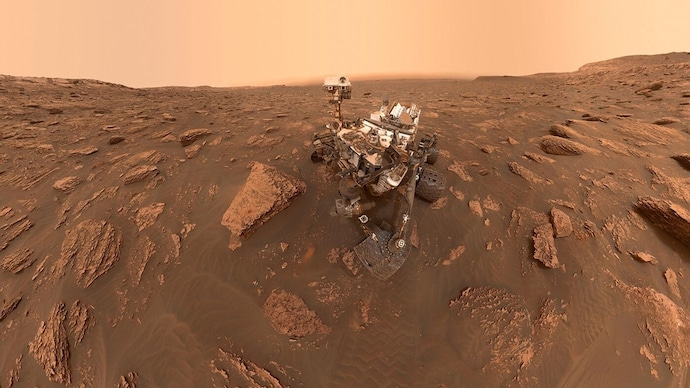
Nasa's Curiosity rover has been exploring Mars for nearly 14 years, drilling into rocks, analysing soil, and sending back thousands of images from the Red Planet's surface.
In all that time, engineers had seen rocks crack and layers flake off during drilling. But nothing quite like what happened recently, when a rock came completely out of the Martian ground and refused to let go.
The rover was drilling into a rock that scientists had nicknamed "Atacama", which is a chunk of the ground on Mars and is roughly the size of a large laptop, about 1.5 feet across and 6 inches thick, weighing around 13 kilograms.
The plan was routine. The rover was supposed to drill in, collect a sample, and simply pull back.
But it didn't turn out to be that simple.
Instead, when Curiosity withdrew its arm, the entire rock came with it, wedging itself firmly around the sleeve of the drill. It just hung there, on the end of the rover's robotic arm, on Mars.
A STUBBORN ROCK
Back on Earth, engineers at Nasa's Jet Propulsion Laboratory watched the images come in and got to work. Their first move was to vibrate the drill, hoping the rock would simply shake loose, but the stubborn piece of Mars' ground did not budge.
Four days later, they repositioned the rover's arm and tried again. This time, cameras captured sand spilling out of the rock as the drill vibrated, showing a sign that something was happening, but in the end, Atacama held on.
Engineers combined a steeper drill angle with rotation, vibration, and spinning of the drill bit, using essentially every tool at their disposal simultaneously.
They expected to need several rounds, but it turned out to be their day as the job was done at a single attempt.
The rock, after being stuck to Curiosity for almost 6 days, finally broke free, fracturing as it struck the Martian ground below.
WHAT IS CURIOSITY?
Launched in 2011 and landed in 2012, Curiosity was originally designed for a two-year mission. It is now well into its second decade on Mars, climbing the slopes of a mountain called Mount Sharp inside Gale Crater, studying the layers of rock that record billions of years of Martian geological and climate history.
The rover's drill is one of its most important tools, and is used to bore into rocks and collect powdered samples for chemical analysis.
The rover has helped scientists determine that ancient Mars once had the right conditions to support microbial life, and continues to provide regular samples and views of Earth's distant neighbour.
The Atacama incident was unusual but ultimately harmless.
Curiosity is now back to work, doing what it has done for over a decade, which is reading the story of another planet, one rock at a time.
Nasa's Curiosity rover has been exploring Mars for nearly 14 years, drilling into rocks, analysing soil, and sending back thousands of images from the Red Planet's surface.
In all that time, engineers had seen rocks crack and layers flake off during drilling. But nothing quite like what happened recently, when a rock came completely out of the Martian ground and refused to let go.
The rover was drilling into a rock that scientists had nicknamed "Atacama", which is a chunk of the ground on Mars and is roughly the size of a large laptop, about 1.5 feet across and 6 inches thick, weighing around 13 kilograms.
The plan was routine. The rover was supposed to drill in, collect a sample, and simply pull back.
But it didn't turn out to be that simple.
Instead, when Curiosity withdrew its arm, the entire rock came with it, wedging itself firmly around the sleeve of the drill. It just hung there, on the end of the rover's robotic arm, on Mars.
A STUBBORN ROCK
Back on Earth, engineers at Nasa's Jet Propulsion Laboratory watched the images come in and got to work. Their first move was to vibrate the drill, hoping the rock would simply shake loose, but the stubborn piece of Mars' ground did not budge.
Four days later, they repositioned the rover's arm and tried again. This time, cameras captured sand spilling out of the rock as the drill vibrated, showing a sign that something was happening, but in the end, Atacama held on.
Engineers combined a steeper drill angle with rotation, vibration, and spinning of the drill bit, using essentially every tool at their disposal simultaneously.
They expected to need several rounds, but it turned out to be their day as the job was done at a single attempt.
The rock, after being stuck to Curiosity for almost 6 days, finally broke free, fracturing as it struck the Martian ground below.
WHAT IS CURIOSITY?
Launched in 2011 and landed in 2012, Curiosity was originally designed for a two-year mission. It is now well into its second decade on Mars, climbing the slopes of a mountain called Mount Sharp inside Gale Crater, studying the layers of rock that record billions of years of Martian geological and climate history.
The rover's drill is one of its most important tools, and is used to bore into rocks and collect powdered samples for chemical analysis.
The rover has helped scientists determine that ancient Mars once had the right conditions to support microbial life, and continues to provide regular samples and views of Earth's distant neighbour.
The Atacama incident was unusual but ultimately harmless.
Curiosity is now back to work, doing what it has done for over a decade, which is reading the story of another planet, one rock at a time.

