A home on the Moon: Nasa announces roadmap to build Moon base
After returning astronauts to deep space, Nasa is now laying the groundwork for something humanity has never attempted before.
Less than two months after four Artemis II astronauts flew around the Moon for the first time in over 50 years, Nasa has moved to the next step.
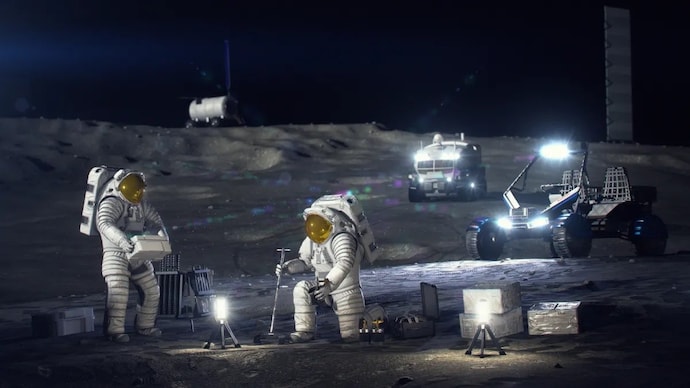
The space agency is working to build a Moon base.
On Tuesday night, the agency announced the roadmap to building humanity's first settlement on another celestial body. Nasa also awarded close to $1 billion in contracts for rovers and landers and announced three cargo missions launching in 2026 to prepare the lunar South Pole for human arrival.
“Every mission, crewed and uncrewed, will be a learning opportunity as we return to the lunar surface, build the infrastructure to stay, and master the skills required to live and operate in one of the most demanding and dangerous environments imaginable,” Nasa Administrator Jared Isaacman said.
THREE MISSIONS TO PREPARE
All three Moon Base missions that Nasa announced for 2026 are meant to test equipment and reduce risk before astronauts land.
These missions will be the first of more than a dozen others Nasa plans to announce this year.
The first mission, called Moon Base I, will use Blue Origin’s lander to deliver two scientific instruments to a ridge near the Moon’s South Pole. This will include cameras to study how rocket exhaust interacts with the lunar surface on landing, and a reflector that helps spacecraft in orbit figure out exactly where they are.
Moon Base II will then follow to send a small rover along with around 500 kgs of supplies, to practice moving cargo around the Moon’s surface, which is something astronauts will need to do routinely.
Moon Base III will be designed to study the unusual bright patches on the Moon’s surface, called lunar swirls, and will also carry equipment from the European Space Agency (ESA) and South Korea’s space agency.
THE MOON MONEY
Nasa has paid two American companies, Astrolab and Lunar Outpost, $219 million and $220 million, respectively, to build the first Moon rovers, with both ready for use by 2028.
Astrolab’s rover will weigh about 900 kgs and will be designed to carry astronauts at speeds above 9.5 kmph.
Lunar Outpost’s version will be lighter and faster, designed to move at speeds more than 14 kmph. It is planned to be designed so that it can be driven by a person on board, controlled remotely from Earth, or even operate on its own. Ideally, it will be built to survive on the Moon for up to a year.
Getting these rovers to the Moon’s surface is Blue Origin’s job. The company, owned by Jeff Bezos, was paid $188 million for that task, with the option to earn an additional $280.4 million based on performance.
Both rover builders have 18 months to finish their designs, test them with astronauts, and have them ready to fly.
SENDING SCOUTS BEFORE HUMANS
Nasa is also sending four small hopping drones to the Moon in 2028, built to photograph terrain that is too dangerous or difficult for rovers to reach.
A company called Firefly Aerospace will build the spacecraft to carry them, and once the drones finish their flights, sensors left behind will keep collecting data for months. If successful, it will mark Nasa’s first step toward a continuous, unbroken presence at the Moon’s South Pole.
“The Moon Base will be America’s and humanity’s first outpost on another celestial world,” Isaacman said. “We will go for science, for all we stand to gain from an economic and technological perspective, for the innovations that will make life better here on Earth, and to prepare for where we will inevitably go next.”
Less than two months after four Artemis II astronauts flew around the Moon for the first time in over 50 years, Nasa has moved to the next step.
The space agency is working to build a Moon base.
On Tuesday night, the agency announced the roadmap to building humanity's first settlement on another celestial body. Nasa also awarded close to $1 billion in contracts for rovers and landers and announced three cargo missions launching in 2026 to prepare the lunar South Pole for human arrival.
“Every mission, crewed and uncrewed, will be a learning opportunity as we return to the lunar surface, build the infrastructure to stay, and master the skills required to live and operate in one of the most demanding and dangerous environments imaginable,” Nasa Administrator Jared Isaacman said.
THREE MISSIONS TO PREPARE
All three Moon Base missions that Nasa announced for 2026 are meant to test equipment and reduce risk before astronauts land.
These missions will be the first of more than a dozen others Nasa plans to announce this year.
The first mission, called Moon Base I, will use Blue Origin’s lander to deliver two scientific instruments to a ridge near the Moon’s South Pole. This will include cameras to study how rocket exhaust interacts with the lunar surface on landing, and a reflector that helps spacecraft in orbit figure out exactly where they are.
Moon Base II will then follow to send a small rover along with around 500 kgs of supplies, to practice moving cargo around the Moon’s surface, which is something astronauts will need to do routinely.
Moon Base III will be designed to study the unusual bright patches on the Moon’s surface, called lunar swirls, and will also carry equipment from the European Space Agency (ESA) and South Korea’s space agency.
THE MOON MONEY
Nasa has paid two American companies, Astrolab and Lunar Outpost, $219 million and $220 million, respectively, to build the first Moon rovers, with both ready for use by 2028.
Astrolab’s rover will weigh about 900 kgs and will be designed to carry astronauts at speeds above 9.5 kmph.
Lunar Outpost’s version will be lighter and faster, designed to move at speeds more than 14 kmph. It is planned to be designed so that it can be driven by a person on board, controlled remotely from Earth, or even operate on its own. Ideally, it will be built to survive on the Moon for up to a year.
Getting these rovers to the Moon’s surface is Blue Origin’s job. The company, owned by Jeff Bezos, was paid $188 million for that task, with the option to earn an additional $280.4 million based on performance.
Both rover builders have 18 months to finish their designs, test them with astronauts, and have them ready to fly.
SENDING SCOUTS BEFORE HUMANS
Nasa is also sending four small hopping drones to the Moon in 2028, built to photograph terrain that is too dangerous or difficult for rovers to reach.
A company called Firefly Aerospace will build the spacecraft to carry them, and once the drones finish their flights, sensors left behind will keep collecting data for months. If successful, it will mark Nasa’s first step toward a continuous, unbroken presence at the Moon’s South Pole.
“The Moon Base will be America’s and humanity’s first outpost on another celestial world,” Isaacman said. “We will go for science, for all we stand to gain from an economic and technological perspective, for the innovations that will make life better here on Earth, and to prepare for where we will inevitably go next.”

