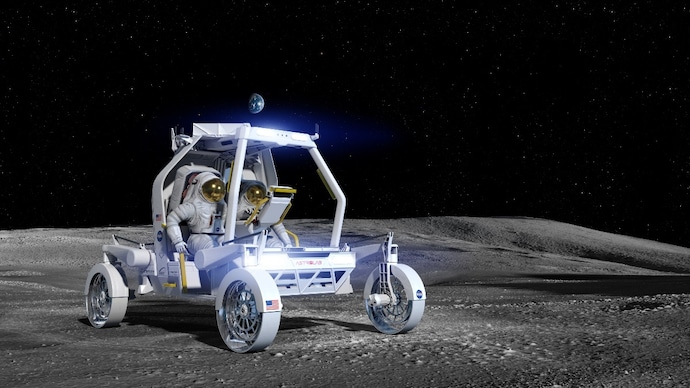
This is the car astronauts will soon drive on the Moon. See pictures
As Nasa prepares to return humans to the Moon for the long term, the agency is paying over $200 million to ensure astronauts can drive across the lunar surface.
Nasa has decided to build the first ever human settlement on the Moon, announcing the roadmap to build a permanent Moon Base on the lunar surface.
The agency envisions a sustained human presence at the lunar South Pole, where near-constant sunlight and deposits of water ice offer critical resources for long-term operations. This planned base will support scientific research, resource utilisation, and preparation for future trips to Mars.
And to facilitate these ambitious tasks and goals, astronauts will need practical ways to move around the harsh lunar terrain, and do so while carrying tools, samples, and supplies over distances far beyond what they can walk.
Nasa has, therefore, already decided what many of those astronauts will drive.
The space agency has selected California-based Astrolab as one of two providers to build crewed lunar rovers under its Lunar Terrain Vehicle Services (LTVS) programme. Astrolab will receive a $219 million task order to develop and deliver its Crewed Lunar Vehicle-1, or CLV-1, with an expected arrival on the Moon by 2028.
ROVER TO VEHICLE
Astrolab originally developed a rover, called the FLEX rover, as a flexible platform for cargo, science, and general lunar work.
For Nasa’s needs, the company adapted this proven design into the more focused CLV-1, a new vehicle built primarily to transport two suited astronauts and their equipment rather than haul heavy external cargo.
It features a compact, open-frame design that makes it easy for astronauts in bulky spacesuits to climb aboard. Special airless tyres, developed with partner Venturi Space, provide strong traction on loose lunar soil, and help the rover handle slopes and rocky obstacles.
The same partner supplies advanced batteries and power systems that also allow the vehicle to operate reliably through the Moon’s extreme temperature changes.
WORKING ON THE MOON
Astrolab will be working with other partners, including Interlune and Odyssey Space Research, who will contribute expertise in navigation, science support, and mission operations.
This rover builds on the spirit of the Apollo Lunar Roving Vehicle but brings modern improvements in mobility, endurance, and adaptability.
With a top speed of more than 9 kmph on flat ground and the ability to manage steep inclines, it will let astronauts explore craters, shadowed regions, and scientifically interesting sites that were previously out of reach during short surface stays.
By choosing two different rover providers, Nasa seems to be encouraging competition, reducing risk, and speeding up innovation, all of which are key ingredients for turning occasional visits to the Moon into a lasting lunar outpost.
CLV-1 is an important part of that mission, and also a practical step that turns the dream of a Moon base into something astronauts can actually drive across.
Nasa has decided to build the first ever human settlement on the Moon, announcing the roadmap to build a permanent Moon Base on the lunar surface.
The agency envisions a sustained human presence at the lunar South Pole, where near-constant sunlight and deposits of water ice offer critical resources for long-term operations. This planned base will support scientific research, resource utilisation, and preparation for future trips to Mars.
And to facilitate these ambitious tasks and goals, astronauts will need practical ways to move around the harsh lunar terrain, and do so while carrying tools, samples, and supplies over distances far beyond what they can walk.
Nasa has, therefore, already decided what many of those astronauts will drive.
The space agency has selected California-based Astrolab as one of two providers to build crewed lunar rovers under its Lunar Terrain Vehicle Services (LTVS) programme. Astrolab will receive a $219 million task order to develop and deliver its Crewed Lunar Vehicle-1, or CLV-1, with an expected arrival on the Moon by 2028.
ROVER TO VEHICLE
Astrolab originally developed a rover, called the FLEX rover, as a flexible platform for cargo, science, and general lunar work.
For Nasa’s needs, the company adapted this proven design into the more focused CLV-1, a new vehicle built primarily to transport two suited astronauts and their equipment rather than haul heavy external cargo.
It features a compact, open-frame design that makes it easy for astronauts in bulky spacesuits to climb aboard. Special airless tyres, developed with partner Venturi Space, provide strong traction on loose lunar soil, and help the rover handle slopes and rocky obstacles.
The same partner supplies advanced batteries and power systems that also allow the vehicle to operate reliably through the Moon’s extreme temperature changes.
WORKING ON THE MOON
Astrolab will be working with other partners, including Interlune and Odyssey Space Research, who will contribute expertise in navigation, science support, and mission operations.
This rover builds on the spirit of the Apollo Lunar Roving Vehicle but brings modern improvements in mobility, endurance, and adaptability.
With a top speed of more than 9 kmph on flat ground and the ability to manage steep inclines, it will let astronauts explore craters, shadowed regions, and scientifically interesting sites that were previously out of reach during short surface stays.
By choosing two different rover providers, Nasa seems to be encouraging competition, reducing risk, and speeding up innovation, all of which are key ingredients for turning occasional visits to the Moon into a lasting lunar outpost.
CLV-1 is an important part of that mission, and also a practical step that turns the dream of a Moon base into something astronauts can actually drive across.

