Watch: Shockwaves from the Philippines earthquake crossed India, shook the planet
A magnitude 7.8 earthquake off the southern Philippines sent seismic waves across the planet. The signals, tracked worldwide, showed how a major rupture can make Earth vibrate for hours.
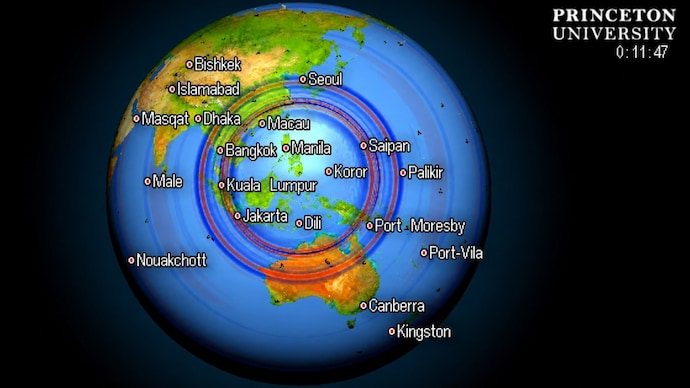
The powerful magnitude 7.8 earthquake that struck off the southern Philippines sent seismic waves racing across the planet, shaking the entire Earth for hours and providing scientists with a remarkable glimpse into how energy from major earthquakes travels through the globe.
Researchers at Princeton University shared a striking shake map that visualised the movement of seismic waves generated by the quake.
At least 20 people were killed and more than 200 injured after a powerful 7.8-magnitude earthquake struck. Authorities in the Philippines, Indonesia and international monitoring agencies quickly issued tsunami alerts, urging people living along vulnerable coastlines to move to higher ground.
The animation showed shockwaves spreading outward from the epicentre near Mindanao, crossing oceans and continents before eventually reaching the earthquake's antipode, the point on Earth's surface directly opposite the source of the quake.
According to seismologists, earthquakes of this magnitude release an enormous amount of energy into the Earth's crust. That energy travels as different types of seismic waves, including primary (P) waves and secondary (S) waves, which can pass through the planet's interior and along its surface.
While people far from the epicentre may not feel the shaking, sensitive instruments around the world detect these waves as they propagate thousands of kilometres from the source.
The Princeton shake map highlighted the extraordinary speed and reach of the seismic energy. Within minutes, the waves had spread across Asia and the Pacific. Over the following hours, they continued to reverberate around the globe, effectively causing the entire planet to oscillate.
Scientists note that Earth behaves much like a bell after a major earthquake. Just as a struck bell continues to vibrate long after the initial impact, the planet experiences subtle vibrations that can persist for hours or even days following a powerful seismic event.
These vibrations, known as free oscillations, are too small for humans to notice but can be measured by global seismic networks.
The Philippines earthquake also triggered tsunami warnings across parts of the Pacific, though the primary scientific focus soon shifted to the extraordinary seismic signals recorded worldwide. The event shows that a single powerful rupture beneath the ocean floor can send detectable shockwaves through every corner of the planet.
For scientists, each major earthquake offers a natural experiment, helping reveal the hidden structure and behaviour of Earth's interior.
The powerful magnitude 7.8 earthquake that struck off the southern Philippines sent seismic waves racing across the planet, shaking the entire Earth for hours and providing scientists with a remarkable glimpse into how energy from major earthquakes travels through the globe.
Researchers at Princeton University shared a striking shake map that visualised the movement of seismic waves generated by the quake.
At least 20 people were killed and more than 200 injured after a powerful 7.8-magnitude earthquake struck. Authorities in the Philippines, Indonesia and international monitoring agencies quickly issued tsunami alerts, urging people living along vulnerable coastlines to move to higher ground.
The animation showed shockwaves spreading outward from the epicentre near Mindanao, crossing oceans and continents before eventually reaching the earthquake's antipode, the point on Earth's surface directly opposite the source of the quake.
According to seismologists, earthquakes of this magnitude release an enormous amount of energy into the Earth's crust. That energy travels as different types of seismic waves, including primary (P) waves and secondary (S) waves, which can pass through the planet's interior and along its surface.
While people far from the epicentre may not feel the shaking, sensitive instruments around the world detect these waves as they propagate thousands of kilometres from the source.
The Princeton shake map highlighted the extraordinary speed and reach of the seismic energy. Within minutes, the waves had spread across Asia and the Pacific. Over the following hours, they continued to reverberate around the globe, effectively causing the entire planet to oscillate.
Scientists note that Earth behaves much like a bell after a major earthquake. Just as a struck bell continues to vibrate long after the initial impact, the planet experiences subtle vibrations that can persist for hours or even days following a powerful seismic event.
These vibrations, known as free oscillations, are too small for humans to notice but can be measured by global seismic networks.
The Philippines earthquake also triggered tsunami warnings across parts of the Pacific, though the primary scientific focus soon shifted to the extraordinary seismic signals recorded worldwide. The event shows that a single powerful rupture beneath the ocean floor can send detectable shockwaves through every corner of the planet.
For scientists, each major earthquake offers a natural experiment, helping reveal the hidden structure and behaviour of Earth's interior.

