Gurindervir, Vishal, Tejaswin: The night Ranchi witnessed Indian track history
At the Birsa Munda Stadium, Gurindervir Singh, Vishal TK, and Tejaswin Shankar shattered three national records, pushing India into elite Asian contention. This is how three athletes altered the trajectory of the nation's track history.
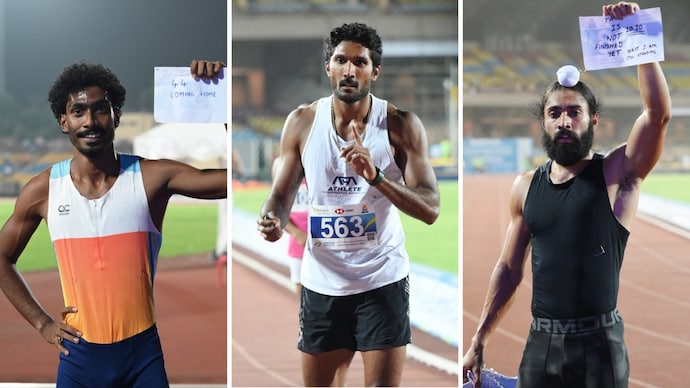
For decades, Indian track and field functioned on a loop of isolated brilliance. A single star would emerge, shoulder the nation’s hopes, and leave a vacuum upon retirement. But what happened at the Birsa Munda Stadium in Ranchi wasn’t a lone spark. It was a multipronged demolition of historical limitations, executed by three athletes who did not just break national records. They dragged Indian athletics back into relevance.
Within a single session, Gurindervir Singh, Vishal TK, and Tejaswin Shankar achieved what generations before them could only chase. They obliterated psychological barriers, topped continental charts, and proved that India can be more than just mere participants.
THE PSYCHOLOGICAL BREAKTHROUGH
The tone for the night was set by raw, unadulterated speed. For years, sub-10.10 seconds was the phantom wall Indian sprinting could never scale. A 10.3-second sprint won domestic praise, while a 10.2 made you an anomaly. But Gurindervir Singh stopped looking at domestic benchmarks.
Following a gruelling, psychological back-and-forth rivalry with Animesh Kujur that has seen the national record traded multiple times over recent months, Gurindervir stopped the clock at a staggering 10.09 seconds.
The immediate aftermath was pure theatre. Gurindervir took off the running shoes that carried him into history and threw it on the ground, before flashing a handwritten note to the cameras, a nod to the defiant flair of modern IPL stars. It read, "Task is not finished yet. 10.10, wait I am still standing."
It was a declaration of war on low expectations. By clocking 10.09s, Gurindervir did not just qualify for the Commonwealth Games. He logged the second-fastest time in all of Asia this season. He gave India something it has lacked for nearly a century: a pure sprinter capable of standing on a continental podium without an ounce of impostor syndrome.
Shattering the ceiling
The clock read 10.09 seconds, but the real breakthrough was psychological. For decades, Indian sprinting has been weighed down by an unspoken skepticism—a defeatist narrative about physiological limits and global standards. Gurindervir Singh didn't just break a national record; he challenged that entire premise.
"People used to think Indian genetics are weak, that Indians can’t run the 100m, and that there’s no future in sprinting," Gurindervir said, addressing the historical bias that has long shadowed the discipline.
By becoming the first Indian to breach the 10.10-second barrier, his performance serves as a definitive, track-tested eviction of those old doubts. It is a proof of concept for a new generation of athletes who no longer view global finals as an impossible destination.
"I just want to prove everyone wrong," he added. "Indian genes are very strong & it's just the start."
DECADES OF CHASING SUB-45
If Gurindervir’s win was an explosion, Vishal TK’s performance in the 400m was the culmination of a decades-long obsession. In quarter-mile running, sub-46 seconds is strong, and a mid-45 is respectable. But breaking the 45-second barrier is the definitive dividing line between regional excellence and world-class territory.
Vishal crossed that line, clocking an astonishing 44.98 seconds to become the first Indian in history to run a sub-45.
WATCH THE RACE HERE
The weight of the moment was palpable. In the stands, a member of his support staff was caught on camera screaming "India, India!" in a state of sheer, tearful euphoria. Vishal, clear-headed and deliberate, turned around his race bib to reveal a pre-written message: "44, I'm coming home."
This was not a fluke; it was a manifested destiny. Beyond the individual glory of becoming Asia’s fastest 400m runner this season, Vishal’s breakthrough instantly mutates India’s 4x400m relay program into a lethal, world-level threat.
THE 8000 POINT CLUB
While the sprinters burned up the track, Tejaswin Shankar was quietly orchestrating a revolution of endurance and versatility. For three years, critics viewed Tejaswin as a world-class high jumper playing a side-quest in the decathlon. In Ranchi, he permanently ended that narrative.
Tejaswin accumulated 8,057 points, shattering his own national record of 7,947 and becoming the first Indian ever to cross the elite 8,000-point threshold. In the gruelling world of combined events, 8,000 points is the international gold standard.
With this performance, Tejaswin comfortably secured his Commonwealth qualification and rocketed to No. 7 on the all-time Asian history list. He is no longer an experimental multi-athlete. He is an elite continental contender.
A CONTINENTAL SHIFT
The real story of Ranchi is not just of three broken records. It is the sudden, vertical shift in perspective.
In a single evening, India had the fastest 400m runner in Asia this season, the second-fastest 100m sprinter on the continent, and one of the greatest Asian decathletes to ever live. The conversation has fundamentally changed. These are no longer "good Indian performances" destined to look respectable in a heat sheet. These are athletes built to win.
The task, as Gurindervir wrote, is far from finished. But the psychological glass ceiling over Indian athletics has not just been cracked. It has been completely pulverised.
For decades, Indian track and field functioned on a loop of isolated brilliance. A single star would emerge, shoulder the nation’s hopes, and leave a vacuum upon retirement. But what happened at the Birsa Munda Stadium in Ranchi wasn’t a lone spark. It was a multipronged demolition of historical limitations, executed by three athletes who did not just break national records. They dragged Indian athletics back into relevance.
Within a single session, Gurindervir Singh, Vishal TK, and Tejaswin Shankar achieved what generations before them could only chase. They obliterated psychological barriers, topped continental charts, and proved that India can be more than just mere participants.
THE PSYCHOLOGICAL BREAKTHROUGH
The tone for the night was set by raw, unadulterated speed. For years, sub-10.10 seconds was the phantom wall Indian sprinting could never scale. A 10.3-second sprint won domestic praise, while a 10.2 made you an anomaly. But Gurindervir Singh stopped looking at domestic benchmarks.
Following a gruelling, psychological back-and-forth rivalry with Animesh Kujur that has seen the national record traded multiple times over recent months, Gurindervir stopped the clock at a staggering 10.09 seconds.
The immediate aftermath was pure theatre. Gurindervir took off the running shoes that carried him into history and threw it on the ground, before flashing a handwritten note to the cameras, a nod to the defiant flair of modern IPL stars. It read, "Task is not finished yet. 10.10, wait I am still standing."
It was a declaration of war on low expectations. By clocking 10.09s, Gurindervir did not just qualify for the Commonwealth Games. He logged the second-fastest time in all of Asia this season. He gave India something it has lacked for nearly a century: a pure sprinter capable of standing on a continental podium without an ounce of impostor syndrome.
Shattering the ceiling
The clock read 10.09 seconds, but the real breakthrough was psychological. For decades, Indian sprinting has been weighed down by an unspoken skepticism—a defeatist narrative about physiological limits and global standards. Gurindervir Singh didn't just break a national record; he challenged that entire premise.
"People used to think Indian genetics are weak, that Indians can’t run the 100m, and that there’s no future in sprinting," Gurindervir said, addressing the historical bias that has long shadowed the discipline.
By becoming the first Indian to breach the 10.10-second barrier, his performance serves as a definitive, track-tested eviction of those old doubts. It is a proof of concept for a new generation of athletes who no longer view global finals as an impossible destination.
"I just want to prove everyone wrong," he added. "Indian genes are very strong & it's just the start."
DECADES OF CHASING SUB-45
If Gurindervir’s win was an explosion, Vishal TK’s performance in the 400m was the culmination of a decades-long obsession. In quarter-mile running, sub-46 seconds is strong, and a mid-45 is respectable. But breaking the 45-second barrier is the definitive dividing line between regional excellence and world-class territory.
Vishal crossed that line, clocking an astonishing 44.98 seconds to become the first Indian in history to run a sub-45.
WATCH THE RACE HERE
The weight of the moment was palpable. In the stands, a member of his support staff was caught on camera screaming "India, India!" in a state of sheer, tearful euphoria. Vishal, clear-headed and deliberate, turned around his race bib to reveal a pre-written message: "44, I'm coming home."
This was not a fluke; it was a manifested destiny. Beyond the individual glory of becoming Asia’s fastest 400m runner this season, Vishal’s breakthrough instantly mutates India’s 4x400m relay program into a lethal, world-level threat.
THE 8000 POINT CLUB
While the sprinters burned up the track, Tejaswin Shankar was quietly orchestrating a revolution of endurance and versatility. For three years, critics viewed Tejaswin as a world-class high jumper playing a side-quest in the decathlon. In Ranchi, he permanently ended that narrative.
Tejaswin accumulated 8,057 points, shattering his own national record of 7,947 and becoming the first Indian ever to cross the elite 8,000-point threshold. In the gruelling world of combined events, 8,000 points is the international gold standard.
With this performance, Tejaswin comfortably secured his Commonwealth qualification and rocketed to No. 7 on the all-time Asian history list. He is no longer an experimental multi-athlete. He is an elite continental contender.
A CONTINENTAL SHIFT
The real story of Ranchi is not just of three broken records. It is the sudden, vertical shift in perspective.
In a single evening, India had the fastest 400m runner in Asia this season, the second-fastest 100m sprinter on the continent, and one of the greatest Asian decathletes to ever live. The conversation has fundamentally changed. These are no longer "good Indian performances" destined to look respectable in a heat sheet. These are athletes built to win.
The task, as Gurindervir wrote, is far from finished. But the psychological glass ceiling over Indian athletics has not just been cracked. It has been completely pulverised.

