FIFA World Cup 2026 Group I Preview: Will Africa's elite outshine Mbappe vs Haaland
Group I preview: World Cup heavyweights France and a historic Senegal side collision in a fascinating section, while an explosive Norway team and stubborn Iraq look to cause ultimate chaos.
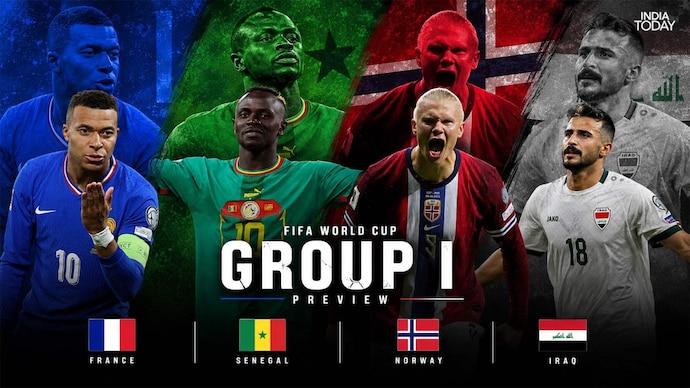
Group I stands out as the most fascinating pool of the opening round, highlighted by a blockbuster clash between heavyweight contenders France and an exceptionally strong Senegal side. This group is far more than a two-way race, however, as a highly dangerous Norway team brings world-class attacking firepower capable of punishing any defensive lapse, while Iraq arrive well-organised and determined to act as ultimate spoilers.
The primary narrative centres on a dramatic showdown of distinct footballing styles and elite individual talent. While subplots involving individual rivalries will inevitably dominate the headlines, the group will ultimately be decided by tactical control in midfield and defensive resilience under pressure.
With a tournament favourite, a historic African challenger, an explosive European wildcard, and a stubborn underdog all drawn together, every single match in this section promises to be a high-stakes battle.
FIFA WORLD CUP 2026 FULL COVERAGE
GROUP F: MEET THE TEAMS
Group I presents a beautiful mix of elite heavyweights, generation-defining attacking talent, and tactical resilience. Here is your definitive guide to the four nations competing for a place in the knockout rounds.
FRANCE: Les Bleus enter the tournament as absolute favourites, armed with a squad boasting immense depth and tournament pedigree. Under the steady guidance of Didier Deschamps, the French comfortably secured their place in North America by dominating their qualifying campaign.
Stylistically, France are a devastating transition team. They balance a rock-solid, physical defensive foundation with explosive, world-class individual brilliance in the final third. Capable of winning matches through tactical patience or pure counter-attacking speed, they are heavily expected to dictate the terms of this group.
SENEGAL: The Lions of Teranga carry the weight of an entire continent on their shoulders. This experienced, star-studded squad represents Africa's absolute best chance in history to go all the way and lift the World Cup trophy. No longer just a team happy to qualify, Senegal possesses the perfect blend of elite European club experience and immense physical power.
Tactically, they are built around a robust, disciplined spine that excels at breaking up opposition play before launching swift, vertical attacks. With world-class talent across every single department, this team has the tactical maturity, depth, and belief required to genuinely challenge the global elite and break the ultimate glass ceiling.
NORWAY: Norway ends a generation-long tournament drought to bring an incredibly exciting, modern side to the global stage. Having navigated a highly competitive European qualification group, the Scandinavians represent the ultimate wildcard of the quartet.
While their defensive unit will face its sternest test yet against elite opposition, their frontline possesses world-class firepower capable of dismantling any system. Norway looks to control matches through a technical midfield, using quick, direct passing to unlock tight spaces and feed their lethal attacking outlets.
IRAQ: The Lions of Mesopotamia arrive in North America as the ultimate disruptive dark horses. Having booked their historic ticket via a dramatic play-off campaign, Iraq returns to the world stage with absolutely nothing to lose and everything to gain.
Tactically, Iraq will rely on an incredibly disciplined, low-defensive block designed to frustrate its more illustrious group opponents. They are resilient, highly organised, and exceptionally dangerous on set-pieces. While they lack the star power of their rivals, their collective work rate makes them fully capable of stealing a crucial result.
GAME OF THE GROUP: FRANCE vs NORWAY
While the opening day carries plenty of romance, the final match day showdown between France and Norway is the true blockbuster of the group. In the era after Lionel Messi and Cristiano Ronaldo, the individual rivalry between Kylian Mbappe and Erling Haaland was meant to be football’s ultimate headline act. While the rivalry might've simmered down, this match marks the very first time these two global icons will face each other on the international stage.
France enters the tournament as established, battle-tested World Cup heavyweights. On the other hand, Norway arrives as fascinating underdogs. They boast a new golden generation that has comfortably beaten mid-tier teams, but they remain largely untested against the absolute elite of world football.
With both generational forwards expected to carry the goalscoring hopes of their nations, this match offers far more than just qualification points. The winner will walk away with major bragging rights in a defining rivalry that is could rule the sport for the next decade.
GROUP F: PLAYERS TO WATCH OUT FOR
Sadio Mane (Senegal)
The emotional heartbeat of Senegalese football is ready for its ultimate international redemption arc. Missing out on the previous winter tournament in Qatar due to a heartbreaking last-minute injury left a massive void in the team, forcing the African champions to navigate the knockout stages without their primary attacking outlet.
Now operating in the Saudi Pro League, the veteran forward has adapted his game from a high-pressing winger to a clever, experienced playmaker who dictates the tempo of the attack. His relationship with manager Aliou Cisse ensures he remains the tactical anchor of the side, bridging the gap between old veterans and emerging young talents. His leadership will be tested on the opening day against France, where his tournament experience and composed finishing will be vital if the Lions of Teranga are to disrupt the group favourites.
Erling Haaland (Norway)
Norway have spent a generation on the footballing periphery, but the presence of their talismanic striker instantly transforms them into a team capable of frightening the elite. The towering forward has spent his club career shattering records at Borussia Dortmund and Manchester City, establishing himself as the ultimate penalty box predator.
Tactically, his role for the national team is entirely different to his club environment. Without the luxury of constant creative service, he must hunt for opportunities on the counter-attack and use his immense physical strength to unnerve centre-backs. His historic international goal-scoring ratio proves he can turn half-chances into match-winning moments. For Norway to survive a brutal group, they do not need him to dominate possession; they simply need him to maintain his ruthless, single-touch efficiency when the crucial moments arrive.
Kylian Mbappe (France)
The French captain enters the tournament at a critical crossroads in his international career. Having inherited the armband from Hugo Lloris, the explosive forward is no longer just the young prodigy who electrified the world in Russia. He is now the tactical focal point and vocal leader of a changing French generation under Didier Deschamps.\
On the pitch, his game relies on terrifying acceleration and a signature ability to cut inside from the left wing. Despite experiencing a transitional period and intense media scrutiny following his high-profile move to the Spanish capital, his international pedigree remains flawless. After carrying his country through the high-stakes drama of the last World Cup final, he has proven his ability to perform under intense pressure, making him invaluable. He knows that securing another trophy will permanently cement his legacy amongst the true greats of modern football, if it hasn't already.
GROUP I: SCHEDULE
- France vs Iraq - June 17 - Philadelphia
- Norway vs Senegal - June 17 - New York/New Jersey
- Norway vs France - June 23 - Boston
- Senegal vs Iraq - June 23 - Toronto
- France vs Senegal - June 27 - New York/New Jersey
- Iraq vs Norway - June 27 - Boston
GROUP I: FULL SQUADS
France: Best Finish (Champions 1998, 2018)
Goalkeepers: Mike Maignan, Robin Risser, Brice Samba
Defenders: Lucas Digne, Malo Gusto, Lucas Hernandez, Theo Hernandez, Ibrahima Konate, Jules Kounde, Maxence Lacroix, William Saliba, Dayot Upamecano
Midfielders: N'Golo Kante, Manu Kone, Adrien Rabiot, Aurelien Tchouameni, Warren Zaire-Emery
Forwards: Maghnes Akliouche, Bradley Barcola, Rayan Cherki, Ousmane Dembele, Desire Doue, Jean-Philippe Mateta, Kylian Mbappe, Michael Olise, Marcus Thuram
Senegal: Best Finish (Quarterfinals, 2002)
Goalkeepers: Yehvann Diouf, Edouard Mendy, Mory Diaw
Defenders: Mamadou Sarr, Kalidou Koulibaly, Abdoulaye Seck, Ismail Jakobs, Krepin Diatta, Moussa Niakhate, Antoine Mendy, El Hadji Malick Diouf
Midfielders: Idrissa Gana Gueye, Pathe Ciss, Lamine Camara, Pape Matar Sarr, Habib Diarra, Bara Sapoko Ndiaye, Pape Gueye
Forwards: Assane Diao, Bamba Dieng, Sadio Mane, Nicolas Jackson, Cherif Ndiaye, Iliman Ndiaye, Ismaila Sarr, Ibrahim Mbaye
Norway: Best Finish (Round of 16, 1998)
Goalkeepers: Orjan Nyland, Sander Tangvik, Egil Selvik
Defenders: Kristoffer Ajer, Leo Ostigard, David Moller Wolfe, Fredrik Andre Bjorkan, Marcus Holmgren Pedersen, Torbjorn Heggem, Sondre Langas, Henrik Falchener, Julian Ryerson
Midfielders: Morten Thorsby, Patrick Berg, Sander Berge, Martin Odegaard, Fredrik Aursnes, Kristian Thorstvedt, Thelo Aasgaard, Andreas Schjelderup, Oscar Bobb, Jens Petter Hauge
Forwards: Alexander Sorloth, Erling Haaland, Jorgen Strand Larsen, Antonio Nusa
Iraq: Best Finish (Group Stage, 1986)
Goalkeepers: Fahad Talib, Jalal Hassan, Ahmed Basil
Defenders: Rebin Ghareeb, Hussein Ali, Zaid Tahseen, Akam Hashim, Munaf Younus, Ahmed Yahya, Merchas Doski, Mustafa Saadoon, Frans Putros
Midfielders: Youssef Amyn, Ibrahim Bayesh, Zidane Iqbal, Amir Alammari, Kevin Yakob, Aimar Sher, Zaid Ismael
Forwards: Ali Alhamadi, Mohanad Ali, Ahmed Qasim, Ali Yousif, Ali Jasim, Aymen Hussein, Marko Farji
Group I stands out as the most fascinating pool of the opening round, highlighted by a blockbuster clash between heavyweight contenders France and an exceptionally strong Senegal side. This group is far more than a two-way race, however, as a highly dangerous Norway team brings world-class attacking firepower capable of punishing any defensive lapse, while Iraq arrive well-organised and determined to act as ultimate spoilers.
The primary narrative centres on a dramatic showdown of distinct footballing styles and elite individual talent. While subplots involving individual rivalries will inevitably dominate the headlines, the group will ultimately be decided by tactical control in midfield and defensive resilience under pressure.
With a tournament favourite, a historic African challenger, an explosive European wildcard, and a stubborn underdog all drawn together, every single match in this section promises to be a high-stakes battle.
FIFA WORLD CUP 2026 FULL COVERAGE
GROUP F: MEET THE TEAMS
Group I presents a beautiful mix of elite heavyweights, generation-defining attacking talent, and tactical resilience. Here is your definitive guide to the four nations competing for a place in the knockout rounds.
FRANCE: Les Bleus enter the tournament as absolute favourites, armed with a squad boasting immense depth and tournament pedigree. Under the steady guidance of Didier Deschamps, the French comfortably secured their place in North America by dominating their qualifying campaign.
Stylistically, France are a devastating transition team. They balance a rock-solid, physical defensive foundation with explosive, world-class individual brilliance in the final third. Capable of winning matches through tactical patience or pure counter-attacking speed, they are heavily expected to dictate the terms of this group.
SENEGAL: The Lions of Teranga carry the weight of an entire continent on their shoulders. This experienced, star-studded squad represents Africa's absolute best chance in history to go all the way and lift the World Cup trophy. No longer just a team happy to qualify, Senegal possesses the perfect blend of elite European club experience and immense physical power.
Tactically, they are built around a robust, disciplined spine that excels at breaking up opposition play before launching swift, vertical attacks. With world-class talent across every single department, this team has the tactical maturity, depth, and belief required to genuinely challenge the global elite and break the ultimate glass ceiling.
NORWAY: Norway ends a generation-long tournament drought to bring an incredibly exciting, modern side to the global stage. Having navigated a highly competitive European qualification group, the Scandinavians represent the ultimate wildcard of the quartet.
While their defensive unit will face its sternest test yet against elite opposition, their frontline possesses world-class firepower capable of dismantling any system. Norway looks to control matches through a technical midfield, using quick, direct passing to unlock tight spaces and feed their lethal attacking outlets.
IRAQ: The Lions of Mesopotamia arrive in North America as the ultimate disruptive dark horses. Having booked their historic ticket via a dramatic play-off campaign, Iraq returns to the world stage with absolutely nothing to lose and everything to gain.
Tactically, Iraq will rely on an incredibly disciplined, low-defensive block designed to frustrate its more illustrious group opponents. They are resilient, highly organised, and exceptionally dangerous on set-pieces. While they lack the star power of their rivals, their collective work rate makes them fully capable of stealing a crucial result.
GAME OF THE GROUP: FRANCE vs NORWAY
While the opening day carries plenty of romance, the final match day showdown between France and Norway is the true blockbuster of the group. In the era after Lionel Messi and Cristiano Ronaldo, the individual rivalry between Kylian Mbappe and Erling Haaland was meant to be football’s ultimate headline act. While the rivalry might've simmered down, this match marks the very first time these two global icons will face each other on the international stage.
France enters the tournament as established, battle-tested World Cup heavyweights. On the other hand, Norway arrives as fascinating underdogs. They boast a new golden generation that has comfortably beaten mid-tier teams, but they remain largely untested against the absolute elite of world football.
With both generational forwards expected to carry the goalscoring hopes of their nations, this match offers far more than just qualification points. The winner will walk away with major bragging rights in a defining rivalry that is could rule the sport for the next decade.
GROUP F: PLAYERS TO WATCH OUT FOR
Sadio Mane (Senegal)
The emotional heartbeat of Senegalese football is ready for its ultimate international redemption arc. Missing out on the previous winter tournament in Qatar due to a heartbreaking last-minute injury left a massive void in the team, forcing the African champions to navigate the knockout stages without their primary attacking outlet.
Now operating in the Saudi Pro League, the veteran forward has adapted his game from a high-pressing winger to a clever, experienced playmaker who dictates the tempo of the attack. His relationship with manager Aliou Cisse ensures he remains the tactical anchor of the side, bridging the gap between old veterans and emerging young talents. His leadership will be tested on the opening day against France, where his tournament experience and composed finishing will be vital if the Lions of Teranga are to disrupt the group favourites.
Erling Haaland (Norway)
Norway have spent a generation on the footballing periphery, but the presence of their talismanic striker instantly transforms them into a team capable of frightening the elite. The towering forward has spent his club career shattering records at Borussia Dortmund and Manchester City, establishing himself as the ultimate penalty box predator.
Tactically, his role for the national team is entirely different to his club environment. Without the luxury of constant creative service, he must hunt for opportunities on the counter-attack and use his immense physical strength to unnerve centre-backs. His historic international goal-scoring ratio proves he can turn half-chances into match-winning moments. For Norway to survive a brutal group, they do not need him to dominate possession; they simply need him to maintain his ruthless, single-touch efficiency when the crucial moments arrive.
Kylian Mbappe (France)
The French captain enters the tournament at a critical crossroads in his international career. Having inherited the armband from Hugo Lloris, the explosive forward is no longer just the young prodigy who electrified the world in Russia. He is now the tactical focal point and vocal leader of a changing French generation under Didier Deschamps.\
On the pitch, his game relies on terrifying acceleration and a signature ability to cut inside from the left wing. Despite experiencing a transitional period and intense media scrutiny following his high-profile move to the Spanish capital, his international pedigree remains flawless. After carrying his country through the high-stakes drama of the last World Cup final, he has proven his ability to perform under intense pressure, making him invaluable. He knows that securing another trophy will permanently cement his legacy amongst the true greats of modern football, if it hasn't already.
GROUP I: SCHEDULE
- France vs Iraq - June 17 - Philadelphia
- Norway vs Senegal - June 17 - New York/New Jersey
- Norway vs France - June 23 - Boston
- Senegal vs Iraq - June 23 - Toronto
- France vs Senegal - June 27 - New York/New Jersey
- Iraq vs Norway - June 27 - Boston
GROUP I: FULL SQUADS
France: Best Finish (Champions 1998, 2018)
Goalkeepers: Mike Maignan, Robin Risser, Brice Samba
Defenders: Lucas Digne, Malo Gusto, Lucas Hernandez, Theo Hernandez, Ibrahima Konate, Jules Kounde, Maxence Lacroix, William Saliba, Dayot Upamecano
Midfielders: N'Golo Kante, Manu Kone, Adrien Rabiot, Aurelien Tchouameni, Warren Zaire-Emery
Forwards: Maghnes Akliouche, Bradley Barcola, Rayan Cherki, Ousmane Dembele, Desire Doue, Jean-Philippe Mateta, Kylian Mbappe, Michael Olise, Marcus Thuram
Senegal: Best Finish (Quarterfinals, 2002)
Goalkeepers: Yehvann Diouf, Edouard Mendy, Mory Diaw
Defenders: Mamadou Sarr, Kalidou Koulibaly, Abdoulaye Seck, Ismail Jakobs, Krepin Diatta, Moussa Niakhate, Antoine Mendy, El Hadji Malick Diouf
Midfielders: Idrissa Gana Gueye, Pathe Ciss, Lamine Camara, Pape Matar Sarr, Habib Diarra, Bara Sapoko Ndiaye, Pape Gueye
Forwards: Assane Diao, Bamba Dieng, Sadio Mane, Nicolas Jackson, Cherif Ndiaye, Iliman Ndiaye, Ismaila Sarr, Ibrahim Mbaye
Norway: Best Finish (Round of 16, 1998)
Goalkeepers: Orjan Nyland, Sander Tangvik, Egil Selvik
Defenders: Kristoffer Ajer, Leo Ostigard, David Moller Wolfe, Fredrik Andre Bjorkan, Marcus Holmgren Pedersen, Torbjorn Heggem, Sondre Langas, Henrik Falchener, Julian Ryerson
Midfielders: Morten Thorsby, Patrick Berg, Sander Berge, Martin Odegaard, Fredrik Aursnes, Kristian Thorstvedt, Thelo Aasgaard, Andreas Schjelderup, Oscar Bobb, Jens Petter Hauge
Forwards: Alexander Sorloth, Erling Haaland, Jorgen Strand Larsen, Antonio Nusa
Iraq: Best Finish (Group Stage, 1986)
Goalkeepers: Fahad Talib, Jalal Hassan, Ahmed Basil
Defenders: Rebin Ghareeb, Hussein Ali, Zaid Tahseen, Akam Hashim, Munaf Younus, Ahmed Yahya, Merchas Doski, Mustafa Saadoon, Frans Putros
Midfielders: Youssef Amyn, Ibrahim Bayesh, Zidane Iqbal, Amir Alammari, Kevin Yakob, Aimar Sher, Zaid Ismael
Forwards: Ali Alhamadi, Mohanad Ali, Ahmed Qasim, Ali Yousif, Ali Jasim, Aymen Hussein, Marko Farji

