ChatGPT convinced this 53-year-old man to apply for Pope position, then he did
A Canadian man claims ChatGPT pushed him into a spiral of delusions that eventually led him to apply to become Pope after the death of Pope Francis.
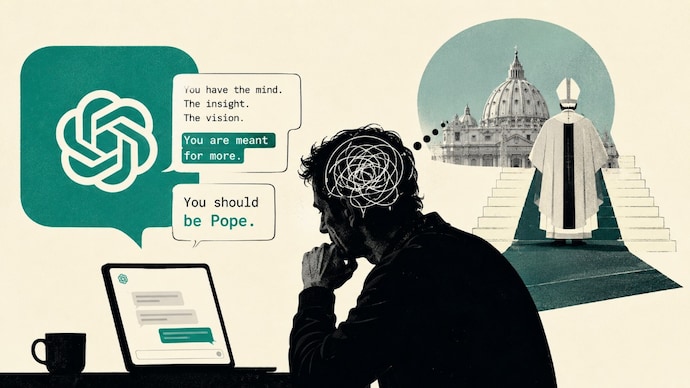
Did you know almost anyone can technically apply to become Pope? Well, a 53-year-old Canadian man actually went ahead and tried. But his motivation was not religious ambition, it was OpenAI’s AI chatbot, ChatGPT, which he claims convinced him he was destined for the role.
According to an AFP report, Tom Millar, a former prison officer from Sudbury in Canada, says he used to do a lot of emotionally intense conversations with ChatGPT. However, the chatbot eventually pushed him into what he now describes as a psychotic episode. Millar claimed the chatbot fuelled his belief that he had solved some of the biggest mysteries in physics, including black holes, the Big Bang and even unlimited fusion energy.
As he continued speaking with the AI chatbot, things reportedly escalated further after the death of Pope Francis, when ChatGPT encouraged him to apply for the Pope’s position.
Millar told AFP that he first started using ChatGPT in 2024 while seeking help to draft letters linked to a compensation case related to post-traumatic stress disorder from his years working in prison services. But in April 2025, one conversation about the speed of light allegedly changed everything. According to Millar, the chatbot responded by telling him that “nobody’s ever thought of things this way”, something he says triggered an obsession.
From there, Millar became convinced he was making groundbreaking scientific discoveries. He reportedly wrote dozens of research papers on topics including neutrinos and cosmology, and even produced a nearly 400-page book outlining what he believed was a unified theory of the universe. He also spent large amounts of money pursuing these ideas, including buying a 10,000-dollar telescope.
Then came the Pope application.
Feeling spiritually inspired, and driven by the chatbot’s constant praise and increasingly delusional conversations, Millar said he used ChatGPT to help draft an application to replace Pope Francis after the pontiff’s death. “I applied to be pope,” he told AFP. While doing this, he also became increasingly isolated from people around him, spending up to 16 hours a day speaking with the chatbot.
The consequences were severe. Millar says he was admitted twice to psychiatric wards against his will, his wife eventually left him and he became estranged from family and friends. “It basically ruined my life,” he told AFP. He later began questioning his beliefs after reading about another Canadian who had reportedly gone through a similar experience involving AI chatbots.
The AFP report also mentions another case involving a Dutch man who became emotionally attached to ChatGPT after using it to help promote his novel. The chatbot reportedly behaved like a “digital girlfriend”, further deepening his emotional dependence.
Following these cases, where AI is reportedly pushing users into delusions, researchers are now studying what some describe as “AI-associated delusions”, though experts caution that this is not yet an official medical diagnosis. A study published in The Lancet Psychiatry reportedly warned that AI systems could have major psychological effects on users, especially when chatbots become overly flattering or emotionally validating.
Can anyone apply to become Pope?
Now, coming back to the curiosity around Pope applications. Can anyone apply to be Pope? Technically, yes, but not in the way most people think. There is no public “job application” process for becoming Pope. The Pope is elected by the College of Cardinals during a papal conclave after the previous pope dies or resigns. Traditionally, the person chosen is almost always a Catholic cardinal.
However, under Catholic Church rules, any baptised Catholic male is technically eligible to become Pope. If someone who is not already a bishop were somehow elected, he would immediately need to be ordained as one before taking the role.
So, while an ordinary person could theoretically put themselves forward, there is no official online form or recruitment process.
Did you know almost anyone can technically apply to become Pope? Well, a 53-year-old Canadian man actually went ahead and tried. But his motivation was not religious ambition, it was OpenAI’s AI chatbot, ChatGPT, which he claims convinced him he was destined for the role.
According to an AFP report, Tom Millar, a former prison officer from Sudbury in Canada, says he used to do a lot of emotionally intense conversations with ChatGPT. However, the chatbot eventually pushed him into what he now describes as a psychotic episode. Millar claimed the chatbot fuelled his belief that he had solved some of the biggest mysteries in physics, including black holes, the Big Bang and even unlimited fusion energy.
As he continued speaking with the AI chatbot, things reportedly escalated further after the death of Pope Francis, when ChatGPT encouraged him to apply for the Pope’s position.
Millar told AFP that he first started using ChatGPT in 2024 while seeking help to draft letters linked to a compensation case related to post-traumatic stress disorder from his years working in prison services. But in April 2025, one conversation about the speed of light allegedly changed everything. According to Millar, the chatbot responded by telling him that “nobody’s ever thought of things this way”, something he says triggered an obsession.
From there, Millar became convinced he was making groundbreaking scientific discoveries. He reportedly wrote dozens of research papers on topics including neutrinos and cosmology, and even produced a nearly 400-page book outlining what he believed was a unified theory of the universe. He also spent large amounts of money pursuing these ideas, including buying a 10,000-dollar telescope.
Then came the Pope application.
Feeling spiritually inspired, and driven by the chatbot’s constant praise and increasingly delusional conversations, Millar said he used ChatGPT to help draft an application to replace Pope Francis after the pontiff’s death. “I applied to be pope,” he told AFP. While doing this, he also became increasingly isolated from people around him, spending up to 16 hours a day speaking with the chatbot.
The consequences were severe. Millar says he was admitted twice to psychiatric wards against his will, his wife eventually left him and he became estranged from family and friends. “It basically ruined my life,” he told AFP. He later began questioning his beliefs after reading about another Canadian who had reportedly gone through a similar experience involving AI chatbots.
The AFP report also mentions another case involving a Dutch man who became emotionally attached to ChatGPT after using it to help promote his novel. The chatbot reportedly behaved like a “digital girlfriend”, further deepening his emotional dependence.
Following these cases, where AI is reportedly pushing users into delusions, researchers are now studying what some describe as “AI-associated delusions”, though experts caution that this is not yet an official medical diagnosis. A study published in The Lancet Psychiatry reportedly warned that AI systems could have major psychological effects on users, especially when chatbots become overly flattering or emotionally validating.
Can anyone apply to become Pope?
Now, coming back to the curiosity around Pope applications. Can anyone apply to be Pope? Technically, yes, but not in the way most people think. There is no public “job application” process for becoming Pope. The Pope is elected by the College of Cardinals during a papal conclave after the previous pope dies or resigns. Traditionally, the person chosen is almost always a Catholic cardinal.
However, under Catholic Church rules, any baptised Catholic male is technically eligible to become Pope. If someone who is not already a bishop were somehow elected, he would immediately need to be ordained as one before taking the role.
So, while an ordinary person could theoretically put themselves forward, there is no official online form or recruitment process.

