Google's free AI tool helps non-coders build 2.5 lakh Android apps
Google said users created more than 2.5 lakh Android apps in a week through AI Studio. The rollout has widened app creation beyond coders while raising questions about discoverability and quality control.
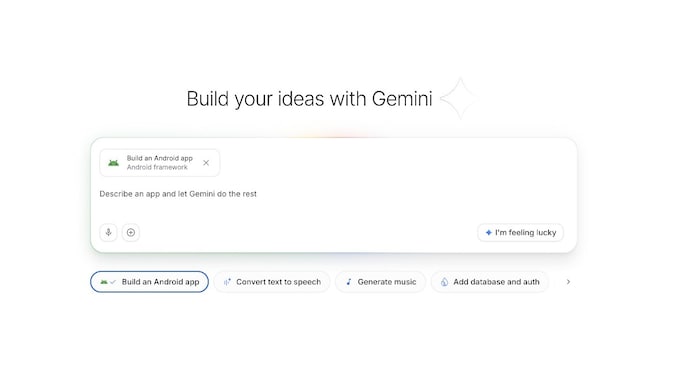
Google's latest AI push is showing just how quickly app development is changing. The company has revealed that more than 2.5 lakh Android apps have already been created using its free AI-powered tool inside Google AI Studio, and the surprising part is that most of the people building them had never created an app before. The announcement came from Logan Kilpatrick, a member of technical staff working on Gemini at Google. In a post shared on X, he said that the company has just launched the ability to build native Android apps directly through AI Studio for free. According to him, users have already created over 250,000 Android apps within just a week of launch.
"Likely >99% of these folks never built an Android app before, everyone can now build, no coding required," Kilpatrick wrote.
The tool appears to simplify one of the biggest challenges in software development — coding knowledge. Instead of writing complex lines of code manually, users can now rely on Gemini-powered prompts and AI assistance to create working Android apps. Google is clearly targeting a much wider audience here, including students, creators, small business owners, hobby developers and even people who simply want to build personal-use apps.
Kilpatrick also talked about the scale of the Android ecosystem while encouraging users to try the feature. “Android has over 3 billion active users, and now anyone can build an app for themselves or this 3 billion user audience,” he said, adding that such a possibility would have sounded unrealistic just five years ago.
Google may allow direct Play Store publishing later
While the ability to create apps using AI is already live, Google seems to be working toward making the publishing process easier too. Responding to a user question on X, Kilpatrick said developers can currently deploy apps to the Play test track directly from AI Studio. He also hinted that direct publishing to the Play Store from AI Studio could arrive later this summer.
That could become a major change for beginner developers because app publishing on the Play Store still involves several approval and compliance steps. Developers first need to create a Play Console account and sometimes complete identity verification. Google also requires app descriptions, screenshots, app icons, privacy policy links and other listing information before submission.
Beyond that, developers must complete multiple compliance declarations under the “App content” section. This includes details about ads, target audience, data collection practices and content ratings. Apps requesting sensitive permissions like location, SMS or contacts usually face extra scrutiny. If an app includes login access, Google reviewers may also ask for working test credentials.
Once an Android App Bundle is uploaded, Google reviews the app for policy violations, malware risks, privacy concerns and misleading behaviour. Reviews for first-time developers can sometimes take several days. According to Google, approvals may take up to seven days or longer in exceptional cases.
Not everyone is convinced AI-built apps will succeed
The viral announcement also triggered debate online about the future quality of AI-generated apps. One user pointed out that while lowering the barrier to entry is a positive move, the real challenge would be helping those apps find actual users and a market. Kilpatrick agreed and responded by saying Google would work on solving that next.
Some users also raised concerns about Play Store quality control. One comment suggested that most of these AI-generated apps may never successfully reach the Play Store. Responding to that, Kilpatrick said the quality standards for app stores should remain high. He added that while many people may build apps only for personal use, apps that go through the full publishing process should still meet high-quality expectations.
Another interesting part of the conversation was Kilpatrick revealing that even he had never built an Android app before testing the tool internally around five to six weeks ago.
Google's latest AI push is showing just how quickly app development is changing. The company has revealed that more than 2.5 lakh Android apps have already been created using its free AI-powered tool inside Google AI Studio, and the surprising part is that most of the people building them had never created an app before. The announcement came from Logan Kilpatrick, a member of technical staff working on Gemini at Google. In a post shared on X, he said that the company has just launched the ability to build native Android apps directly through AI Studio for free. According to him, users have already created over 250,000 Android apps within just a week of launch.
"Likely >99% of these folks never built an Android app before, everyone can now build, no coding required," Kilpatrick wrote.
The tool appears to simplify one of the biggest challenges in software development — coding knowledge. Instead of writing complex lines of code manually, users can now rely on Gemini-powered prompts and AI assistance to create working Android apps. Google is clearly targeting a much wider audience here, including students, creators, small business owners, hobby developers and even people who simply want to build personal-use apps.
Kilpatrick also talked about the scale of the Android ecosystem while encouraging users to try the feature. “Android has over 3 billion active users, and now anyone can build an app for themselves or this 3 billion user audience,” he said, adding that such a possibility would have sounded unrealistic just five years ago.
Google may allow direct Play Store publishing later
While the ability to create apps using AI is already live, Google seems to be working toward making the publishing process easier too. Responding to a user question on X, Kilpatrick said developers can currently deploy apps to the Play test track directly from AI Studio. He also hinted that direct publishing to the Play Store from AI Studio could arrive later this summer.
That could become a major change for beginner developers because app publishing on the Play Store still involves several approval and compliance steps. Developers first need to create a Play Console account and sometimes complete identity verification. Google also requires app descriptions, screenshots, app icons, privacy policy links and other listing information before submission.
Beyond that, developers must complete multiple compliance declarations under the “App content” section. This includes details about ads, target audience, data collection practices and content ratings. Apps requesting sensitive permissions like location, SMS or contacts usually face extra scrutiny. If an app includes login access, Google reviewers may also ask for working test credentials.
Once an Android App Bundle is uploaded, Google reviews the app for policy violations, malware risks, privacy concerns and misleading behaviour. Reviews for first-time developers can sometimes take several days. According to Google, approvals may take up to seven days or longer in exceptional cases.
Not everyone is convinced AI-built apps will succeed
The viral announcement also triggered debate online about the future quality of AI-generated apps. One user pointed out that while lowering the barrier to entry is a positive move, the real challenge would be helping those apps find actual users and a market. Kilpatrick agreed and responded by saying Google would work on solving that next.
Some users also raised concerns about Play Store quality control. One comment suggested that most of these AI-generated apps may never successfully reach the Play Store. Responding to that, Kilpatrick said the quality standards for app stores should remain high. He added that while many people may build apps only for personal use, apps that go through the full publishing process should still meet high-quality expectations.
Another interesting part of the conversation was Kilpatrick revealing that even he had never built an Android app before testing the tool internally around five to six weeks ago.

