Google announces Gemini 3.5 Flash and Antigravity 2.0, claims they made full OS in 12 hours
Google has introduced Gemini 3.5 Flash and Antigravity 2.0 at Google I/O 2026, showcasing its growing push into AI-powered coding tools and autonomous software agents. The company claimed Antigravity 2.0 managed to build the core of a working operating system in just 12 hours using 93 AI sub-agents.
Google has used its annual developer event, Google I/O 2026, to show just how serious it is about AI-powered software development. Alongside the launch of the new Gemini 3.5 models, the company also introduced Antigravity 2.0, an upgraded agentic coding platform that Google claims was capable of building the core of a functioning operating system in just 12 hours.
The announcement came during a presentation by Varun Mohan, who described Antigravity 2.0 as an “unabashedly agent-first” platform focused on helping developers build software with teams of autonomous AI agents. During the live demo, Google revealed that it had tested the platform by assigning it a massive challenge: create an entirely new operating system from scratch.
According to Google, the system launched 93 separate sub-agents during the process, generated 2.6 billion tokens, and completed the core framework of the operating system in around 12 hours. The company also claimed the entire process used less than $1,000 worth of tokens, which is being positioned as a major efficiency milestone for large-scale AI coding projects.
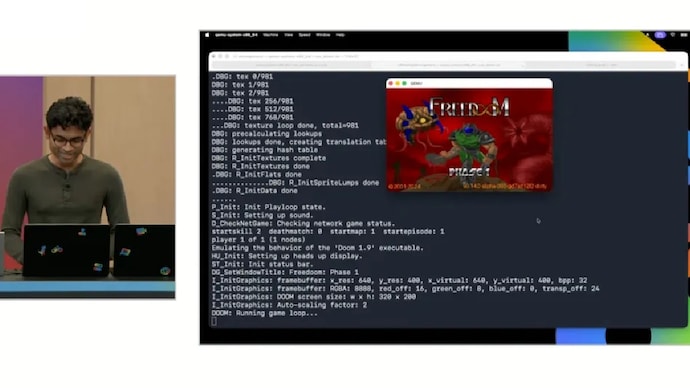
The demo became even more dramatic when Google attempted to run the classic game Doom on the AI-built operating system. Initially, the OS failed because it lacked keyboard drivers. Mohan then asked Antigravity to generate the missing drivers in real time. Moments later, the game reportedly became playable after the AI wrote the required code live on stage.
The presentation highlighted Google’s growing focus on “agentic AI,” a concept where multiple AI systems work together independently to complete larger and longer tasks. Instead of acting like a simple chatbot, these agents can split responsibilities across different workflows at the same time. Google said one agent could build a website, another could create brand assets, while another could handle product planning simultaneously.
Google also confirmed that Antigravity 2.0 is now available broadly as a standalone desktop application. The platform will additionally support command-line access for developers who want deeper integration into their workflows.
At the same event, Sundar Pichai unveiled Gemini 3.5 Flash, calling it faster and more capable than the previous Gemini 3.1 generation. According to Google, the new model is designed specifically for more advanced AI agents, longer-running workflows, and complex development tasks.
Pichai said Gemini 3.5 Flash can generate output tokens at nearly four times the speed of competing frontier AI models. Google also claimed the model performs better across most benchmarks while operating at roughly half the cost of rival systems. The company is making Gemini 3.5 Flash the default Gemini model starting today, while Gemini 3.5 Pro is expected to arrive later.
Google DeepMind CTO Koray Kavukcuoglu said the model is particularly strong at handling autonomous agents that can work continuously for hours on coding and research projects without human intervention. Google believes this could help developers automate larger software tasks that currently require entire engineering teams.
Google has used its annual developer event, Google I/O 2026, to show just how serious it is about AI-powered software development. Alongside the launch of the new Gemini 3.5 models, the company also introduced Antigravity 2.0, an upgraded agentic coding platform that Google claims was capable of building the core of a functioning operating system in just 12 hours.
The announcement came during a presentation by Varun Mohan, who described Antigravity 2.0 as an “unabashedly agent-first” platform focused on helping developers build software with teams of autonomous AI agents. During the live demo, Google revealed that it had tested the platform by assigning it a massive challenge: create an entirely new operating system from scratch.
According to Google, the system launched 93 separate sub-agents during the process, generated 2.6 billion tokens, and completed the core framework of the operating system in around 12 hours. The company also claimed the entire process used less than $1,000 worth of tokens, which is being positioned as a major efficiency milestone for large-scale AI coding projects.
The demo became even more dramatic when Google attempted to run the classic game Doom on the AI-built operating system. Initially, the OS failed because it lacked keyboard drivers. Mohan then asked Antigravity to generate the missing drivers in real time. Moments later, the game reportedly became playable after the AI wrote the required code live on stage.
The presentation highlighted Google’s growing focus on “agentic AI,” a concept where multiple AI systems work together independently to complete larger and longer tasks. Instead of acting like a simple chatbot, these agents can split responsibilities across different workflows at the same time. Google said one agent could build a website, another could create brand assets, while another could handle product planning simultaneously.
Google also confirmed that Antigravity 2.0 is now available broadly as a standalone desktop application. The platform will additionally support command-line access for developers who want deeper integration into their workflows.
At the same event, Sundar Pichai unveiled Gemini 3.5 Flash, calling it faster and more capable than the previous Gemini 3.1 generation. According to Google, the new model is designed specifically for more advanced AI agents, longer-running workflows, and complex development tasks.
Pichai said Gemini 3.5 Flash can generate output tokens at nearly four times the speed of competing frontier AI models. Google also claimed the model performs better across most benchmarks while operating at roughly half the cost of rival systems. The company is making Gemini 3.5 Flash the default Gemini model starting today, while Gemini 3.5 Pro is expected to arrive later.
Google DeepMind CTO Koray Kavukcuoglu said the model is particularly strong at handling autonomous agents that can work continuously for hours on coding and research projects without human intervention. Google believes this could help developers automate larger software tasks that currently require entire engineering teams.

