Elephant gives birth to twin calves in Corbett. Why experts call it uncommon
Wildlife experts have described the sighting as an extraordinary event, explaining that twin births among elephants are extremely uncommon.
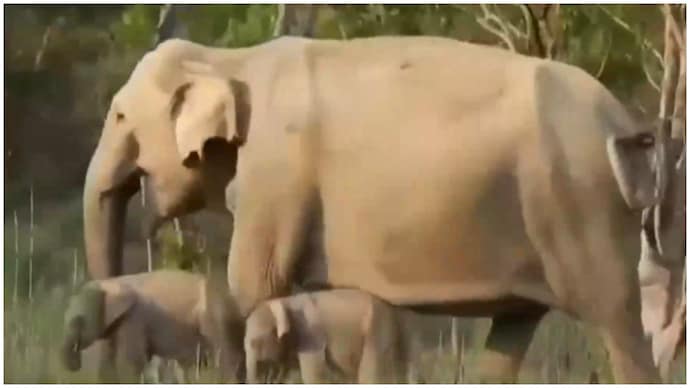
Deep inside the forests of the Jim Corbett National Park in Uttarakhand, forest officials witnessed a sight few wildlife experts ever get to see - a wild elephant moving through the jungle with her twin calves.
On May 9, forest officials in the Jadpahar area of the Bijrani Zone noticed the elephant accompanied by her newborn twin calves. Days later, on May 12 and 13, forest department teams again saw the trio in the Garjia Tourism Zone and recorded videos that went viral online.
The visuals show the twin calves walking along with their mother, playfully wandering around her as the elephant carefully guides them through the forest.
Wildlife experts have described the sighting as an extraordinary event, explaining that twin births among elephants are extremely uncommon. Female elephants generally give birth to only one calf after a gestation period of around 22 months, making the healthy condition and survival of both calves particularly significant.
Conservationists say the sighting is also encouraging from a wildlife conservation perspective, as raising twin calves in the wild can be challenging because of the enormous nutritional and protective demands placed on the mother.
IFS officer Himanshu Tyagi said twin births in elephants account for less than one per cent of all births. He noted that a single elephant calf usually weighs between 70 and 120 kilograms at birth, making it metabolically demanding for a mother elephant to carry two calves simultaneously.
The rare appearance of the elephant and her twin calves has generated excitement among wildlife enthusiasts and tourists visiting Corbett, India’s oldest national park and one of the country’s most well-known tiger reserves.
Deep inside the forests of the Jim Corbett National Park in Uttarakhand, forest officials witnessed a sight few wildlife experts ever get to see - a wild elephant moving through the jungle with her twin calves.
On May 9, forest officials in the Jadpahar area of the Bijrani Zone noticed the elephant accompanied by her newborn twin calves. Days later, on May 12 and 13, forest department teams again saw the trio in the Garjia Tourism Zone and recorded videos that went viral online.
The visuals show the twin calves walking along with their mother, playfully wandering around her as the elephant carefully guides them through the forest.
Wildlife experts have described the sighting as an extraordinary event, explaining that twin births among elephants are extremely uncommon. Female elephants generally give birth to only one calf after a gestation period of around 22 months, making the healthy condition and survival of both calves particularly significant.
Conservationists say the sighting is also encouraging from a wildlife conservation perspective, as raising twin calves in the wild can be challenging because of the enormous nutritional and protective demands placed on the mother.
IFS officer Himanshu Tyagi said twin births in elephants account for less than one per cent of all births. He noted that a single elephant calf usually weighs between 70 and 120 kilograms at birth, making it metabolically demanding for a mother elephant to carry two calves simultaneously.
The rare appearance of the elephant and her twin calves has generated excitement among wildlife enthusiasts and tourists visiting Corbett, India’s oldest national park and one of the country’s most well-known tiger reserves.

