How Bengal's Bapuji cake is still popular with GenZ and millennials alike
Trends may come and go, but Bapuji Cake's foundation remains unchanged. As the bakery's owner Amitava Jana said during an exclusive conversation, the beloved brand continues to be guided by three enduring values — humanity, loyalty and ethics.
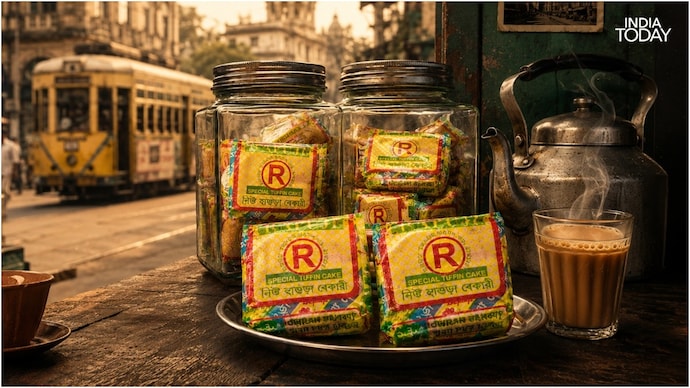
It is a balmy afternoon in Kolkata sometime in the early 2000s. A classroom full of restless children keep glancing at the wall clock, waiting for the tiffin bell to finally rescue them from fractions and grammar lessons. The moment it rings, steel tiffin boxes snap open across wooden benches and school corridors erupt into chaos. Inside many of those boxes sits the same familiar object: a thick slice of Bapuji Cake wrapped in colourful crinkly paper stamped with a large red “R”.
Years later, even today, when you open that slightly greasy wrapping paper, it feels less like opening a cake and more like a memory.
Long before gourmet patisseries, Korean buns and Instagram desserts entered Kolkata’s vocabulary, Bapuji Cake had already claimed its place in the emotional geography of Bengali childhood. Soft yet dense, fragrant with vanilla, petha and dry fruits, and sold at tiny neighbourhood grocery shops and inside giant glass jars at para (locality) bakeries. It was never glamorous.
Nobody bought it because it looked fancy. Nobody photographed it. Nobody even thought too much about it.
It was simply there
The humble tea cake quietly became part of school recesses, train journeys, evening cha sessions and middle-class growing up across Howrah, Hooghly and Kolkata.
First introduced in the early 1970s, Bapuji Cake was never marketed as an aspirational luxury. In fact, its appeal lay in the opposite. It was affordable, accessible and deeply ordinary. Yet decades later, that ordinariness is exactly what has made it iconic.
Today, a single slice costs around Rs 7. But for many Bengalis, its value cannot be measured in rupees. The cake has survived changing food trends, economic shifts and the arrival of flashy bakery chains while retaining the same taste, texture and unmistakable aroma that people remember from childhood.
And perhaps that is why nostalgia alone cannot fully explain Bapuji Cake’s legacy. Because for many families, the cake represented something larger than food — familiarity, continuity and quiet comfort in a rapidly changing city.
To understand Bapuji Cake is to understand a certain kind of memory: one where happiness often came wrapped in slightly greasy paper and tasted faintly of vanilla and dry fruits.
Every region inherits a taste that eventually becomes inseparable from memory. For Mumbai, it may be the vada pav eaten outside school gates with coins from a parent’s wallet. For Delhi, perhaps the bakery patties and cream rolls that waited at the end of evening tuition classes. Across much of South India, it could be the ritual of warm vegetable puffs and tea from neighbourhood bakeries at dusk. For Bengalis, Bapuji Cake belongs to that same emotional archive — not as a celebrated delicacy, but as something quieter and far more enduring.
A slice of Bengal since 1973
The story of Bapuji Cake began in 1973, inside a modest bakery in Howrah founded by late industrialist Alokesh Jana. It is fascinating how some of Bengal’s most enduring cultural markers were never created with grand ambition.
It was not introduced as a luxury confectionery item or a “heritage” food product. It was simply designed to be affordable; a cake ordinary families could buy without thinking twice about the price. Sold initially at just 60 paise a slice under New Howrah Bakery and Confectionery, the cake travelled across neighbourhood grocery stores, tea stalls and bakery counters in Kolkata, Howrah and Hooghly until it became part of everyday life almost by accident.
Its emotional hold on Bengal became obvious during the pandemic, as it briefly disrupted supply and the cake disappeared from shelves for a short period. What followed was almost absurd in the best possible way – people genuinely panicked.
Social media flooded with nostalgia posts, complaints and anxious questions about where Bapuji Cake had vanished. Mainstream news outlets even covered the shortage. That was perhaps the moment many Bengalis collectively realised that Bapuji Cake had stopped being “just cake” a long time ago.
Today, the legacy of the cake continues under the stewardship of Alokesh Jana’s sons, Amitava and Animesh, who have managed to preserve the original philosophy behind the brand while expanding the business into breads, biscuits and other bakery products. And honestly, that continuity feels rare now.
Speaking to indiatoday.tech, Amitava Jana emphasised on three rules of running this 52-year-old legacy – “humanity, loyalty and ethics." For him, providing the customer with the same taste and quality is what drives the brand.
The memory that hits home
The memory of Bapuji Cake did not end in school. It followed me into my college years at Jadavpur University, threading itself through exhausting lectures, adda sessions that stretched well past reason, and the particular desperation of last-minute assignment panic.
Somewhere in that chaos, a slice of Bapuji Cake with a hot bhnaarer cha (kulhad chai) became its own ritual. Cheap enough for broke students, filling enough to pass off as survival food, and comforting enough to make bad days feel, if only briefly, survivable. It belonged to the emotional ecosystem of Kolkata as naturally as rain-drenched tram tracks and political graffiti walls.
But ask people what they are actually nostalgic for, and the answers get far more interesting than the cake itself.
For Abhishek Das, an Analytics Manager at HSBC, the cake is inseparable from the specific texture of a Kolkata boyhood, the kind you can almost smell: "The very mention of Bapuji cake brings back fond memories of the umpteen tea stalls and small vendor shops across the city, especially North Kolkata, that serve this small packet of joy. In essence, it really is synonymous to the lazy summer siesta of our childhood and school memories."
There is something in that image, the afternoon heat, the unhurried vendor, the rustling packet, that no amount of artisanal frosting could replicate.
Bengaluru-based Shreyashi Bose reaches for a different register entirely, and lands on something that feels almost sociological. "No matter what class of people, they have all eaten it. It unites masses irrespective of class, caste, creed. It has never changed packaging and it has never promised anything but what it is. Like Boroline, it hasn't changed, and something about that unchanged, monolith-like energy fuels our nostalgia."
There is a particular kind of power in things that simply refuse to evolve. They become, over time, a form of proof, that not everything bends to the market, not everything gets a rebrand.
Not everyone, however, romanticises it quite so broadly. Akash Chatterjee, a journalist, is more exacting about what he thinks actually did the work. "The nostalgia around Bapuji cake lies in the taste and the price. It was pocket-friendly and used to be a good option for breakfast. The murabba was the centre of attraction, along with other small pieces of fruit."
His point cuts through the sentimentality with a certain honesty: "The cake stood apart because of its distinct taste, coming at a low cost." Sometimes the thing is simply the thing, no metaphor required.
Roshni Chakraborty, a senior journalist, reaches for a comparison that will land immediately for anyone who did not grow up in Kolkata. "Think about the small Britannia cupcakes with the oil paper stuck to the bottom which you would peel off and, if no one was watching, probably lick or scrape clean. Now take that feel and go back a few more years to a cake that is almost as yummy, certainly more filling, and even cheaper. The bite you kept waiting for was the one with a piece of pedha — just yummy."
It is the kind of food memory that bypasses language entirely, less described than re-experienced.
Video producer Ishanee Dhar's recollection is quieter, and perhaps the more affecting for it. "We used to celebrate our birthdays with a simple Rs 7 cake topped with a candle: small, yet deeply meaningful moments." Seven rupees. A candle. A birthday. There is an entire world of uncomplicated joy compressed into that sentence.
Underneath all of this, though, sits a sharper cultural question, one that PR professional Susmita Pakrasi articulates with some precision. "Its emotional value has probably increased precisely because today's food culture is so polished and expensive. Modern desserts are often designed to impress visually first — gourmet patisserie, Instagram aesthetics, imported ingredients, premium pricing. Bapuji cake belongs to the opposite philosophy. It feels accessible, familiar, unpretentious."
She calls it emotional democracy — "a cake that didn't make people feel excluded." In an era where even a cup of coffee comes with a lecture on single-origin beans, that kind of straightforwardness starts to feel almost radical.
Which raises the uncomfortable thought: what would have happened if Bapuji had tried to move upmarket? The responses, when posed to people, are swift and unanimous.
"No," says Roshni, without hesitation. "The appeal of the cake is its mass affordability and simplicity. It wouldn't really be the same if it started to look different or, worse, 'upgraded'."
Susmita sharpens the argument further. "The moment something like that aggressively rebrands itself into a luxury product, it risks losing the exact thing people loved about it, emotional honesty. Nostalgic foods survive because they resist reinvention just enough. They evolve quietly, but they don't abandon their social identity."
Abhishek, though, is the most unsparing. "Bapuji cake would never survive in an urban tale. The very essence of it, seeped in nostalgia, is a loud reminder of the gentler times we associate it with. If it tries to become fancy, it would be a tale as stale as a nearly forgotten Instagram reel that barely catches our attention." And then, in a line that perhaps says it better than anything else: "Bapuji represents an entire generation's love, childhood, tiffin, adda at the local para stalls and an easy quick meal option in a few pennies."
The legacy
Today, the responsibility of carrying forward Bapuji Cake’s legacy rests with Amitava and Animesh Jana, who have managed to preserve the brand’s old-world familiarity while carefully expanding the business into breads, biscuits and other bakery products.
Speaking about the philosophy behind the brand, Amitava says the focus was never on turning Bapuji Cake into a premium or aspirational product. “The cake’s unique name was kind of a tribute to Gandhiji, the father of the nation who was fondly called Bapuji,” he says. “We want the quality to remain high, and we have never compromised on the weight as we believe Bapuji cake should always be a filler snack for people from all sections.”
That commitment to affordability, he admits, has not always been easy to maintain. Over the years, the brand has weathered everything from trademark disputes and court battles over the Bapuji name to one of its biggest crises during the COVID-19 pandemic, when production and distribution came to a near standstill.
“There was a point during Covid when everything became uncertain,” Amitava recalls. “Like many old businesses, we also faced a massive roadblock. Even after the lockdown was lifted, it was tough to bring back the workers from their hometowns. But the emotional connection people have with Bapuji Cake helped it survive. Once things reopened, demand slowly came back.”
And according to him, that demand is far from fading away.
“People often think only older generations eat Bapuji Cake because of nostalgia, but even today, students and young people buy it regularly,” he says. “In fact, the production demand that dipped during the pandemic has revived.”
Perhaps most tellingly, even in an age where nearly every nostalgic food item is repackaged into something more expensive and “premium”, Bapuji Cake continues to resist that transformation. Amitava says keeping the cake affordable remains a conscious decision.
“We had to invest from our own pockets to maintain the quality, but with the petrol price hikes, the prices may increase in the coming years,” he says.
In many ways, that single sentence explains why the cake continues to endure. Bapuji Cake survived not because it reinvented itself for modern times, but because it understood the emotional value of remaining familiar.
The cake that Kolkata kept
There is a particular kind of immortality that belongs not to the grand or the gilded, but to the quietly indispensable. Bapuji Cake has never announced itself, it has simply persisted, the way certain smells persist, the way certain streets do, lodged somewhere between muscle memory and feeling.
Cities are ruthless editors; they cut what doesn’t serve the news. And yet here it is, still wrapped in the same unpretentious yellow, still sitting on the same tea-stall counters, still finding its way into the same tiffin boxes that a whole generation of Bengali mothers packed with the particular tenderness of ordinary mornings. The murabba at its centre, sticky, amber, unhurried, feels almost like a metaphor for the city itself: something sweet and preserving at the core, holding together everything layered around it.
Kolkata has shed many skins since Bapuji first appeared on its streets. It has grown louder, faster, hungrier for the new. But there are appetites that resist reinvention, that live not in the stomach but somewhere older and less rational, in the part of us that still reaches, almost involuntarily, for the taste of a time we cannot quite return to but cannot quite release.
You don't choose Bapuji Cake. At some point, growing up in Kolkata, it simply chooses you.
It is a balmy afternoon in Kolkata sometime in the early 2000s. A classroom full of restless children keep glancing at the wall clock, waiting for the tiffin bell to finally rescue them from fractions and grammar lessons. The moment it rings, steel tiffin boxes snap open across wooden benches and school corridors erupt into chaos. Inside many of those boxes sits the same familiar object: a thick slice of Bapuji Cake wrapped in colourful crinkly paper stamped with a large red “R”.
Years later, even today, when you open that slightly greasy wrapping paper, it feels less like opening a cake and more like a memory.
Long before gourmet patisseries, Korean buns and Instagram desserts entered Kolkata’s vocabulary, Bapuji Cake had already claimed its place in the emotional geography of Bengali childhood. Soft yet dense, fragrant with vanilla, petha and dry fruits, and sold at tiny neighbourhood grocery shops and inside giant glass jars at para (locality) bakeries. It was never glamorous.
Nobody bought it because it looked fancy. Nobody photographed it. Nobody even thought too much about it.
It was simply there
The humble tea cake quietly became part of school recesses, train journeys, evening cha sessions and middle-class growing up across Howrah, Hooghly and Kolkata.
First introduced in the early 1970s, Bapuji Cake was never marketed as an aspirational luxury. In fact, its appeal lay in the opposite. It was affordable, accessible and deeply ordinary. Yet decades later, that ordinariness is exactly what has made it iconic.
Today, a single slice costs around Rs 7. But for many Bengalis, its value cannot be measured in rupees. The cake has survived changing food trends, economic shifts and the arrival of flashy bakery chains while retaining the same taste, texture and unmistakable aroma that people remember from childhood.
And perhaps that is why nostalgia alone cannot fully explain Bapuji Cake’s legacy. Because for many families, the cake represented something larger than food — familiarity, continuity and quiet comfort in a rapidly changing city.
To understand Bapuji Cake is to understand a certain kind of memory: one where happiness often came wrapped in slightly greasy paper and tasted faintly of vanilla and dry fruits.
Every region inherits a taste that eventually becomes inseparable from memory. For Mumbai, it may be the vada pav eaten outside school gates with coins from a parent’s wallet. For Delhi, perhaps the bakery patties and cream rolls that waited at the end of evening tuition classes. Across much of South India, it could be the ritual of warm vegetable puffs and tea from neighbourhood bakeries at dusk. For Bengalis, Bapuji Cake belongs to that same emotional archive — not as a celebrated delicacy, but as something quieter and far more enduring.
A slice of Bengal since 1973
The story of Bapuji Cake began in 1973, inside a modest bakery in Howrah founded by late industrialist Alokesh Jana. It is fascinating how some of Bengal’s most enduring cultural markers were never created with grand ambition.
It was not introduced as a luxury confectionery item or a “heritage” food product. It was simply designed to be affordable; a cake ordinary families could buy without thinking twice about the price. Sold initially at just 60 paise a slice under New Howrah Bakery and Confectionery, the cake travelled across neighbourhood grocery stores, tea stalls and bakery counters in Kolkata, Howrah and Hooghly until it became part of everyday life almost by accident.
Its emotional hold on Bengal became obvious during the pandemic, as it briefly disrupted supply and the cake disappeared from shelves for a short period. What followed was almost absurd in the best possible way – people genuinely panicked.
Social media flooded with nostalgia posts, complaints and anxious questions about where Bapuji Cake had vanished. Mainstream news outlets even covered the shortage. That was perhaps the moment many Bengalis collectively realised that Bapuji Cake had stopped being “just cake” a long time ago.
Today, the legacy of the cake continues under the stewardship of Alokesh Jana’s sons, Amitava and Animesh, who have managed to preserve the original philosophy behind the brand while expanding the business into breads, biscuits and other bakery products. And honestly, that continuity feels rare now.
Speaking to indiatoday.tech, Amitava Jana emphasised on three rules of running this 52-year-old legacy – “humanity, loyalty and ethics." For him, providing the customer with the same taste and quality is what drives the brand.
The memory that hits home
The memory of Bapuji Cake did not end in school. It followed me into my college years at Jadavpur University, threading itself through exhausting lectures, adda sessions that stretched well past reason, and the particular desperation of last-minute assignment panic.
Somewhere in that chaos, a slice of Bapuji Cake with a hot bhnaarer cha (kulhad chai) became its own ritual. Cheap enough for broke students, filling enough to pass off as survival food, and comforting enough to make bad days feel, if only briefly, survivable. It belonged to the emotional ecosystem of Kolkata as naturally as rain-drenched tram tracks and political graffiti walls.
But ask people what they are actually nostalgic for, and the answers get far more interesting than the cake itself.
For Abhishek Das, an Analytics Manager at HSBC, the cake is inseparable from the specific texture of a Kolkata boyhood, the kind you can almost smell: "The very mention of Bapuji cake brings back fond memories of the umpteen tea stalls and small vendor shops across the city, especially North Kolkata, that serve this small packet of joy. In essence, it really is synonymous to the lazy summer siesta of our childhood and school memories."
There is something in that image, the afternoon heat, the unhurried vendor, the rustling packet, that no amount of artisanal frosting could replicate.
Bengaluru-based Shreyashi Bose reaches for a different register entirely, and lands on something that feels almost sociological. "No matter what class of people, they have all eaten it. It unites masses irrespective of class, caste, creed. It has never changed packaging and it has never promised anything but what it is. Like Boroline, it hasn't changed, and something about that unchanged, monolith-like energy fuels our nostalgia."
There is a particular kind of power in things that simply refuse to evolve. They become, over time, a form of proof, that not everything bends to the market, not everything gets a rebrand.
Not everyone, however, romanticises it quite so broadly. Akash Chatterjee, a journalist, is more exacting about what he thinks actually did the work. "The nostalgia around Bapuji cake lies in the taste and the price. It was pocket-friendly and used to be a good option for breakfast. The murabba was the centre of attraction, along with other small pieces of fruit."
His point cuts through the sentimentality with a certain honesty: "The cake stood apart because of its distinct taste, coming at a low cost." Sometimes the thing is simply the thing, no metaphor required.
Roshni Chakraborty, a senior journalist, reaches for a comparison that will land immediately for anyone who did not grow up in Kolkata. "Think about the small Britannia cupcakes with the oil paper stuck to the bottom which you would peel off and, if no one was watching, probably lick or scrape clean. Now take that feel and go back a few more years to a cake that is almost as yummy, certainly more filling, and even cheaper. The bite you kept waiting for was the one with a piece of pedha — just yummy."
It is the kind of food memory that bypasses language entirely, less described than re-experienced.
Video producer Ishanee Dhar's recollection is quieter, and perhaps the more affecting for it. "We used to celebrate our birthdays with a simple Rs 7 cake topped with a candle: small, yet deeply meaningful moments." Seven rupees. A candle. A birthday. There is an entire world of uncomplicated joy compressed into that sentence.
Underneath all of this, though, sits a sharper cultural question, one that PR professional Susmita Pakrasi articulates with some precision. "Its emotional value has probably increased precisely because today's food culture is so polished and expensive. Modern desserts are often designed to impress visually first — gourmet patisserie, Instagram aesthetics, imported ingredients, premium pricing. Bapuji cake belongs to the opposite philosophy. It feels accessible, familiar, unpretentious."
She calls it emotional democracy — "a cake that didn't make people feel excluded." In an era where even a cup of coffee comes with a lecture on single-origin beans, that kind of straightforwardness starts to feel almost radical.
Which raises the uncomfortable thought: what would have happened if Bapuji had tried to move upmarket? The responses, when posed to people, are swift and unanimous.
"No," says Roshni, without hesitation. "The appeal of the cake is its mass affordability and simplicity. It wouldn't really be the same if it started to look different or, worse, 'upgraded'."
Susmita sharpens the argument further. "The moment something like that aggressively rebrands itself into a luxury product, it risks losing the exact thing people loved about it, emotional honesty. Nostalgic foods survive because they resist reinvention just enough. They evolve quietly, but they don't abandon their social identity."
Abhishek, though, is the most unsparing. "Bapuji cake would never survive in an urban tale. The very essence of it, seeped in nostalgia, is a loud reminder of the gentler times we associate it with. If it tries to become fancy, it would be a tale as stale as a nearly forgotten Instagram reel that barely catches our attention." And then, in a line that perhaps says it better than anything else: "Bapuji represents an entire generation's love, childhood, tiffin, adda at the local para stalls and an easy quick meal option in a few pennies."
The legacy
Today, the responsibility of carrying forward Bapuji Cake’s legacy rests with Amitava and Animesh Jana, who have managed to preserve the brand’s old-world familiarity while carefully expanding the business into breads, biscuits and other bakery products.
Speaking about the philosophy behind the brand, Amitava says the focus was never on turning Bapuji Cake into a premium or aspirational product. “The cake’s unique name was kind of a tribute to Gandhiji, the father of the nation who was fondly called Bapuji,” he says. “We want the quality to remain high, and we have never compromised on the weight as we believe Bapuji cake should always be a filler snack for people from all sections.”
That commitment to affordability, he admits, has not always been easy to maintain. Over the years, the brand has weathered everything from trademark disputes and court battles over the Bapuji name to one of its biggest crises during the COVID-19 pandemic, when production and distribution came to a near standstill.
“There was a point during Covid when everything became uncertain,” Amitava recalls. “Like many old businesses, we also faced a massive roadblock. Even after the lockdown was lifted, it was tough to bring back the workers from their hometowns. But the emotional connection people have with Bapuji Cake helped it survive. Once things reopened, demand slowly came back.”
And according to him, that demand is far from fading away.
“People often think only older generations eat Bapuji Cake because of nostalgia, but even today, students and young people buy it regularly,” he says. “In fact, the production demand that dipped during the pandemic has revived.”
Perhaps most tellingly, even in an age where nearly every nostalgic food item is repackaged into something more expensive and “premium”, Bapuji Cake continues to resist that transformation. Amitava says keeping the cake affordable remains a conscious decision.
“We had to invest from our own pockets to maintain the quality, but with the petrol price hikes, the prices may increase in the coming years,” he says.
In many ways, that single sentence explains why the cake continues to endure. Bapuji Cake survived not because it reinvented itself for modern times, but because it understood the emotional value of remaining familiar.
The cake that Kolkata kept
There is a particular kind of immortality that belongs not to the grand or the gilded, but to the quietly indispensable. Bapuji Cake has never announced itself, it has simply persisted, the way certain smells persist, the way certain streets do, lodged somewhere between muscle memory and feeling.
Cities are ruthless editors; they cut what doesn’t serve the news. And yet here it is, still wrapped in the same unpretentious yellow, still sitting on the same tea-stall counters, still finding its way into the same tiffin boxes that a whole generation of Bengali mothers packed with the particular tenderness of ordinary mornings. The murabba at its centre, sticky, amber, unhurried, feels almost like a metaphor for the city itself: something sweet and preserving at the core, holding together everything layered around it.
Kolkata has shed many skins since Bapuji first appeared on its streets. It has grown louder, faster, hungrier for the new. But there are appetites that resist reinvention, that live not in the stomach but somewhere older and less rational, in the part of us that still reaches, almost involuntarily, for the taste of a time we cannot quite return to but cannot quite release.
You don't choose Bapuji Cake. At some point, growing up in Kolkata, it simply chooses you.

