Iran war turned his music school to rubble. He refused to let missiles have the last word
From Iran, Hamidreza Afarideh spoke to indiatoday.tech, and said how he had spent nearly 15 years building Honiak Music School with his wife, Sheida Ebadatdoust.
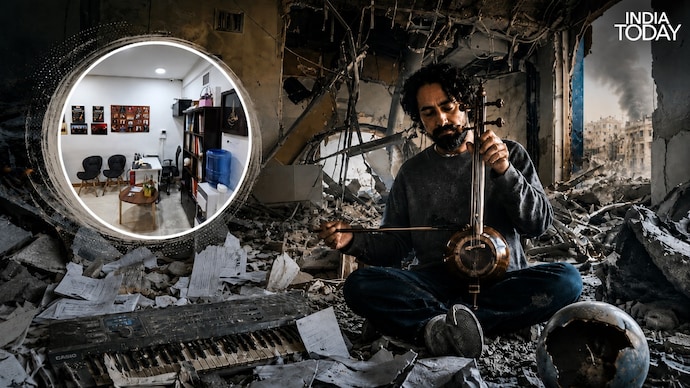
For weeks now, the war involving Iran, Israel, and the United States has reduced entire neighbourhoods in Iran to rubble. Apartment blocks have collapsed overnight, families have dug through debris searching for loved ones, and smoke had, until the recent ceasefire, become a constant presence over cities once filled with ordinary life. While global conversations remained focussed on missile strikes, retaliation, oil routes, and the strategic importance of the Strait of Hormuz, another image quietly emerged from Tehran, one that captured a very different kind of devastation.
It was not a video of fighter jets or collapsing buildings. It was a grieving music teacher sitting inside the ruins of his bombed music school, playing the kamancheh as dust and broken concrete surrounded him. Within hours, the haunting clip of Hamidreza Afarideh spread across social media, becoming a heart-breaking symbol of what war leaves behind once the headlines move on.
From Iran, Afarideh spoke to indiatoday.tech, and said how he had spent nearly 15 years building the school with his wife, Sheida Ebadatdoust. Located on Tehran's Piroozi Street, the Honiak Music School had become a second home for nearly 250 students and 22 teachers.
On March 23, 2026, the bombing took place.
Within minutes, classrooms collapsed, instruments were buried under rubble, and the life Afarideh had painstakingly built disappeared. But instead of leaving the wreckage in silence, the musician returned to the ruins and played. The haunting video soon travelled far beyond Iran, with thousands online calling it one of the most poignant images to emerge from the conflict so far.
The Honiak Music School had not appeared overnight. It had taken Afarideh and his wife, Sheida, years of teaching, saving, repairing, and growing.
Now, that life was gone. "When I returned and saw it, everything was destroyed," he says. "Fifteen years of hard work, mine and my wife's, were gone in a single night."
The loss, he later calculated, was not just emotional. It was material too: nearly $42,000 (Rs 35 lakh approximately), wiped out in a single strike. But even that number feels insufficient when placed next to what actually disappeared. Because the school was never just an investment. It was a life.
The night everything fell silent
The missile strike on March 23 came as part of the ongoing US and Israeli attacks on Iran, an escalation that turned entire neighbourhoods into fault lines of fear. In Tehran, explosions had blurred into routine, and sirens had faded into background noise.
But there is always a moment when war stops being distant. For Afarideh, that moment was standing in front of what used to be his school. The small, quiet victories of a child finally mastering a note, a room filling up with music slowly, year after year. All of it now lay buried under debris.
"We did not just lose a building," he says. "We lost a large part of our memories. Memories built with around 250 students and with 22 colleagues and teachers, many of whom were young people we helped grow through cultural work," Afarideh adds. Children had entered at the age of five and grown into adults inside those walls, carrying pieces of the school into who they became.
"In a way, that place was like a child we never had. We do not have children, but that place meant as much as one to us."
A school that held more than music
For the students, the loss was something harder to explain. The Honiak Music Academy had never been only about learning an instrument. It was where children arrived carrying emotions they could not always articulate – anxiety, loneliness, uncertainty – and left with something steadier.
"For our students, that place was not just a school – it was a safe space," Afarideh says. The messages began almost immediately after the news spread. Students asking when they could return. Parents were hoping for an answer that did not exist.
"They contact us every day asking when it will be rebuilt. But without financial support, we cannot rebuild it."
"One of the most heartbreaking moments was when a young child, after seeing the destroyed building, was unable to speak for hours," the music teacher remembers.
The decision to play
The building was not safe when Afarideh returned. Parts of it could still teeter on the edge of collapse. The threat of more strikes had not passed and there were reasons to stay away, but he went back anyway.
Not to search for what could be salvaged, but because he could not accept the ruins to be his last memory of that place. "I wanted the last sound coming from that place to be music – not bombs or missiles."
Afarideh had sat down amidst the rubble, dust rising around him, wires hanging overhead, the sky visible through what used to be a ceiling. And he played.
There was no audience. No applause waiting. Only the remains of something that had once held life. "To me, music means peace," he says. "Music is a universal language, one that can express sorrow, joy, and everything a human being wants to share with another."
The notes travelled through broken walls and open air, filling a space that had been stripped of everything else. For a few minutes, the school existed again, not in structure, but in sound and the video soon went viral across social media platforms.
Watch the heart-breaking clip here:
"I wanted the final voice of that place to be the voice of art," Afarideh mentions.
What remains after everything is taken
The video of him playing travelled far beyond Tehran. Messages poured in from across the world, from India, the United States, Europe, Asia.
"People around the world are simply seeking peace and calm. Everyone wants to live together and stand in empathy with one another," he says.
There is a quiet insistence in the way he speaks about Iran – not as a battlefield, but as a place that has always tried to speak through art.
"We are a country with thousands of years of civilisation, and we have always tried to communicate with the world through art and music," he says. "In reality, the people of Iran are peaceful."
Living with what cannot be rebuilt
In the days since the strike, Afarideh has returned to music. But it no longer feels the same.
"When I play music now, I do not feel fear – I feel grief," he says. "It feels like part of me is still buried under that rubble." He thinks about the instruments still lying there, silent.
"Every time I play, I am reminded of those instruments whose voices are gone," he remembers. The future remains uncertain. There is no clear path to rebuilding, no immediate solution waiting.
"This experience has left us mentally shaken and uncertain. We truly do not know what to do next." And yet, there is something he refuses to let go of. "Music is not over for us," Afarideh adds.
If anything, he believes this loss will find its way into what he creates next, shaping it, deepening it, making it carry something it did not before.
"I worry about children who have been traumatised, elderly people living in fear, and lonely individuals who may not even have someone to mourn them," Afarideh laments.
His thoughts stretch beyond his own loss. "I worry about the future of my country and the next generation – what answer we will have for them if everything is lost."
There is no dramatic ending to his story. No rebuilding yet. No closure. Only a quiet, stubborn hope.
"I hope for a day when peace takes over the world, when people can live together without weapons, without war."
When Hamidreza Afarideh stood inside the ruins of his school, he was standing in what remained of 15 years of his life. Concrete can be cleared. Walls can be rebuilt. But some things do not return. Somewhere beneath that rubble lie the echoes of 250 students, years of effort, and a life built slowly enough to matter.
The US-Iran war
Even now, long after the bombs reduced his music school to rubble, the war around Hamidreza Afarideh refuses to quieten. The Strait of Hormuz, a narrow artery through which much of the world's oil moves, remains at the centre of a dangerous geopolitical tug-of-war, with fresh tensions erupting after reports of a ship seizure near the United Arab Emirates.
US President Donald Trump recently admitted his patience with Iran was "running out" following talks with Chinese President Xi Jinping, as fears of further escalation continue to loom over the region. But while world powers negotiate shipping lanes, oil routes, and military strategy, people like Afarideh are left sitting inside the wreckage of ordinary lives.
Meanwhile, in Tehran, amid dust-covered instruments and collapsed classrooms, a music teacher is still trying to come to terms with the fact that the place where children once learnt melodies is now just another casualty of war.
For weeks now, the war involving Iran, Israel, and the United States has reduced entire neighbourhoods in Iran to rubble. Apartment blocks have collapsed overnight, families have dug through debris searching for loved ones, and smoke had, until the recent ceasefire, become a constant presence over cities once filled with ordinary life. While global conversations remained focussed on missile strikes, retaliation, oil routes, and the strategic importance of the Strait of Hormuz, another image quietly emerged from Tehran, one that captured a very different kind of devastation.
It was not a video of fighter jets or collapsing buildings. It was a grieving music teacher sitting inside the ruins of his bombed music school, playing the kamancheh as dust and broken concrete surrounded him. Within hours, the haunting clip of Hamidreza Afarideh spread across social media, becoming a heart-breaking symbol of what war leaves behind once the headlines move on.
From Iran, Afarideh spoke to indiatoday.tech, and said how he had spent nearly 15 years building the school with his wife, Sheida Ebadatdoust. Located on Tehran's Piroozi Street, the Honiak Music School had become a second home for nearly 250 students and 22 teachers.
On March 23, 2026, the bombing took place.
Within minutes, classrooms collapsed, instruments were buried under rubble, and the life Afarideh had painstakingly built disappeared. But instead of leaving the wreckage in silence, the musician returned to the ruins and played. The haunting video soon travelled far beyond Iran, with thousands online calling it one of the most poignant images to emerge from the conflict so far.
The Honiak Music School had not appeared overnight. It had taken Afarideh and his wife, Sheida, years of teaching, saving, repairing, and growing.
Now, that life was gone. "When I returned and saw it, everything was destroyed," he says. "Fifteen years of hard work, mine and my wife's, were gone in a single night."
The loss, he later calculated, was not just emotional. It was material too: nearly $42,000 (Rs 35 lakh approximately), wiped out in a single strike. But even that number feels insufficient when placed next to what actually disappeared. Because the school was never just an investment. It was a life.
The night everything fell silent
The missile strike on March 23 came as part of the ongoing US and Israeli attacks on Iran, an escalation that turned entire neighbourhoods into fault lines of fear. In Tehran, explosions had blurred into routine, and sirens had faded into background noise.
But there is always a moment when war stops being distant. For Afarideh, that moment was standing in front of what used to be his school. The small, quiet victories of a child finally mastering a note, a room filling up with music slowly, year after year. All of it now lay buried under debris.
"We did not just lose a building," he says. "We lost a large part of our memories. Memories built with around 250 students and with 22 colleagues and teachers, many of whom were young people we helped grow through cultural work," Afarideh adds. Children had entered at the age of five and grown into adults inside those walls, carrying pieces of the school into who they became.
"In a way, that place was like a child we never had. We do not have children, but that place meant as much as one to us."
A school that held more than music
For the students, the loss was something harder to explain. The Honiak Music Academy had never been only about learning an instrument. It was where children arrived carrying emotions they could not always articulate – anxiety, loneliness, uncertainty – and left with something steadier.
"For our students, that place was not just a school – it was a safe space," Afarideh says. The messages began almost immediately after the news spread. Students asking when they could return. Parents were hoping for an answer that did not exist.
"They contact us every day asking when it will be rebuilt. But without financial support, we cannot rebuild it."
"One of the most heartbreaking moments was when a young child, after seeing the destroyed building, was unable to speak for hours," the music teacher remembers.
The decision to play
The building was not safe when Afarideh returned. Parts of it could still teeter on the edge of collapse. The threat of more strikes had not passed and there were reasons to stay away, but he went back anyway.
Not to search for what could be salvaged, but because he could not accept the ruins to be his last memory of that place. "I wanted the last sound coming from that place to be music – not bombs or missiles."
Afarideh had sat down amidst the rubble, dust rising around him, wires hanging overhead, the sky visible through what used to be a ceiling. And he played.
There was no audience. No applause waiting. Only the remains of something that had once held life. "To me, music means peace," he says. "Music is a universal language, one that can express sorrow, joy, and everything a human being wants to share with another."
The notes travelled through broken walls and open air, filling a space that had been stripped of everything else. For a few minutes, the school existed again, not in structure, but in sound and the video soon went viral across social media platforms.
Watch the heart-breaking clip here:
"I wanted the final voice of that place to be the voice of art," Afarideh mentions.
What remains after everything is taken
The video of him playing travelled far beyond Tehran. Messages poured in from across the world, from India, the United States, Europe, Asia.
"People around the world are simply seeking peace and calm. Everyone wants to live together and stand in empathy with one another," he says.
There is a quiet insistence in the way he speaks about Iran – not as a battlefield, but as a place that has always tried to speak through art.
"We are a country with thousands of years of civilisation, and we have always tried to communicate with the world through art and music," he says. "In reality, the people of Iran are peaceful."
Living with what cannot be rebuilt
In the days since the strike, Afarideh has returned to music. But it no longer feels the same.
"When I play music now, I do not feel fear – I feel grief," he says. "It feels like part of me is still buried under that rubble." He thinks about the instruments still lying there, silent.
"Every time I play, I am reminded of those instruments whose voices are gone," he remembers. The future remains uncertain. There is no clear path to rebuilding, no immediate solution waiting.
"This experience has left us mentally shaken and uncertain. We truly do not know what to do next." And yet, there is something he refuses to let go of. "Music is not over for us," Afarideh adds.
If anything, he believes this loss will find its way into what he creates next, shaping it, deepening it, making it carry something it did not before.
"I worry about children who have been traumatised, elderly people living in fear, and lonely individuals who may not even have someone to mourn them," Afarideh laments.
His thoughts stretch beyond his own loss. "I worry about the future of my country and the next generation – what answer we will have for them if everything is lost."
There is no dramatic ending to his story. No rebuilding yet. No closure. Only a quiet, stubborn hope.
"I hope for a day when peace takes over the world, when people can live together without weapons, without war."
When Hamidreza Afarideh stood inside the ruins of his school, he was standing in what remained of 15 years of his life. Concrete can be cleared. Walls can be rebuilt. But some things do not return. Somewhere beneath that rubble lie the echoes of 250 students, years of effort, and a life built slowly enough to matter.
The US-Iran war
Even now, long after the bombs reduced his music school to rubble, the war around Hamidreza Afarideh refuses to quieten. The Strait of Hormuz, a narrow artery through which much of the world's oil moves, remains at the centre of a dangerous geopolitical tug-of-war, with fresh tensions erupting after reports of a ship seizure near the United Arab Emirates.
US President Donald Trump recently admitted his patience with Iran was "running out" following talks with Chinese President Xi Jinping, as fears of further escalation continue to loom over the region. But while world powers negotiate shipping lanes, oil routes, and military strategy, people like Afarideh are left sitting inside the wreckage of ordinary lives.
Meanwhile, in Tehran, amid dust-covered instruments and collapsed classrooms, a music teacher is still trying to come to terms with the fact that the place where children once learnt melodies is now just another casualty of war.

