Trump arrives in China for high-stakes talks with Xi Jinping
US President Donald Trump landed in the Chinese capital alongside an entourage that included Elon Musk and Jensen Huang.
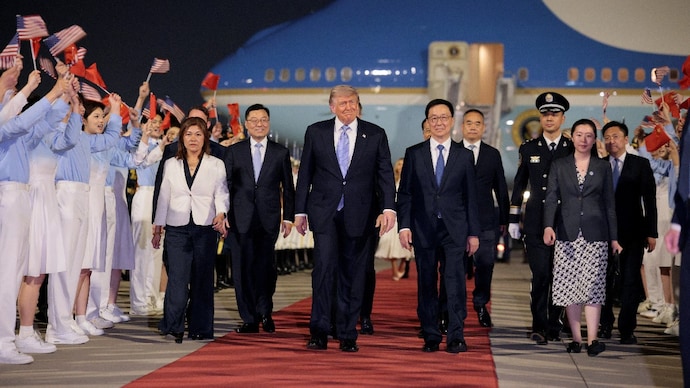
US President Donald Trump arrived in Beijing on Wednesday for a high-stakes summit with Chinese President Xi Jinping, carrying a delegation of top business leaders and fresh pressure to stabilise ties between the world’s two largest economies amid the widening Iran conflict.
Trump landed in the Chinese capital alongside an entourage that included Elon Musk and Jensen Huang to secure commercial wins and ease tensions that have strained trade, technology and global supply chains.
The US President was greeted by Chinese Vice President Han Zheng alongside senior officials, including US Ambassador to China David Perdue, Chinese Ambassador to the US Xie Feng and China’s Executive Vice Foreign Minister Ma Zhaoxu.
The carefully choreographed welcome is also set to feature a military honour guard, a military band and nearly 300 Chinese youths in matching blue-and-white uniforms waving Chinese flags along the tarmac. Xi is expected to formally welcome Trump during a state ceremony on Thursday morning (local time).
The visit marks the first trip by a sitting US President to China in nearly a decade and comes at a politically fraught moment for Trump, who faces economic pressure at home and growing scrutiny over the fallout from the Iran war ahead of November’s midterm elections.
IRAN, TRADE AND AI TO DOMINATE TALKS
Before leaving Washington, Trump signalled he would not rely on Beijing to help end the conflict with Tehran or loosen Iran’s tightening grip over the Strait of Hormuz, one of the world’s most strategically important oil chokepoints.
"I don't think we need any help with Iran. We'll win it one way or the other, peacefully or otherwise," Trump told reporters before departure.
Still, the Iran conflict is expected to dominate much of the summit agenda alongside trade disputes, artificial intelligence, Taiwan and export controls on advanced semiconductors. Trump said he planned to personally press Xi to open China further to American businesses, particularly technology firms seeking access to the Chinese market.
The inclusion of Huang drew particular attention in Washington and Beijing. Nvidia has struggled to secure regulatory approval to sell its advanced H200 artificial intelligence chips in China amid tightening US export restrictions and escalating competition over AI development.
According to news agency Reuters, Trump asked Huang to join the trip at the last minute. The Nvidia chief executive was later spotted boarding Air Force One during a refuelling stop in Alaska.
"I will be asking President Xi, a leader of extraordinary distinction, to 'open up' China so that these brilliant people can work their magic," Trump wrote on Truth Social.
TRADE AND TAIWAN REMAIN FLASHPOINTS
As Trump prepared for the ceremonial welcome in Beijing, Treasury Secretary and chief trade negotiator Scott Bessent held three hours of preparatory talks with Chinese Vice Premier He Lifeng at South Korea’s Incheon airport. China’s state-run Xinhua news agency described the discussions as "candid, in-depth and constructive."
The talks focused heavily on preserving a fragile trade truce reached last October, when Trump suspended steep tariffs on Chinese imports and Beijing stepped back from restrictions on rare earth exports critical for industries ranging from electric vehicles to defence manufacturing.
US officials have said Washington hopes to expand exports of Boeing aircraft, agricultural products and energy supplies to China while also establishing new frameworks for trade and AI cooperation. Beijing, meanwhile, continues to push for looser US restrictions on chipmaking equipment and advanced semiconductor exports.
China also reiterated its opposition on Wednesday to American arms sales to Taiwan, where a proposed $14 billion package still awaits Trump’s approval.
Under US law, Washington is required to provide Taiwan with defensive support despite the absence of formal diplomatic relations, which has been a longstanding flashpoint in US-China ties.
Xi, by contrast, faces far less immediate political pressure despite China’s slowing economy.
"The Trump administration needs this meeting more than China does, as it needs to show to American voters that deals are signed, money is made," Liu Qian, founder of Beijing-based geopolitical consultancy Wusawa Advisory, told Reuters.
US President Donald Trump arrived in Beijing on Wednesday for a high-stakes summit with Chinese President Xi Jinping, carrying a delegation of top business leaders and fresh pressure to stabilise ties between the world’s two largest economies amid the widening Iran conflict.
Trump landed in the Chinese capital alongside an entourage that included Elon Musk and Jensen Huang to secure commercial wins and ease tensions that have strained trade, technology and global supply chains.
The US President was greeted by Chinese Vice President Han Zheng alongside senior officials, including US Ambassador to China David Perdue, Chinese Ambassador to the US Xie Feng and China’s Executive Vice Foreign Minister Ma Zhaoxu.
The carefully choreographed welcome is also set to feature a military honour guard, a military band and nearly 300 Chinese youths in matching blue-and-white uniforms waving Chinese flags along the tarmac. Xi is expected to formally welcome Trump during a state ceremony on Thursday morning (local time).
The visit marks the first trip by a sitting US President to China in nearly a decade and comes at a politically fraught moment for Trump, who faces economic pressure at home and growing scrutiny over the fallout from the Iran war ahead of November’s midterm elections.
IRAN, TRADE AND AI TO DOMINATE TALKS
Before leaving Washington, Trump signalled he would not rely on Beijing to help end the conflict with Tehran or loosen Iran’s tightening grip over the Strait of Hormuz, one of the world’s most strategically important oil chokepoints.
"I don't think we need any help with Iran. We'll win it one way or the other, peacefully or otherwise," Trump told reporters before departure.
Still, the Iran conflict is expected to dominate much of the summit agenda alongside trade disputes, artificial intelligence, Taiwan and export controls on advanced semiconductors. Trump said he planned to personally press Xi to open China further to American businesses, particularly technology firms seeking access to the Chinese market.
The inclusion of Huang drew particular attention in Washington and Beijing. Nvidia has struggled to secure regulatory approval to sell its advanced H200 artificial intelligence chips in China amid tightening US export restrictions and escalating competition over AI development.
According to news agency Reuters, Trump asked Huang to join the trip at the last minute. The Nvidia chief executive was later spotted boarding Air Force One during a refuelling stop in Alaska.
"I will be asking President Xi, a leader of extraordinary distinction, to 'open up' China so that these brilliant people can work their magic," Trump wrote on Truth Social.
TRADE AND TAIWAN REMAIN FLASHPOINTS
As Trump prepared for the ceremonial welcome in Beijing, Treasury Secretary and chief trade negotiator Scott Bessent held three hours of preparatory talks with Chinese Vice Premier He Lifeng at South Korea’s Incheon airport. China’s state-run Xinhua news agency described the discussions as "candid, in-depth and constructive."
The talks focused heavily on preserving a fragile trade truce reached last October, when Trump suspended steep tariffs on Chinese imports and Beijing stepped back from restrictions on rare earth exports critical for industries ranging from electric vehicles to defence manufacturing.
US officials have said Washington hopes to expand exports of Boeing aircraft, agricultural products and energy supplies to China while also establishing new frameworks for trade and AI cooperation. Beijing, meanwhile, continues to push for looser US restrictions on chipmaking equipment and advanced semiconductor exports.
China also reiterated its opposition on Wednesday to American arms sales to Taiwan, where a proposed $14 billion package still awaits Trump’s approval.
Under US law, Washington is required to provide Taiwan with defensive support despite the absence of formal diplomatic relations, which has been a longstanding flashpoint in US-China ties.
Xi, by contrast, faces far less immediate political pressure despite China’s slowing economy.
"The Trump administration needs this meeting more than China does, as it needs to show to American voters that deals are signed, money is made," Liu Qian, founder of Beijing-based geopolitical consultancy Wusawa Advisory, told Reuters.

