
In this thriller, job market has cut-throat competition – literally
In Donald Westlake's 'The Ax' and its latest film version from Park Chan-wook, the villain is capitalism and its ruthlessness.

Oracle, a tech giant, has reportedly fired 30,000 employees. In this age of AI, that seems to be a trend, not only in that sector but also spilling across sectors. At the other end of the spectrum, labourers in India were once again streaming out of cities back to their villages last month when the Iran war led to a short supply of cooking fuel. Be it a former Oracle executive or a Surat daily wager, the question they face is: What to do when the source of livelihood vanishes? How can one survive once the savings run dry? It is an ultimate nightmare, especially for the middle class. With the rising uncertainty everywhere, it has been a recurring nightmare. How far can one go in this fight for survival?
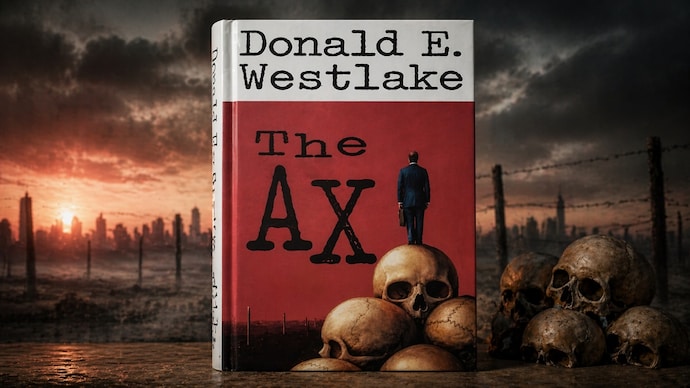
Burke Devore, the protagonist of Donald Westlake’s ‘The Ax’ (1997), is prepared to even kill in order to put food on the table. Westlake, who wrote over a hundred novels (also under pseudonyms such as ‘Richard Stark’), has hit upon a crucial theme here. His commentary on moral corrosion at the heart of capitalism appealed to the celebrated Greek-French filmmaker Costa-Gavras who made a film from the novel, ‘The Axe’ (2005).
Another remake is making waves now. South Korean maverick Park Chan-wook’s ‘No Other Choice’ (2025) premiered at the Venice International Film Festival, won several global awards, and it has become the third highest-grossing film in the domestic market. Park’s fans include Quentin Tarantino. Anurag Kashyap has said this latest offering is even better than ‘OldBoy’ (2003), the sleek thriller with double twist that is also an updated Greek tragedy.
‘No Other Choice’ speaks to the moment – more than Westlake’s novel did when it was published. Burke Devore, a 51-year-old father of two, unemployed for close to two years, says:
“As the computer takes our jobs, most people don’t even seem to realise why it’s happening. Why was I fired, they want to know, when the company’s in the black and doing better than ever? And the answer is, we were fired because the computer made us unnecessary and made mergers possible and our absence makes the company even stronger, and the dividends even larger, the return on investment even more generous.”
Devore has exhausted every avenue to find a job. A manager in the paper industry, he finds out from a trade journal a dream job. If the man currently doing that job was eliminated, there could still be candidates more suitable than him. So, he places a fake advertisement and picks six people most likely to beat him. His task now is to eliminate them and then that man. And this simple family man goes about it in a single-minded fashion – without any guilt or remorse. He thinks he has no other choice:
“I’m not a killer. I’m not a murderer, I never was, I don’t want to be such a thing, soulless and ruthless and empty. That’s not me. What I’m doing now I was forced into, by the logic of events, the shareholders’ logic, and the executives’ logic, and the logic of the marketplace, and the logic of the workforce”
Devore’s plans and execution may seem outlandish and far-fetched, but his voice and his ruminations make the novel all too believable. The job market reminds him of the history of the term ‘Clearance’: In the eighteenth century the landlords of Scottish Highlands decided to remove all tenant farmers, living on that land for generations, to raise sheep there. This heartless eviction came to be known as ‘clearance’. The corporate bosses doing the firing are, Devore believes, the descendents of those landlords.
The worst part of capitalism is that it makes enemies of friends. When they were working together, they enjoyed camaraderie, but now competing for the same few openings, they are rivals:
“And now Everett Dynes. He was like me, he should be my friend, my ally, we should work together against our common enemies. We shouldn’t claw each other, down here in the pit, fight each other for scraps, while they laugh up above. Or, even worse; while they don’t even bother to notice up, up above.”
Devore also blames the pace of change for this state of affairs. There was a time of certainties, when people died in the same world they were born into. That time is gone. “The world doesn’t just change these days, it upheaves, constantly,” and the trouble is, “I can’t change the circumstances of the world I live in.” The market mechanism gives no handle to most of us.
Many of us have been there. We know what Devore is talking about, even if none of us picked up an axe to get the next job. He does not suspect – but we may also appreciate the fact – that what we are running after is also the fruit of the same capitalist system. He does not dare to Be the Change or imagine that Another World is Possible. Once he finds his next job, he will be happy with the world once again. Yet, his diagnosis of the nefarious times we live in is clear and simple:
“Today, our moral code is based on the idea that the end justifies the means.”