
Before 33% quota: Where women stand in Indian politics
At the Lok Sabha and state levels, women are far from achieving parity.

As India moves towards operationalising the Nari Shakti Vandan Adhiniyam, it is important to examine where women actually stand in Indian politics. While there has been a steady rise in women’s participation in education and the workforce, their presence in politics remains limited.
The law, passed in 2023, is now set to be amended during a special three-day Parliamentary session. It allocates 33 per cent reservation for women in the Lok Sabha and state assemblies. It also plans to expand the Lok Sabha to 816 seats, with 273 reserved for women.
GRASSROOTS STRENGTH
According to the Ministry of Statistics and Programme Implementation, women’s participation in Panchayati Raj institutions is strong, with many states crossing the 50 per cent mark. Uttarakhand leads with 56 per cent, followed by Andhra Pradesh and Chhattisgarh. However, states like Uttar Pradesh, Punjab, and Ladakh have much lower representation. Overall, women hold about 46.6 per cent of seats in local bodies.
WHERE WOMEN LAG
At the Lok Sabha and state levels, women are far from achieving parity. According to a report by the Association for Democratic Reforms and National Election Watch, out of 51,000-odd candidates who contested in Lok Sabha and State/UT elections across the country, only about 10 per cent (5,095) were women. Among 4,666 MPs/MLAs across the country, only 464 or 10 per cent are women.
In the 2024 Lok Sabha elections, women made up only 9.6 per cent of the total candidates (800 out of 8,360). Nearly 28 per cent of constituencies had no women candidates. Among Lok Sabha constituencies, Baramati, Secunderabad, and Warangal saw the highest number of women candidates.
Among major parties, the Bharatiya Janata Party had the highest share of women candidates (16 per cent), followed by the Indian National Congress and the Communist Party of India (Marxist) at 13 per cent each, and the Bahujan Samaj Party at eight per cent in the 2024 elections.
Women’s participation as candidates in Assembly elections remained low across India. The study analysed elections between 2021 and 2025. Of 43,348 candidates that participated, only 4,295, about 10 per cent, were women. Across 4,123 constituencies (41 per cent), there were no women candidates at all.
Notably, no state or Union Territory had more than 15 per cent women candidates. In the current Assembly, the highest share of women candidates was seen in Delhi and Odisha at around 14 per cent each, followed by Chhattisgarh and Uttar Pradesh at 13 per cent each, and Tripura at 12 per cent. Most states, however, reported around 10 per cent or fewer women candidates.
States like Karnataka and Punjab had only seven per cent women candidates, while Himachal Pradesh and Manipur were even lower at six per cent. The lowest participation is seen in Arunachal Pradesh and Jammu and Kashmir (five per cent each), and in Nagaland, at just two per cent.
WOMEN MPS IN LOK SABHA
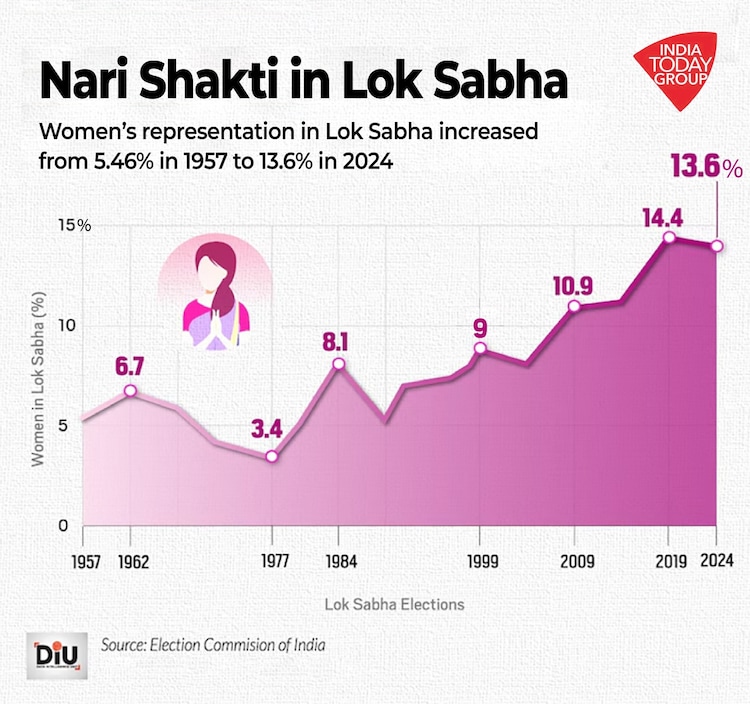
Women’s representation in the Lok Sabha has slowly increased over time, but it is still low. It rose from 5.46 per cent in 1957 to 13.6 per cent in 2024, with some ups and downs in between.
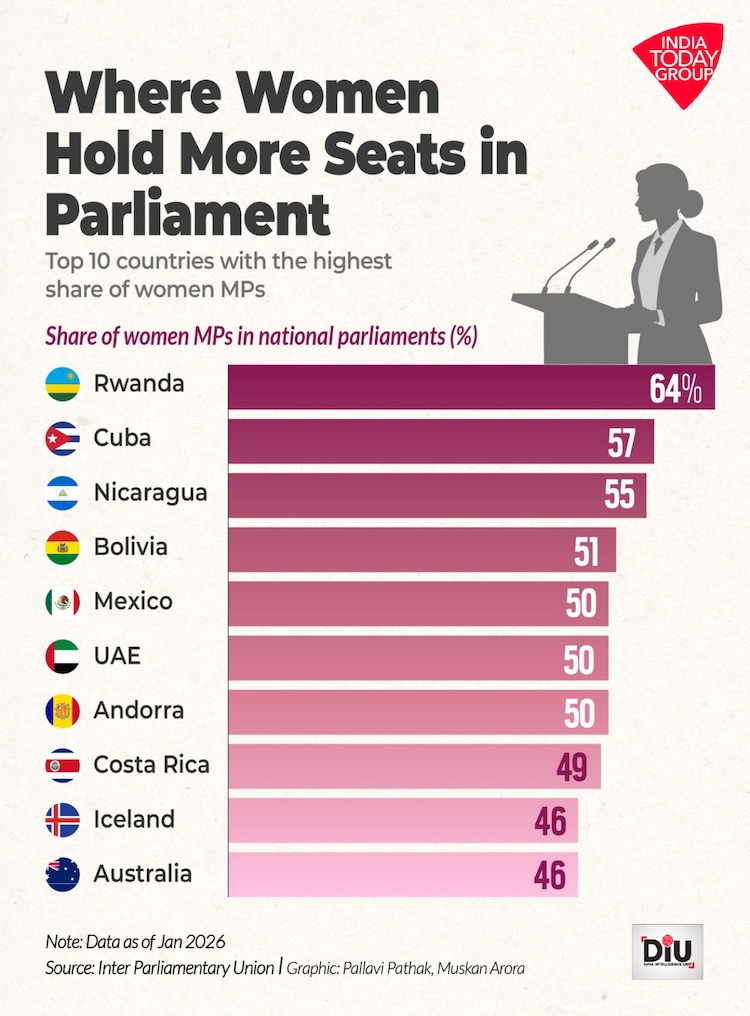
At the global level, some countries are doing very well in giving women equal power in parliament. Rwanda leads with the highest share, where women hold about 64 per cent of seats. Other countries like Cuba and Nicaragua also show strong participation, with more than half of the seats held by women.