
'I was called here as the AI Kid..': Kerala's youngest prodigy pushes for India-led AI
India's youngest AI prodigy, 16-year-old Raul John Aju from Kerala, who first drew national attention after addressing the India Today South Conclave 2025, has now stepped onto a wider global stage at the India AI Impact Summit 2026, where he met world leaders and technology decision-makers.

Raul John Aju, India’s young AI prodigy, attended the India AI Impact Summit 2026 at Bharat Mandapam from February 16 to 20. Speaking about his experience at the summit and his interaction with the UN Secretary-General, Raul said he had been invited as the ‘AI Kid of India’ and was also a speaker at the event.
“I met him here, and it was a very good experience. I was called here as I am known as the ‘AI Kid of India’, and I am also speaking here. I have been building AI tools and have trained 1.5 lakh students and some companies. I have been doing self-learning with the help of YouTube and the guidance of my parents,” he said.
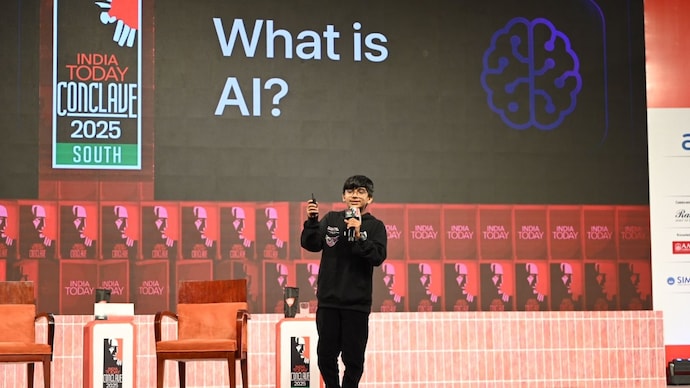
Earlier, at the India Today South Conclave 2025, Kerala-based 16-year-old AI prodigy Raul John Aju addressed the gathering and spoke about artificial intelligence in simple, practical terms. He urged Indians to build their own strength in the technology instead of fearing it.
Explaining the technology in relatable terms, Raul said artificial intelligence is already part of everyday life, from search engines to video recommendations, and should be used meaningfully.
He summed it up in direct words: “AI is just boring math and data.”
He further explained that most AI systems work on prediction, whether it is predicting the next word, pixel, or sound.
“AI is being used basically as prediction, right?” he said, adding that once understood, the mechanics of AI are not as complex as they appear.
A PRAGMATIC VIEW OF JOBS AND SKILLS
Raul addressed the common worry that machines will take jobs. His warning was direct and practical: “AI will not replace you, but someone using AI,” he said, pushing the audience to learn how to use tools rather than fear them.
He argued that those who adopt AI will gain an edge, firms and people who innovate tend to thrive, while those who stop innovating fall behind.
He gave an example of Nokia, which failed because it did not adapt to new innovation and stuck to the old one.
He pointed out how quickly AI tools have been adopted compared with earlier technologies and used that speed to argue for immediate learning and action. The message was simple: gain skills now so you are the person who can use AI to solve problems.
BUILDING USEFUL TOOLS
Raul showed how he applies this thinking in his own work. “The presentation is made with the help of AI,” he revealed, and described a steady focus on solving everyday problems.
His short social videos demonstrate practical uses, such as choosing a hairstyle or cleaning audio, while his longer videos explain technical ideas in an engaging manner, so viewers do not switch off.
He also spoke about projects that have public value. His JustEase Project 47x aims to simplify legal processes and provide quick emergency guidance.
Raul described a “me-bot” he built, a voice-cloned assistant that teaches in his voice, as a way to scale help when he cannot be present.
RETHINKING EDUCATION AND INNOVATION
Raul argued that India must invest more in research and in education that teaches skills and creativity. “We need to follow skills and creativity,” he said, calling for hands-on learning and more support for R and D.
He suggested that skills and practical projects matter more than rote marks for preparing young people to work with AI.
He also shared his own story as evidence, starting at the age of six, building a robot by the age of 16, and launching tools and channels that reach wide audiences.
That personal example reinforced his core point: curiosity and consistent effort turn ideas into useful tools.
Raul closed with a challenge that was both practical and hopeful: learn to use AI to solve real problems, build tools that help people, and make India a leader in applied AI rather than a follower.