
China's dig at India over NEET row? Embassy flaunts glitch-free Gaokao exam
China appeared to take a dig at India's competitive exam management, highlighting the glitch-free conduct of the Gaokao for nearly 1.3 crore students amid a huge controversy over the NEET-UG paper leak.
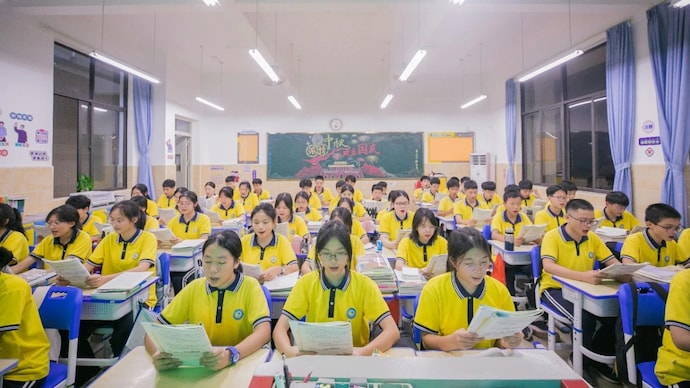
For many families, the examination represents years of preparation and is often seen as one of the most important milestones in a student's life.

New Delhi,UPDATED: Jun 10, 2026 22:16 IST
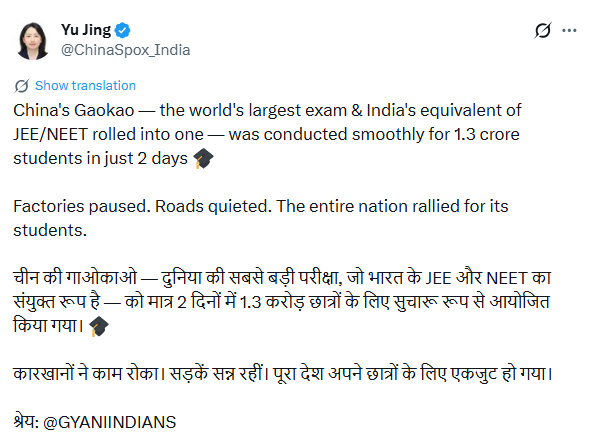
China on Wednesday appeared to take a swipe at India over recurring controversies surrounding competitive exams, including NEET, after showcasing the smooth conduct of its nationwide university entrance test, the Gaokao, which saw nearly 1.3 crore students appear over two days. Highlighting the scale of the effort, the Chinese Embassy in India said factories paused operations, roads were cleared up, and the country rallied behind students to ensure the exam was conducted without disruption.
In a post on X, the Chinese Embassy in India highlighted the scale and organisation of the examination, drawing a comparison with India's JEE and NEET entrance tests. The remarks came against the backdrop of scrutiny over examination management in India following the NEET-UG paper leak on May 3. A re-examination will be held on June 21.
"China's Gaokao, the world's largest exam and India's equivalent of JEE and NEET rolled into one, was conducted smoothly for 1.3 crore students in just two days," Chinese Embassy spokesperson Yu Jing said.
The post underscored the extraordinary logistical arrangements made across the country to facilitate the examination. "Factories paused. Roads quieted. The entire nation rallied for its students," Yu said.
The Gaokao, widely regarded as the world's largest examination, serves as the primary gateway to Chinese universities and is often considered one of the most important events in a student's life. This year's examination was held over two days, with nearly 13 million candidates appearing across the country.
The embassy's comparison with India's engineering and medical entrance examinations was particularly striking. While NEET and JEE are conducted separately and together attract several million candidates annually, the Gaokao combines the university admission process into a single national examination.
Chinese authorities implemented extensive measures to ensure the smooth conduct of the exam. Reports indicated that traffic restrictions were imposed around examination centres, special arrangements were made for transportation of students and, in some regions, factories reduced operations to minimise noise during examination hours.
The Chinese embassy's comments are likely to draw attention in India, where competitive examinations have frequently been at the centre of public debate. The NEET-UG examination, in particular, came under intense scrutiny after the paper leak, triggering huge protests across India.
While the Chinese post did not explicitly refer to those controversies, its emphasis on the seamless conduct of a high-stakes examination involving 1.3 crore students was widely viewed as a comparison with India's examination ecosystem.
The figures underline the scale of China's education system. NEET typically attracts over 20 lakh candidates annually, while JEE Main sees around 15 lakh aspirants. Even combined, the number remains significantly lower than the candidate pool for the Gaokao.
For millions of students in both countries, however, the examinations carry similar significance. They represent years of preparation and often determine access to some of the most sought-after educational opportunities.
By highlighting how the entire country mobilised to support candidates, Beijing sought to showcase the efficiency of its examination system – and, in the process, appeared to draw an implicit contrast with the challenges that have periodically surfaced in India's own entrance-test framework.
- Ends