
Not ISRO, but civil services: The IITian saga with bureaucracy
The unsettling question that many do not dare to ask has now turned into a debate on social platform X. A former IAS officer shared what he had felt throughout his career. The question now looms larger and points towards something far more debatable, which involves the system, IITians and bureaucrats, a view that many quietly appear to support.

New Delhi,UPDATED: May 15, 2026 12:23 IST
On the evening of May 12, after the NEET chaos had consumed television debates, I was sitting on my terrace with a friend who had spent nearly seven years preparing for the UPSC Civil Services Examination. Seven years. An entire school life compressed into one exam cycle. He never made it through.
The conversation drifted from leaked papers to broken systems, from the National Testing Agency to the strange machinery of Indian ambition itself. At one point, he paused and said, almost casually:
“If you think bureaucrats are going to change the system, you are living in a delusion. Most people preparing for UPSC are not dreaming of reform. They are dreaming of power. Unlimited power without boundaries.”
The line stayed with me. And this is not the first time that something similar has come from the mouth of an aspirant. I have previous experiences similar to this.
The next morning, scrolling through X, formerly Twitter, another remark made the discomfort sharper. An individual posted this:
“IIT graduates will join civil services to ‘serve the country’ but never ISRO. Kyun? Desh ki seva ISRO mein kyun nahi ho rahi?”
Her post was answered and reposted by former IAS officer KBS Sidhu, a man who spent more than three decades inside the administrative system. He wrote:
“People do not enter the civil services merely to serve the nation, nor even primarily to make money. They enter to claim, however modestly, a share in the country’s Raj Darbar Yog — the aura, proximity, access, and authority of the ruling establishment. No other profession offers anything remotely comparable.”
The replies came quickly. Some defended the system, while others pointed fingers. Many justified it by arguing that if politicians in India are often seen as corrupt or incompetent, then why should someone who has worked relentlessly for years not aspire to acquire power and hold on to it?
Every year, nearly 10 lakh candidates apply for the UPSC Civil Services Examination. The final selection hovers around 700 to 1,000 candidates, depending on vacancies. The success rate often falls below 0.2%.
A question was left hanging:
Why does India’s most competitive talent pipeline still gravitate toward administrative power more than scientific institutions, laboratories, research ecosystems, or engineering innovation?
And why are people who studied at India’s top institutes turning towards UPSC in such huge numbers? The power game runs deeper than conversations in policy corridors often admit.
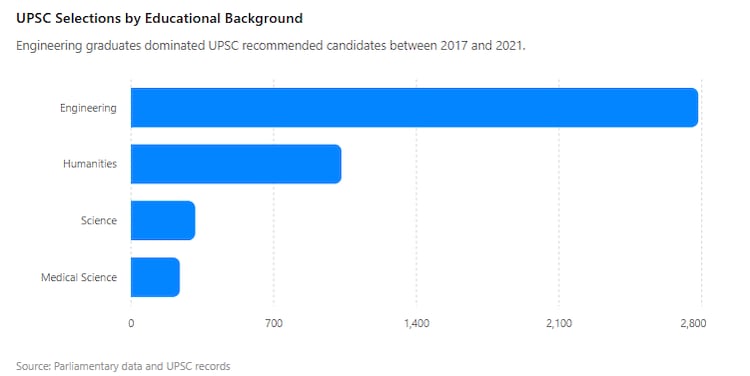
Engineering graduates dominate this ecosystem. UPSC data over multiple years has consistently shown engineers forming the largest educational category among successful candidates.
Between 2017 and 2021, 2,783 out of 4,371 candidates recommended in UPSC Civil Services Examination, nearly 63%, held engineering degrees.
In 2018, IIT Bombay graduate Kanishak Kataria reportedly left a job in South Korea with a package close to Rs 1 crore to prepare for UPSC. He later topped the examination.
IIT Kanpur has historically been cited with a UPSC success rate of around 20.8%.
"Politics may seem like the obvious path to power, but for many educated middle-class Indians, it remains difficult to enter due to money, networks, and entrenched interests." adds Sidhu.
Institutions like the Indian Institutes of Technology regularly produce candidates who move from engineering classrooms to LBSNAA training academies. IIT Delhi, IIT Bombay, and IIT Kanpur alumni frequently appear among toppers and high-rank holders.
Ironically, many of these students come from institutions built originally to strengthen India’s scientific and technological capacity.
Yet the administrative chair often appears more attractive than the laboratory desk.
Former ISRO chairman G. Madhavan Nair had also repeatedly spoken about the challenge of retaining top scientific talent in government research institutions, especially when global private-sector opportunities and elite administrative careers appear more socially rewarding.
Sidhu further focusses on how the civil services route becomes the route to influence. He adds: "Civil services often become an alternative route to influence."
THE 175-YEAR LEGACY
The answer perhaps lies less in economics and more in history.
India may have politically dismantled the British Empire in 1947, but one institution survived almost untouched in spirit — the steel frame of administration once called the Indian Civil Service. The ICS officer under the British Raj was not merely a government employee.
He was the State itself: collector, magistrate, tax authority, district ruler, and imperial representative rolled into one.
The British designed the ICS not for public service in the modern democratic sense, but for control. District administration became an instrument through which a tiny colonial power governed millions.
Independent India renamed it the IAS, wrapped it in constitutional legitimacy and democratic language, but much of the social imagination surrounding it remained intact. The bungalow survived. The convoy survived. The “district sahib” culture survived. Even the public fascination survived.
In many towns across India, an IAS officer still commands a cultural status that scientists, professors, entrepreneurs, and researchers rarely receive. Parents do not distribute sweets because their child joined a semiconductor laboratory. They do it when the child becomes “Collector Sahab”.
The numbers reflect this obsession.
The sociologist Andr Bteille once observed that Indian society continues to retain a deep respect for hierarchy even within democratic structures.
Civil services fit perfectly into that psychology. The bureaucrat occupies a strange space — not elected like a politician, not entirely technical like a scientist, yet socially elevated above both in many settings.
This also explains why UPSC preparation itself has become an industry of aspiration.
Entire neighbourhoods now survive economically on the examination. Places like Mukherjee Nagar and Rajinder Nagar function almost like republics of suspended adulthood. Students spend five, six, sometimes eight years preparing. Families mortgage land. Parents postpone retirement. Coaching centres expand like mini stock exchanges trading in hope.
The Indian bureaucracy therefore sits at an unusual intersection of democracy and monarchy. Officially, the colonial era ended decades ago. Socially, fragments of the durbar still remain.
And perhaps that is what makes the UPSC debate emotionally charged every few years.
Because hidden beneath the language of “nation-building” lies another reality many aspirants quietly understand from the beginning:
In India, there are few examinations that promise not just a job, but entry into the architecture of authority itself.
- Ends