
At Indo-Japan Conclave, why Nayab Singh Saini pitched Haryana as Japan's long-term India base
The Haryana CM stressed that Japanese investment in his state was the outcome of "four decades of trust" and compatibility
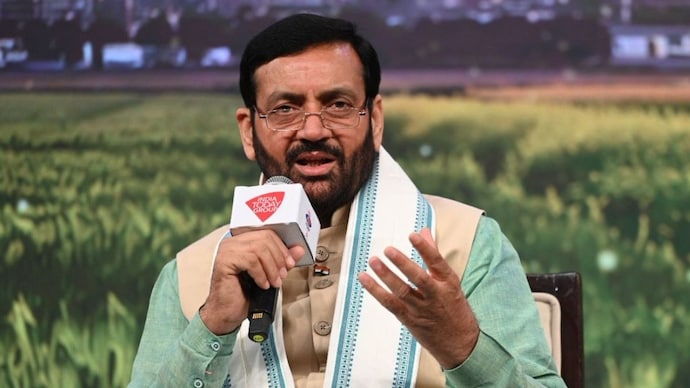

 Haryana chief minister Nayab Singh Saini used his keynote address at the India Today Indo-Japan Conclave in New Delhi on May 22 less as a conventional investment pitch and more as a strategic positioning exercise.
Speaking on the theme ‘Smart States: Haryana Model for Global Partnership’, he argued that in a world increasingly shaped by supply-chain anxieties, geopolitical uncertainty and competition for capital, the next phase of economic growth would depend less on subsidies and more on trust, predictability and institutional responsiveness.
The speech reflected how Indian states are recalibrating their economic narratives in response to global shifts. Haryana, long seen as an industrial extension of the National Capital Region (NCR), is now attempting to brand itself as India’s most mature Japan-ready manufacturing ecosystem. Saini repeatedly stressed that Japanese investment in Haryana was not accidental or incentive-driven but the outcome of “four decades of trust” and cultural compatibility between Japanese industrial practices and Haryana’s manufacturing environment.
That emphasis was significant. As global companies look to diversify supply chains beyond China, India has increasingly projected itself as an alternative manufacturing destination. Within India, however, states are competing fiercely to become preferred gateways for foreign capital. Haryana’s strategy, as outlined by Saini, appears to be to market itself not merely as an investment destination but as a stable operational ecosystem for long-term manufacturing partnerships.
The numbers cited during the address were meant to reinforce that claim. Haryana hosts nearly 394 Japanese industries and more than 600 Japanese business establishments, making it the largest hub for Japanese companies in India. Saini pointed to Gurugram, Manesar, Jhajjar, Bawal and Sonipat as examples of what he described as “India-Japan industrial integration”, rather than isolated industrial clusters.
The speech also attempted to redefine the increasingly overused phrase “Smart State”. Saini argued that smart governance was not about dashboards or digitisation alone, but about anticipating investor concerns, reducing friction and building ecosystems instead of fragmented projects. He described the “Haryana Model” as one based on “responsiveness, reform, reliability and relationships”.
Much of the address focused on logistics and infrastructure, areas where Haryana believes it holds a structural advantage. With two-thirds of the state falling within the NCR, proximity to Delhi, expressways, freight corridors, metro rail networks and airports was presented as central to Haryana’s attractiveness. Saini also highlighted the development of industrial estates, EV ecosystems, electronics clusters and logistics hubs while specifically showcasing the Japanese Industrial Township at METL Jhajjar and a proposed Japanese cluster in Naraingarh.
Importantly, the chief minister sought to signal administrative efficiency. He claimed Haryana had moved beyond “Ease of Doing Business” towards “Speed of Doing Business”, citing reductions in approval timelines through the state’s digital Single Roof Clearance System. The underlying message: investors increasingly value certainty and execution speed over headline policy announcements.
The speech further aligned Haryana with sectors central to current India-Japan economic cooperation—semiconductors, EVs, batteries, robotics, AI and green manufacturing. Saini also placed unusual emphasis on MSMEs, suggesting smaller industrial units could become the next phase of Indo-Japanese collaboration through technology transfer and joint ventures.
Perhaps the most politically calibrated part of the address was the attempt to humanise industrial policy. Saini highlighted Gurugram’s international schools, Japanese restaurants and urban infrastructure to argue that investment ecosystems now depend as much on quality of life as factory infrastructure. The announcement of a dedicated “Sakura Desk” for Japanese investors reinforced this approach of relationship-driven governance.
In essence, Saini’s speech was not merely about attracting Japanese investment. It was Haryana’s attempt to position itself as Japan’s most dependable long-term partner in India’s manufacturing ambitions.
SAINI-SPEAK
- “I have not come here merely to talk about investment. I have come here to talk about trust. A trust that has been built over the last four decades between Haryana and Japan.”
- “Countries and states are no longer competing only on incentives. The competition is now about trust, speed, resilience and partnerships.”
- “For us, a Smart State is one that understands the future in advance, one that listens to investors’ concerns before problems arise.”
- “We are moving from ease to speed, and from speed to predictability. Because investors do not want only approvals—they want certainty.”
- “Haryana is not merely seeking investment. Haryana is inviting you to a partnership.”
Subscribe to India Today Magazine