
Bengal's record voter turnout in phase 1 a democratic tsunami or SIR phobia?
Mamata Banerjee framed it as fear and urgency among voters, the BJP as decisive anti-incumbency. Analysts caution against drawing linear conclusions
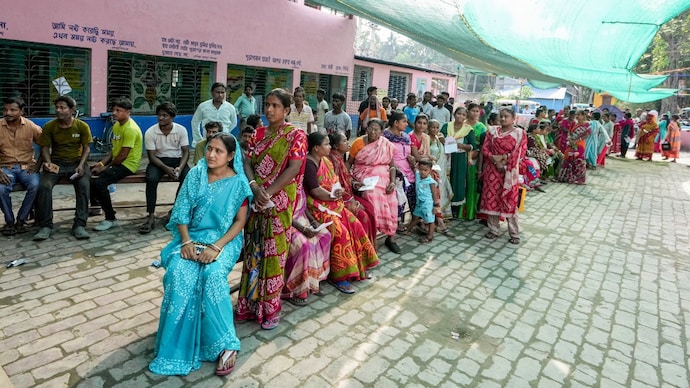


By 9 pm, as the turnout figures for the 152 constituencies that voted settled, even the most experienced of analysts found themselves recalibrating their assumptions. To call it unprecedented would almost understate the scale of what unfolded.
Across large parts of north Bengal, and most strikingly in Murshidabad, voter participation surged to levels that many are now describing as nothing short of a democratic tidal wave. At least 10 constituencies crossed the 96 per cent mark—an extraordinary benchmark in any electoral context, let alone one as politically complex as Bengal’s.
What stands out immediately is the geographical clustering of this surge. Murshidabad, long seen as a politically sensitive and demographically significant district, emerged as the epicentre of this turnout spike. Six of the 10 highest-polling constituencies are located here, suggesting not a random fluctuation but a concentrated and possibly coordinated pattern of voter mobilisation.
Bhagabangola led the pack with an astonishing 96.95 per cent turnout, closely followed by Raghunathganj at 96.81 per cent. The trend continued across Lalbagh, Raninagar, Farakka and Samsherganj, each breaching the 96 per cent threshold. Such uniformity across multiple seats within the same district raises larger questions about the political mood and the intensity of electoral engagement on the ground.
Yet, this is not a Murshidabad story alone. The momentum extends into north Bengal, where constituencies in Cooch Behar and Jalpaiguri recorded similarly high levels of participation. Sitalkuchi and Sitai in Cooch Behar posted turnouts of 96.45 per cent and 96.43 per cent, respectively, while Maynaguri and Harirampur too crossed 96 per cent.
These are not isolated pockets of enthusiasm but part of a broader regional pattern that cuts across districts and social compositions, indicating a deep and widespread electoral churn, say analysts.
Several factors appear to have converged to produce this spike. One of the most immediate explanations was the clean-up of electoral rolls through the Special Intensive Revision (SIR) process. With deceased and duplicate voters removed, the denominator of the voter base effectively shrank, pushing turnout percentages upward even if absolute voting numbers remained constant.
However, this technical explanation alone does not fully capture the scale of participation being witnessed. The consistency of high turnout across multiple constituencies also suggests a behavioural shift among voters.
In districts like Murshidabad, where minority communities form a significant portion of the electorate, the numbers hinted at a heightened sense of political urgency. The turnout suggested that voters were not merely participating but determined to assert their electoral presence decisively. This kind of mobilisation often reflects a perception of stakes being unusually high, whether due to local dynamics, broader political narratives or anxieties about representation and policy direction.
A similar story appears to be unfolding in North Bengal, albeit with a different social underpinning. In constituencies with significant Rajbonshi and Scheduled Caste populations, the surge in turnout points towards an equally strong, if differently motivated, engagement with the electoral process.
This surge triggered sharply competing political interpretations. Trinamool Congress (TMC) chief Mamata Banerjee framed the turnout as a consequence of fear and urgency among voters. “This time, everyone voted since nobody was ready to take any risk as names of countless people have been mercilessly deleted. I want the votes to be counted properly. Everyone is worried about their citizenship due to SIR and NRC (National Register of Citizens,” she said.
The BJP, however, attempted to project the same numbers as evidence of strong anti-incumbency, arguing that such high turnout typically signals a desire for political change.
Experts caution against drawing linear conclusions. While parties will inevitably interpret turnout in ways that suit their narratives, there are indications of a more complex ground reality. Thousands of people are believed to have returned to Bengal specifically to cast their vote amidst fears linked to SIR and the possibility of being deleted from voter rolls if they remained absent. There is also evidence to suggest that individuals who had not participated in previous elections turned up this time, further contributing to the surge.
What makes this moment particularly significant is the convergence of these patterns across distinct regions and demographics. High turnout in one area can often be explained by localised factors, but when similar figures emerge across multiple districts with different socio-political contexts, it points to a larger statewide phenomenon. The first phase of polling, therefore, is not just about impressive numbers; it is about a transformed electoral landscape where participation itself has become a defining feature.
For political parties and strategists, the implications are profound yet uncertain. Both the TMC and BJP are projecting confidence, each claiming that they will secure more than 100 of the 152 seats that went to polls. At a news conference on April 24, Union home minister Amit Shah declared, “We (BJP) have analysed the elections all night. We will get 110 seats out of the 152. I can see a tsunami of change in the state.”
The TMC was quick. Accusing Shah of creating fake narratives, TMC leader Derek O’Brien countered: “Despite a higher turnout in 2026 versus 2021, the total votes cast have actually reduced. The total votes cast in 2021 were 3.10 crores. Total votes cast in 2026 are 3.09 crores. Therefore, total votes cast in 2026 have actually gone down by 83,674 votes The difference between votes cast in 2026 and 2021 is negligible. The higher turnout of 92.7 per cent in 2026 versus 83.98 per cent in 2021 is purely because of reduction in total number of electors after SIR.”
Clearly, the very scale of voter participation that fuels the various claims also complicates them. High turnout does not translate neatly into predictable outcomes, particularly in a state where voting behaviour is shaped by layered identities and shifting alliances.
As analysts pore over booth-level data and attempt to decode patterns, one conclusion is already taking shape. The first phase of the 2026 election has altered the baseline of what is considered normal in Bengal’s electoral politics. Turnout figures touching and exceeding 96 per cent are not just statistical anomalies; they are markers of an electorate that has engaged with the process at an intensity rarely seen before.
Which way this vast and energised vote will ultimately tilt remains difficult to determine. But regardless of the outcome, the scale and nature of participation ensure that this phase will be remembered as a defining moment—one that underscores both the power of the voter and the deep uncertainties shaping Bengal’s political future.
Subscribe to India Today Magazine