
Why Sikkimese director Tribeny Rai's 'Shape of Momo' is a treat on relationships
Rai's film is an authentic portrait of a young woman who refuses to let her standing and opinions be defined and restrained by gender

 All Bishnu wants is to show she can do it all. Lift a gas cylinder. Ensure the family in the orange orchard pays up. Get her elder sister to finish her graduation. Get into a relationship. And not care ‘ki log kya kahenge’.
But patriarchy lurks like a dark shadow in the village to which she has returned after a stint in New Delhi. And women have made peace with their roles and gender dynamics. So when Bishnu behaves like the man of the house, there are clashes with her mother and sister.
For Bishnu’s mom, asserting independence is a way of disbanding from the community; for Bishnu, it is just the natural way to be. For her pregnant sister, there are regrets; for Bishnu, it’s never too late to do what you want.
“I’ll see what kind of a husband a judgemental person likes you gets,” remarks her sister while her mother has had it with her temper and irritable behaviour.
Shape of Momo director Tribeny Rai adeptly balances Bishnu’s stubborn streak and considerate side, and in doing so she presents a fascinating character who prioritises practicality, and who feels guilt but doesn’t let it consume her.
Rai, in her Nepali-language feature directorial debut, presents an authentic portrait of a thirtysomething woman who refuses to let her standing and opinions be defined and restrained by her gender. “I won’t endure. I won’t tolerate,” says Bishnu.
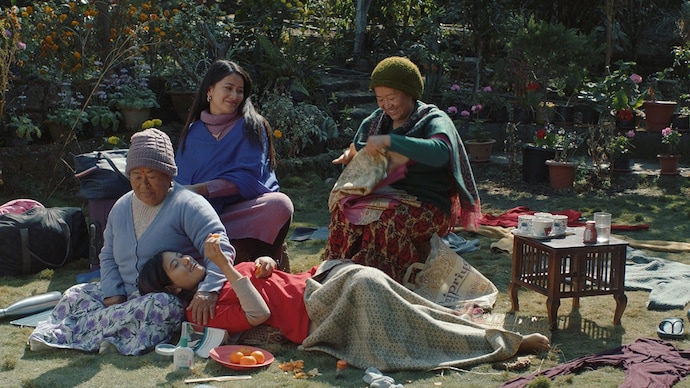
The conflict is more internal as Rai takes viewers into a household of solely women and familiarises them with the characters’ anxieties and complexities. That she does it in such granular detail and understanding shows her strengths in storytelling. There’s tenderness in Rai’s gaze, especially when showcasing the female bond seen in scenes of the women sunbathing in the garden or pulling each other’s legs while savouring momos over dinner.
“I have far better things to do than making pretty-looking momos,” says Bishnu. Rai’s dialogues here are loaded with subtext, offering a peek into the worldviews of the characters. There’s also a perspective on assertion of privilege and outlook of the locals towards outsiders/migrants, thereby exposing the socio-economic disparities.
But it’s in the way Rai weaves the relationship—be it mother-daughter, two sisters, Bishnu and her new boyfriend or most significantly Bishnu the employer and the guy working in her orchard—that Shape of Momo becomes particularly effective.
Nepali actress Gaumaya Gutung settles into Bishnu with effortless ease, channelling both her frustrations and aspirations. The supporting cast playing Bishnu’s mother (Pashupati Rai) and sister (Shyama Shree Sherpa) are natural to the tee.
Sikkim’s landscape, Rai shows, is changing, with the state opening up to tourists. But the opening up of minds is a far more complex process. And women who dare to question the status quo will always find themselves pushed to the edge. The beauty of Shape of Momo is that it doesn’t seek answers; it just asks all the right questions.
Subscribe to India Today Magazine