

SIR had become a fait accompli: Yogendra Yadav on why he skipped court hearing
Yogendra Yadav alleged that the SIR exercise became a "fait accompli" as the Election Commission of India continued rolling out successive phases during the Supreme Court hearing. He further said that, in his view, this effectively amounted to large-scale disenfranchisement of voters and marked a potential erosion of constitutional safeguards.
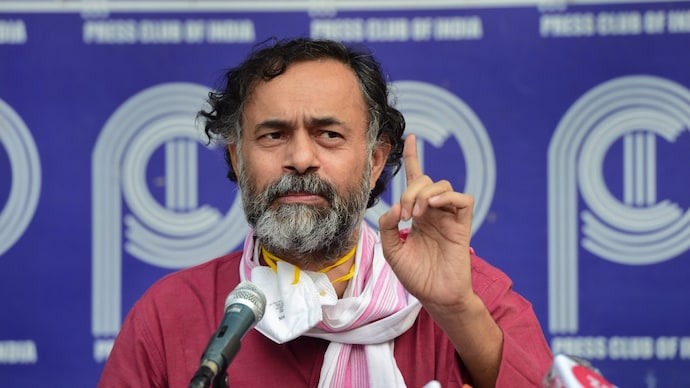


Activist and psephologist Yogendra Yadav, who was a litigant in the Special Intensive Revision (SIR) case before the Supreme Court, said he did not go to the court to hear its final order, adding that in his view the outcome had effectively been settled long ago and only the transcript and fine print remained.
The Supreme Court on Wednesday upheld the poll body’s power to conduct the SIR exercise, saying that it “breathes life” into the democratic process of elections. The verdict came as a boost in the arm after aspersions were cast on the Election Commission, with critics claiming that the massive voter deletions arising from the purification of rolls were politically motivated.
The CJI-led bench also ruled that one’s name being struck off the voter roll is not akin to losing citizenship status. This came amid allegations raised by petitioners that the exercise was being used as a backdoor citizenship exercise.
Pointing to the time when the Supreme Court began hearing the arguments last year, Yadav alleged that after hearing arguments for three days, the court moved away from examining the constitutionality of SIR and instead focused on grievance redressal and arbitration, effectively behaving like a consumer forum rather than a constitutional court. Yadav further claimed that the case was effectively decided when the court allowed the Election Commission of India (ECI) to proceed with the Bihar elections without first adjudicating the core issues or requiring correction of alleged defects in post-SIR rolls.
According to Yadav, once the ECI proceeded with successive phases of SIR while the court continued hearing the matter, the exercise became a “fait accompli,” or an accomplished fact. He also pointed to remarks attributed to the bench, including that voters excluded from rolls could participate in the next election, which he described as marking an abdication of constitutional responsibility. He said that, in effect, the court had authorised large-scale disenfranchisement of voters, calling the moment a potential erosion of constitutional safeguards.
In a separate reaction, senior advocate Prashant Bhushan questioned the timing of the Supreme Court’s judgment on SIR, saying it came “many months after the elections in several states” were already conducted on the basis of what he described as a “totally partisan ECI” and a “non-transparent process.” He further alleged that more than 10 per cent of voters were deleted during the exercise and termed the judgment a “dark day for the judiciary,” calling it the “final nail in the coffin” of concerns raised against the process.