

AAP's mask off, allies should see its real face: Congress after Rajya Sabha exits
The Congress has intensified its attack on the Aam Aadmi Party after Raghav Chadha and six Rajya Sabha MPs exited the party. It says the turmoil has exposed AAP and wants Opposition parties to rethink their ties with it.
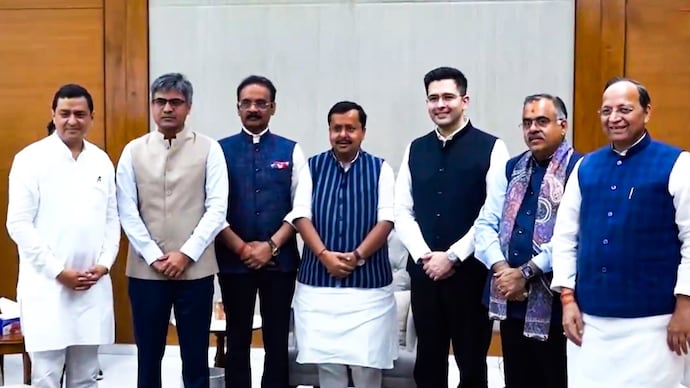


The Congress on Monday mounted a fresh offensive against the Aam Aadmi Party in the wake of the high-profile exit of Raghav Chadha and six other Rajya Sabha MPs, saying the developments have “exposed” the party and raised questions over its role within the Opposition space.
The remarks come at a time when AAP is grappling with internal churn and political setbacks, with the Congress signalling it sees an opening to rebuild its base in states where AAP had eroded its vote share in recent years.
Senior Congress leader Ajay Maken said AAP’s “mask is off”, alleging that the party operates as the “B team” of the BJP. He claimed that further defections could follow in states such as Punjab and Delhi in the coming months.
Maken also took aim at AAP’s governance in Punjab, describing it as evidence of administrative failure. He said that while Congress had aligned with AAP on limited occasions — including post-poll arrangements and the 2024 Lok Sabha elections — the party had repeatedly acted in ways that hurt Congress in direct contests with the BJP.
Citing past elections, he argued that AAP’s expansion in states like Gujarat and Goa had dented Congress’ prospects, pointing to its poor performance in Gujarat in 2022 as an example.
Targeting Arvind Kejriwal, Maken said the AAP leader chose to contest independently in key elections despite broader Opposition coordination efforts. He ruled out the possibility of any future alliance between Congress and AAP, saying such an understanding was unlikely “in the near future or even later”.
The Congress is also seeking to reposition itself within the Opposition by questioning AAP’s credibility as a partner. While AAP is not formally part of the INDIA bloc, it has extended issue-based support on certain matters.
Within the Congress, there is a view that such support has allowed AAP to gain political legitimacy while weakening the party’s own prospects. Leaders are now attempting to project AAP as an unreliable ally in a bid to influence broader Opposition calculations.
AAP’s growing proximity to leaders such as Mamata Banerjee and M K Stalin has added to these concerns, with Congress wary that evolving alignments could reshape Opposition equations ahead of the 2029 general election.
Triggering a major blow to AAP, Raghav Chadha, along with six other Rajya Sabha MPs — Ashok Kumar Mittal, Harbhajan Singh, Sandeep Kumar Pathak, Vikramjit Singh Sahney, Swati Maliwal and Rajinder Gupta — quit the party on April 24 and joined the BJP. All seven are now counted among the BJP’s strength of 113 members in the Upper House.
The mass defection has sharply reduced AAP’s presence in the Rajya Sabha, with only Sanjay Singh, Sant Balbir Singh Seechewal and N D Gupta remaining. Since the number of defecting MPs exceeds the two-thirds threshold, the provisions of the anti-defection law are unlikely to apply in this case.