

Doors shut, details hidden: Census teams face suspicion, silence and heat
Census workers across several states say extreme heat and public hesitation are slowing door-to-door data collection. The exercise is being complicated by privacy fears, low awareness and patchy online self-registration.
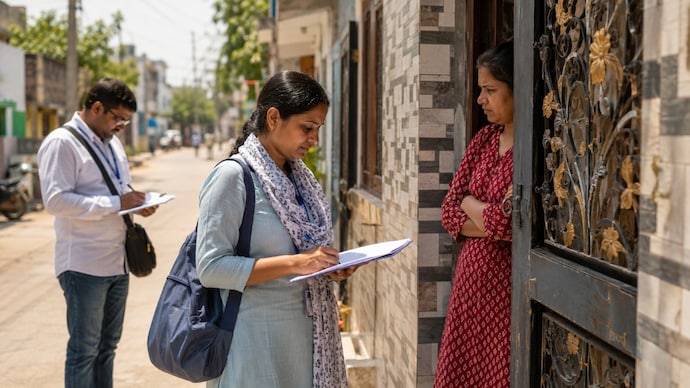


As India pushes ahead with its nationwide census exercise amid an intense summer, the process on the ground is proving far from smooth. From Delhi to Gurugram, Gorakhpur, Chandauli, Punjab, Maharashtra and Bhopal, teachers and government staff engaged in the exercise say extreme heat, lack of awareness and public hesitation over sharing personal information have emerged as the biggest hurdles.
Across several cities, enumerators said residents are refusing to open doors, hiding details about income and property, giving incorrect phone numbers, and questioning why the government needs financial information at all. In many areas, field staff are spending hours outside homes in temperatures crossing 40 to 45 degrees Celsius.
DELHI: FEAR & HESITATION
In the national capital, census workers described widespread hesitation among residents over sharing personal details. Government school teachers assigned to door-to-door surveys in South Delhi's Vasant Kunj area refused to speak on record, but several officials admitted off camera that awareness around the census remained extremely low.
Enumerators said many residents do not allow them inside their homes to avoid answering questions. Even after repeated requests, several households either provide incomplete details or refuse to disclose information related to income and assets.
Workers said the situation is particularly difficult in affluent neighbourhoods, where most residents are away at work during the day and are more reluctant to share financial details. While people generally disclose information about family members, they often avoid answering questions related to movable and immovable assets, making entire days of fieldwork unproductive.
In Delhi's village areas too, the situation has remained tense. Enumerators said some residents reacted angrily when questioned about property and assets, with arguments and confrontations reported in certain localities.
Conditions, however, appeared relatively smoother in slum clusters. Workers said residents there were comparatively more willing to share details, partly because they hoped the census could help them access government welfare schemes in the future.
Several residents who objected to the process said off record that questions related to family size and caste were understandable, but they could not understand why the government needed details about homes, income and assets. Many expressed fears that sharing such information could invite scrutiny from the Income Tax Department or other agencies.
Officials on the ground said the administration first needs to build awareness and address public concerns if the census exercise is to be completed smoothly in the capital.
(Reported by Amardeep Kumar from Delhi.)
KANPUR: TEACHERS OUT ON HOLIDAYS
In Uttar Pradesh's Kanpur, teachers engaged in census work said they have been carrying out field duties despite the summer vacation and extreme heat.
Teacher Sudhanshu, who is part of the exercise, said staff begin work early in the morning and continue till afternoon under harsh sunlight. He said people are initially reluctant to share details related to income, property and family members, especially in rural areas where residents first want to know whether the survey is linked to any government scheme.
According to him, once officials explain that accurate data helps the government frame welfare policies and improve communication during emergencies, people begin cooperating.
He said no deliberate attempts to hide information had surfaced so far, though people routinely ask questions before responding.
The teacher added that gated colonies and apartment complexes in cities usually complete the process at the gate itself, while villagers tend to cooperate more openly and even invite teachers inside their homes.
Officials said identity-related concerns have largely been resolved because enumerators carry government-issued ID cards and appointment letters.
Teams in Kanpur are reportedly leaving for fieldwork around 6.30 am every day and returning by noon to avoid peak heat conditions. Teachers also complained that they had barely received any rest due to continuous government assignments.
Enumerators said digitally aware youth are helping ease the workload by completing self-registration online in advance, with many learning the process through YouTube tutorials and other digital platforms.
(Reported by Simar Chawla from Uttar Pradesh.)
MUMBAI: ASHA WORKERS BATTLE HEAT
In Maharashtra, thousands of ASHA workers have been deployed for the census exercise despite soaring temperatures.
Several workers avoided speaking on camera but shared their experiences anonymously. They said they survey around 10 to 12 households every day, spending nearly three to four hours in the field under harsh sunlight.
An ASHA worker identified only by the surname ‘Patil’ said she alone was responsible for surveying nearly 900 people. She said being a local resident helped build trust among families, though many still hesitated while sharing personal information.
Patil said elderly residents appeared more interested in the process than younger people, and many families offered drinking water to workers amid the heatwave.
Enumerators also reported technical issues with online self-registration. Several forms submitted online reportedly contained errors and had to be corrected manually. Workers added that a large section of the population was still unaware that the census process had begun.
Another worker said some households took hours to complete a single form, while server outages often interrupted the process midway.
Despite the difficulties, workers said most residents were eventually cooperating.
(Reported by Ejaz Khan from Maharashtra.)
GURUGRAM: TEAMS FACE MISTRUST
In Gurugram, teachers and supervisors said they were carrying out surveys in extreme weather conditions while navigating mistrust among residents.
Bhagwan Singh, a teacher assigned to Sarai Alawardi village, said less educated residents and tenants initially viewed census workers with suspicion.
"In the era of digital fraud, people are afraid of sharing personal information," he said, adding that most residents cooperate once the purpose of the exercise is explained.
He said field staff often struggle to find shade while working outdoors for hours.
In affluent areas such as Sector-11, teacher Sapna said many residents do not open doors easily. However, she noted that some households invite enumerators inside and offer water after seeing them work in the heat. She added that educated residents were more likely to complete online self-registration.
Supervisors overseeing the exercise said their teams had been instructed not to intimidate residents while collecting information.
"If teachers themselves get scared of the heat, what will children learn?" one supervisor said, comparing the work ethic expected from teachers to soldiers guarding the country’s borders.
(Reported by Neeraj Vashisht from Haryana.)
GORAKHPUR: VILLAGERS QUESTION INTENT
In Gorakhpur's Mangalpur Bharohiya area, teacher Ajay Kumar Vishwakarma said residents frequently ask why the census is being conducted and what benefit the government derives from it.
He said cooperation has gradually improved after initial resistance. According to him, fieldwork begins at 6.30 am, pauses during peak afternoon heat and resumes around 3 pm.
Enumerators said they had not yet encountered anyone in villages who had completed online self-registration.
Another teacher, Avinash Pandey, said some people still avoid providing complete information, though most cooperate after being convinced.
Arun Kumar said dehydration, sore throats and long walking distances in villages had become major challenges for staff working in the heat.
Teacher Renu Tripathi said villagers generally cooperate, though many hesitate when asked about four-wheelers. She added that being a local teacher helped build trust among residents.
Sanjeev Pandey, working in Gorakhpur city, said people remain uncomfortable disclosing information related to private assets, though they eventually comply after repeated explanations. He added that even in urban areas, online self-registration remained negligible.
(Reported by Gajendra Tripathi from Uttar Pradesh.)
CHANDAULI: VILLAGES COOPERATIVE, COLONIES GUARDED
In eastern Uttar Pradesh's Chandauli district, census workers said villagers were largely cooperating, while residents of newly developed colonies were more guarded.
Sunita Yadav said many residents claimed to have completed online self-enumeration but refused to share the related data when asked.
Another worker, Asha Devi, said villagers freely disclosed details about houses and vehicles, unlike residents in colonies who were reluctant to share personal information.
Supervisor Vikram Srivastava said residents often first questioned the identity of census workers. Trust improved after officials displayed government ID cards equipped with QR scanners that allowed residents to verify their credentials.
(Reported by Uday Gupta from Uttar Pradesh.)
FEROZPUR: FAMILIES HIDING DETAILS
Teachers carrying out census work in Punjab's Ferozepur district said some families were deliberately withholding information.
Gurbhej Singh, posted in the cantonment area, said nearly 80 percent of residents were cooperating, while around 20 percent remained hesitant. He said some households concealed the number of family members living together.
Teacher Seemu, working in police lines, said some residents initially questioned the authenticity of officials before accepting their identity cards.
Gurvinder Kaur said several people objected to questions about property and vehicles, arguing that the census should only collect information about family members. She added that some residents even provided incorrect mobile numbers to avoid follow-up contact.
Geeta Galhotra said fieldwork was often being shifted to evenings because of the heat. She added that government employees and younger residents were showing greater interest in self-registration.
Another teacher, Deep Sikha, said rising crime and fraud had made residents suspicious of outsiders, forcing enumerators to spend extra time explaining the purpose of the exercise.
(Reported by Akshay Kumar from Punjab.)
BHOPAL: DEHYDRATION, FEVER AMONG STAFF
In Madhya Pradesh’s Bhopal, census workers said extreme weather conditions had become the biggest challenge during door-to-door surveys.
Officials said many residents first ask who they are and where they have come from before allowing them to proceed. Enumerators said they rely on official identity cards to build trust.
Several staff members complained of dehydration, fever and weakness while continuing fieldwork in the heat.
Workers said they were covering nearly 80 to 100 households daily. Mobile-based registration was also being used extensively, and officials claimed residents were largely cooperating.
(Reported by Dharmendra Sahu from Madhya Pradesh.)
SONIPAT: FEAR OF LOSING WELFARE BENEFITS
In Haryana's Sonipat, teachers said many families were reluctant to disclose accurate information about income and assets.
Enumerators claimed some residents concealed ownership of four-wheelers and reported having only two-wheelers. Many families feared that revealing higher income or property ownership could lead to cancellation of old-age pensions or BPL ration cards.
Teachers also reported that some residents refused to open doors and viewed census workers suspiciously despite repeated explanations.
Due to the heatwave, staff said they were able to work only around four hours a day and could cover merely 20 to 25 households daily.
(Reported by Pawan Kumar from Haryana.)
PATHANKOT: COOPERATION MIXED WITH HESITATION
In Punjab's Pathankot district, teachers said residents in both urban and rural areas were generally cooperating despite the extreme heat.
Officials said some families still hesitated while sharing private information related to property and assets, though most eventually participated in the survey.
Teachers said they were spending four to five hours daily in the field. They added that online self-registration remained low, forcing most data collection to continue through door-to-door visits.
(Reported by Pawan Singh from Punjab.)