

Policy on B&B was drafted in 2007, Delhi fire horror brings it under scrutiny
A deadly fire at Flourish Stay in Malviya Nagar has turned attention to alleged violations of Delhi's Bed and Breakfast policy. The tragedy has sharpened questions over police checks, civic oversight and long-standing regulatory loopholes.
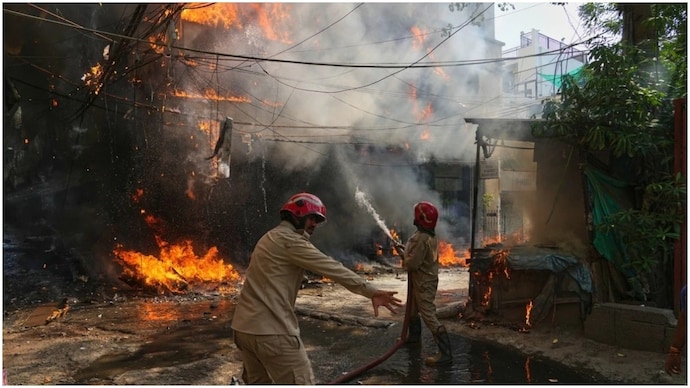


The devastating fire at the Flourish Stay B&B in Delhi's Malviya Nagar, which claimed at least 21 lives, has brought renewed focus on alleged lapses in the Delhi government's "Bed & Breakfast" policy and its implementation.
Delhi's Bed & Breakfast policy was introduced in 2007 and amended several times since. The tragedy has raised questions about the failure of successive administrations to plug loopholes that allegedly enabled the misuse of the policy.
DELHI'S B&B POLICY
Ahead of the 2010 Commonwealth Games, then Union Tourism Minister Ambika Soni proposed the Bed & Breakfast policy in 2006 to augment accommodation capacity in the national capital. The Delhi government enacted the (Incredible India) Bed and Breakfast Establishment Act in 2007 to implement the scheme.
The policy is regulated by the Delhi government's Tourism Department and mandates that a Bed & Breakfast must operate from a residential property. The owner or owners of the property are also required to reside on the premises.
Subsequent amendments tightened ownership norms to curb misuse. Under the rules, the owner must possess at least one government-issued document reflecting the property's address.
A minimum of one room and a maximum of six rooms can be registered under the policy. In addition, rooms designated for Bed & Breakfast operations cannot exceed two-thirds of the total rooms on the property.
The rules were further streamlined during the Arvind Kejriwal government in 2021. Applications for running a B&B were required to be processed within one month instead of the earlier three-month timeline.
Sources told India Today said details of guests are required to be shared with local authorities and Delhi Police. In the case of foreign nationals, Form C/Form III must be submitted as per prescribed norms.
HOW MALVIYA NAGAR B&B FLAUTED RULES
According to sources, Flourish Stay was allegedly being operated as a full-fledged commercial establishment rather than a Bed & Breakfast.
The owner, Lavkesh Bajaj, was not residing at the property with his family, a key requirement under the policy.
Sources alleged that the establishment availed benefits available to residential properties, including domestic rates for electricity and water, as well as lower property tax rates.
Bajaj was reportedly granted permission to operate a maximum of six rooms under the Bed & Breakfast licence. However, sources claimed that as many as 25 rooms were being rented out at the property.
POLICE OVERSIGHT DILUTED AFTER 2025 NOTIFICATION?
Senior police sources said licences for hotels, guest houses and Bed & Breakfast establishments earlier involved verification of both the property and the owner. Applicants with criminal convictions were ineligible.
The verification process also included security checks to ensure that such establishments were not being used as fronts by suspicious elements or foreign nationals. Police scrutiny additionally facilitated coordination among multiple agencies, including the Municipal Corporation of Delhi (MCD).
However, following the 2025 MHA notification, which removed the requirement for police permission for hotels, guest houses and several other establishments, police involvement in the approval process was significantly reduced.
Sources said this diminished the level of scrutiny that such establishments were previously subjected to.
INSTITUTIONAL FAILURES UNDER SCRUTINY
The tragedy has raised several uncomfortable questions for civic authorities.
1) How did the MCD fail to detect that the owner was not residing at the property, despite this being a mandatory condition under the policy?
2) Did the operation of 25 rooms under a licence permitting only six not trigger any red flags?
3) If the property was functioning as a commercial establishment, did the corresponding rise in electricity and utility consumption not attract scrutiny?
The incident has also brought attention to the failure of successive governments — Congress, AAP and BJP — to address loopholes that allegedly enabled the misuse of the Bed & Breakfast policy and allowed hotel-like establishments to proliferate in areas such as Hauz Rani and other parts of the city.