


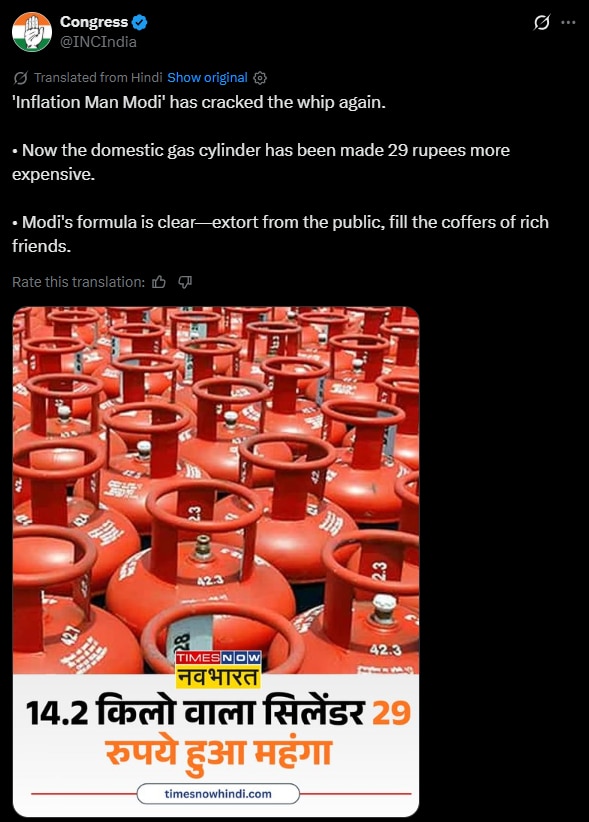
LPG cylinder price hiked by Rs 29; Congress revives 'inflation man' attack on PM
Cooking gas has become more expensive again, but the government says consumers are still paying hundreds of rupees less than the actual cost. Why are oil companies absorbing massive losses, and what role has the West Asia conflict played?
The increase takes the price of a 14.2-kg domestic LPG cylinder in Delhi to Rs 942 from Rs 913.
Domestic cooking gas prices in India have been increased by Rs 29 per cylinder from today, the second revision in three months, as state-owned oil marketing companies struggle to absorb soaring global energy costs linked to the continuing conflict in West Asia.
The increase takes the price of a 14.2-kg domestic LPG cylinder in Delhi to Rs 942 from Rs 913. The latest revision follows a Rs 60 increase announced on March 7 after disruptions in West Asia sent international fuel prices sharply higher.
The development has reignited the political battle over inflation, with the Congress accusing the Narendra Modi government of burdening households already grappling with rising living costs, while the Centre argues that consumers continue to be shielded from the full impact of the global energy shock.
CONGRESS TARGETS CENTRE OVER PRICE RISE
Soon after the increase was announced, the Congress launched a fresh attack on the government.
In a post on X, the party said, "'Inflation Man Modi' has cracked the whip again. Now the domestic gas cylinder has been made 29 rupees more expensive. Modi's formula is clear, extort from the public, fill the coffers of rich friends."
Punjab Congress chief Amarinder Singh Raja Warring also criticised the increase, posting, "This time, the LPG cylinder will cross Rs 1,000. Every family is suffering under inflation. Are these the 'achhe din' promised by the Modi government?"
Reacting to the latest LPG price hike, Haryana Leader of Opposition Bhupinder Singh Hooda accused the BJP government of continuously burdening citizens through repeated increases in fuel and cooking gas prices. He said the recent Rs 29 increase in domestic LPG cylinder prices, following a Rs 42 hike in commercial cylinders, has added further strain on household budgets. Hooda claimed that domestic LPG prices have risen by Rs 89 in the last three months, while commercial cylinder rates have increased by over Rs 1,500 over time. He alleged that consumers are also facing higher prices of petrol, diesel, CNG and smaller gas cylinders despite a decline in global crude oil prices. The Congress leader blamed higher taxes for rising fuel costs and said inflation has increased the prices of essential commodities and agricultural inputs. He urged the government to reduce fuel taxes and take effective measures to control inflation and provide relief to citizens.
The latest increase comes at a time when fuel prices have emerged as a key political issue, with Opposition parties accusing the Centre of failing to provide relief from inflation despite repeated increases in cooking gas and transport fuel prices.
CENTRE DEFENDS LPG PRICE INCREASE
Responding to criticism over the latest increase, the government said Indian households continue to pay among the lowest cooking gas prices in the world despite a sharp rise in international LPG prices following the West Asia conflict.
According to the Petroleum Ministry, the cost of supplying a 14.2-kg LPG cylinder has risen to more than Rs 1,600, while a general consumer in Delhi will pay Rs 942 after the latest revision.
The government said beneficiaries of the Pradhan Mantri Ujjwala Yojana will continue to receive a direct benefit transfer of Rs 300 on the first four refills every year, reducing their effective cost to Rs 642 per cylinder.
"Even a non-PMUY household would pay about Rs 700 below the market-linked cost of the cylinder," the ministry said.
The Centre argued that the increase reflects only a small portion of the actual rise in global costs. It said the Saudi Contract Price for LPG, a key international benchmark, has climbed about 46 per cent since February after disruptions around the Strait of Hormuz tightened supplies from the Gulf.
The ministry also maintained that state-owned oil marketing companies continue to absorb losses of around Rs 700 on every domestic cylinder sold.
WHY LPG PRICES ARE RISING
The government has linked the increase directly to a sharp rise in international LPG prices following disruptions in West Asia.
India imports more than 60 per cent of the LPG it consumes. The landed cost of those imports is linked to the Saudi Contract Price, a benchmark fixed every month by Saudi Aramco.
According to government figures, the Saudi Contract Price for LPG stood at about $522 per tonne in January before the disruption in West Asia. By April, after the Strait of Hormuz crisis tightened supplies from the Gulf, the benchmark had risen to $775 per tonne, an increase of almost 50 per cent.
The Petroleum Ministry said the cost of supplying a domestic 14.2-kg LPG cylinder has now climbed to around Rs 1,600.
Even after the latest increase, a general consumer in Delhi will pay Rs 942, while a beneficiary under the Pradhan Mantri Ujjwala Yojana will pay an effective Rs 642 after receiving a direct benefit transfer of Rs 300 per cylinder.
"The effective Ujjwala price of Rs 642 is at a discount of about 60% to the actual international price of an LPG cylinder," the government said.
MASSIVE LOSSES FOR OIL COMPANIES
The Centre argued that the latest increase covers only a small portion of the losses currently being borne by state-owned fuel retailers.
According to official estimates, oil marketing companies continue to absorb losses of between Rs 600 and Rs 700 on every domestic LPG cylinder sold.
Industry estimates before the latest revision had placed losses at around Rs 703 per cylinder.
The Petroleum Ministry said the under-recovery on domestic LPG is expected to rise to around Rs 60,000 crore in 2025-26, compared with Rs 41,338 crore in the previous financial year.
To offset part of the burden, the Union Cabinet has approved compensation of Rs 30,000 crore for oil marketing companies.
The subsidy programme for more than 10.35 crore Ujjwala beneficiaries will continue unchanged, with each household receiving Rs 300 per cylinder through direct benefit transfer.
WIDER FUEL PRICE PRESSURES
The increase in LPG prices comes amid a broader rise in fuel costs.
Petrol and diesel prices have increased by a cumulative Rs 7.50 per litre since mid-May, while CNG prices have risen by around Rs 6 per kg.
Industry estimates suggest oil companies continue to incur losses of around Rs 11 per litre on petrol and Rs 33.6 per litre on diesel despite recent increases.
The government has maintained that it has deliberately avoided passing on the full impact of higher international energy prices to consumers.
- Ends
With inputs from PTI