

Why F-16 fighter jets escorted PM Modi's aircraft in UAE
UAE F-16 fighter jets escorted Prime Minister Narendra Modi's Air India One as it entered the country's airspace on Friday. The gesture highlighted the close ties between Delhi and Abu Dhabi.


As Prime Minister Narendra Modi's Air India One entered the UAE airspace on Friday, a special gesture awaited him. Symbolic of the close ties between Delhi and Abu Dhabi, UAE F-16 fighter jets were seen escorting PM Modi's aircraft. The same F-16 Block 60 'Desert Falcon' fighters, operated by the UAE Air Force, were recently seen in action as they took down drones and projectiles fired by Iran during its conflict with the US and Israel.
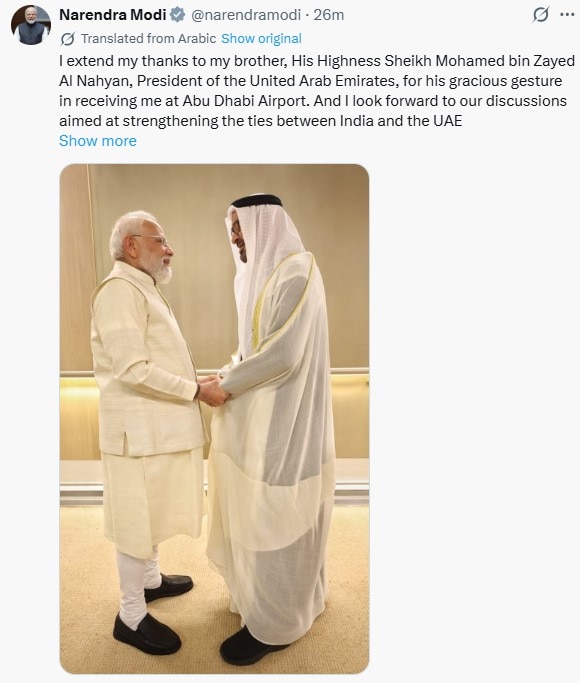
UAE, which has been embroiled in the Middle East conflict, was PM Modi's first stop in his five-nation tour. As PM Modi's Air India One entered the UAE airspace, two F-16 jets were seen accompanying the aircraft as it landed in Abu Dhabi. At the airport, PM Modi was given a ceremonial welcome before he sat down with UAE President Mohamed bin Zayed Al Nahyan (MBZ) for a bilateral meeting.
"It is a reflection of the deep strategic partnership, trust, and personal warmth shared between the leadership of India and the UAE," BJP IT Cell chief Amit Malviya tweeted. The BJP said the gesture underscored the profound global respect and strengthening of ties between the nations.
PM MODI VISITS UAE AMID MIDDLE EAST CONFLICT
PM Modi's eighth visit to the UAE comes at a time when Abu Dhabi has been in the thick of the ongoing Iran war. The UAE has faced over 2,500 drones and missiles from Iran, most of which have been intercepted.
During his meeting with MBZ, the Prime Minister thanked him for the special gesture and called the UAE his "second home". In fact, the UAE is home to over 4 million Indians, the largest number among the Gulf countries.
"Your Air Force jets escorted me today. This is an honour to the people of India," PM Modi said during his brief stopover. The Prime Minister also underlined that the manner in which the UAE was targeted was "unacceptable".
"India stands shoulder to shoulder with the UAE in every situation," PM Modi said.
Much of the discussion between the two sides centred on energy cooperation. The prolonged closure of the Strait of Hormuz, the global energy chokepoint, by Iran has led to a crucial shortage of oil, LNG and LPG supplies. India, which imports almost 85% of its oil, has faced the brunt of the Middle East conflict.
Despite it being just a brief stopover, India secured big returns from the UAE, including an agreement on supplies of LPG (mainly used as cooking gas). It is significant as India has been reeling from an LPG crunch for about a month now.
Other agreements include a framework for a strategic defence partnership and an investment worth $ 5 billion in Indian infrastructure. Two MoUs were also signed on strategic petroleum reserves and on setting up a ship repair cluster at Vadinar in Gujarat.
The timing of the agreements, especially the one on defence, is crucial. It was just three months ago that MBZ made a three-hour standalone visit to India in January.
The hush-hush visit came months after Saudi Arabia and Pakistan signed a NATO-style defence pact. On the other hand, the UAE's ties with both Saudi Arabia and Pakistan have been tense.
Last month, the UAE asked Pakistan to return a $ 3.5 billion loan amid Islamabad's deepening ties with Saudi Arabia. The UAE also walked out of OPEC and OPEC+ over differences with Saudi Arabia.
It is against this backdrop that PM Modi's visit to the UAE assumes significance. From the UAE, the Prime Minister will travel to the Netherlands, Sweden, Norway and Italy.