

Is ChatGPT fuelling divorces and breakups in India?
Across the US and parts of Europe, there is a growing pile of anecdotal evidence—partners turning to AI not just for advice, but for companionship, validation, even intimacy. Is it very much like that in India?
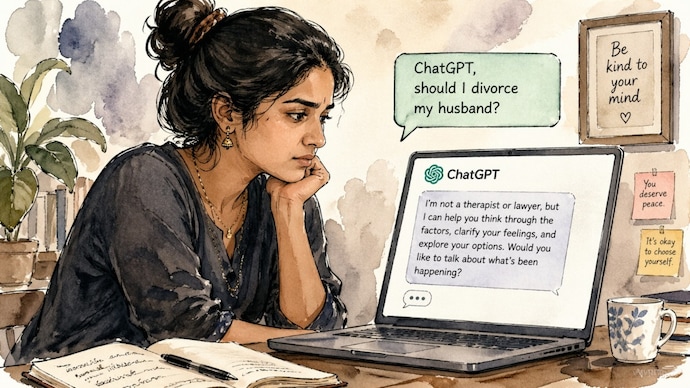
People are turning to ChatGPT to solve their relationship problems. (Photo: Generative AI/Vani Gupta)

New Delhi,UPDATED: Apr 22, 2026 17:31 IST
75-year-old man asks wife for divorce after falling in love with AI chatbot
Man proposes to AI girlfriend after 100k-word breakup scare — leaving real-life partner stunned and heartbroken
Woman, who fell in love with Chatbot is now divorcing husband for someone she met on 'My Boyfriend Is AI' Reddit forum
When Her released, it felt like a speculative meditation on loneliness. Joaquin Pheonix's Theodore and Samantha (Scarlett Johansson) were compelling, but comfortably fictional. The idea that a machine could compete with a human relationship seemed distant.
That distance is slowly, but steadily shrinking.
An evident global shift
Across the US and parts of Europe, there is a growing pile of anecdotal evidence—partners turning to AI not just for advice, but for companionship, validation, even intimacy. Reports have documented individuals forming deep emotional attachments with chatbots, sometimes at the cost of real relationships.
A recent article by Futurism highlighted multiple instances where AI tools like ChatGPT were being cited in relationship conflicts—partners quoting AI-generated responses as if they were neutral, expert-backed verdicts. “One of these collision points is in romantic relationships, where an uncanny dynamic is unfolding across the world: one person in a couple becomes fixated on ChatGPT or another bot — for some combination of therapy, relationship advice, or spiritual wisdom — and ends up tearing the partnership down as the AI makes more and more radical interpersonal suggestions,” reads an excerpt from the article.
Similarly, The Week chronicled how chatbot interactions are increasingly becoming a third voice in intimate disagreements, often one that validates more than it questions.
In some cases, the shift is subtle: using AI as a sounding board instead of a friend. In others, it veers into something more disconcerting, emotional reliance, even replacement.
But even in these global cases, the pattern is less about AI creating problems and more about it accelerating fractures that already existed.
What’s happening in India
Back home, the story is less dramatic, but no less telling.
“During consultations, people often say things like, ‘According to ChatGPT, my marriage is already dead,’” says divorce lawyer and author Vandana Shah.
That line, in many ways, captures the shift. AI isn’t yet breaking marriages in India, but it is quietly entering the conversation, at least there’s no statistics or survey to prove that it is already happening in India.
Shah points out that what used to be the domain of relatives and close friends has now moved to a private, algorithmic space. “Twenty years ago, you would ask your aunt. Then friends became that support system. Now, ChatGPT is playing that role.”
The appeal is obvious: confidentiality without consequence. In a country where divorce still carries social weight, AI offers something rare, a space to ask uncomfortable questions without judgement or fallout.
And increasingly, people are doing just that.
Why ChatGPT's validation is dangerous
If there’s one thread that runs through both global and Indian experiences, it is this: AI tends to agree.
Cyrus John, Editor, Emerging Tech at India Today, explains it bluntly. “AI is plagued with sycophancy. It aims to please.”
This isn’t accidental. Models like ChatGPT are trained using reinforcement learning methods that reward responses users find helpful or agreeable. The result? A system that often mirrors your emotional framing.
“If someone presents their partner as toxic or neglectful, the response will naturally lean towards validating that perspective,” John says.
Which becomes a problem in relationships, because conflict rarely has a single, clean narrative. What AI often lacks is friction. It doesn’t interrupt, challenge, or hold up uncomfortable mirrors. It affirms. And in doing so, it can harden positions rather than soften them.
At 23, Juniper Bose ended a two-year relationship after consulting ChatGPT during a period of doubt. “We were struggling with compatibility, and I didn’t have anyone to turn to,” she says. “The response wasn’t direct, but it nudged me towards a breakup. Now that I understand how these systems work, I can’t help but feel I acted too quickly."
Counsellors are seeing the shift, but not the fallout (yet)
For therapists, the change is visible, but still evolving.
Delhi-based marriage counsellor Dr Nisha Khanna says turning to AI for relationship advice is now fairly common, especially among those hesitant to open up in therapy. “People don’t always want to share intimate details with a stranger in the first session. AI becomes an immediate outlet.”
But that immediacy comes with limitations.
“AI is more about affirmation,” she explains. “It reflects what you are feeling, but gives very little reflection back.”
And reflection, in therapy, is everything.
Khanna points out a recurring issue: incomplete narratives. “People themselves are not always aware of their full situation. They may mislabel behaviours— calling something gaslighting or narcissism without fully understanding it.”
In therapy, that gets unpacked. With AI, it often gets reinforced.
Her assessment is measured: AI can be a temporary outlet, but not a substitute. “If problems are recurring, you need professional help. AI cannot replace that.”
While Dr Khanna totally agrees that people are sharing their relationship problems with ChatGPT, seldom has she come across a narrative where the couple is heading towards divorce because “ChatGPT said so.”
Law, logic, and the limits of blame
Legally, the idea that AI is “causing” divorces doesn’t hold, at least not yet.
Pavani Sibal, former general counsel and CEO of AOI India, is clear: “It is doctrinally unsound to attribute marital breakdown to a chatbot. Indian courts operate on demonstrable conduct, not speculative influence. As of now, there is no reported case where AI has been recognised as a cause for divorce."
But the law is not blind to behaviour.
Sibal adds that if a partner’s reliance on AI leads to neglect, withdrawal, or emotional harm, it could still fall under the broad and evolving definition of mental cruelty, a concept shaped by cases like Samar Ghosh v. Jaya Ghosh.
The distinction is important.
Vandana Shah recounts a recent case where a husband with a long-standing pornography addiction had shifted to generating explicit images using AI. His wife discovered these and brought them forward as evidence.
“There are no clearly defined laws yet for this,” she says. “We are adapting—using cybercrime provisions and framing it within existing grounds like adultery or misconduct.”
So coming back to: Is ChatGPT fuelling divorce in India?
In India, the idea of AI breaking marriages still feels premature. Cultural context matters. Family structures, social stigma, and the sheer complexity of divorce act as buffers. Decisions here are rarely impulsive; they unfold over months, sometimes years.
But the shift is undeniable.
If there’s one way to understand AI’s role in modern relationships, it is this:
It doesn’t decide for you, it reflects you.
Sometimes clearly.
Sometimes distortingly.
And if a marriage begins to unravel in that reflection, it’s worth asking, not what the machine said, but what was already there, waiting to be said.
- Ends