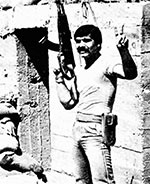
Palestinians train for a prolonged struggle
The PLO has come a long way since the founding congress of the organisation in Jerusalem in 1964, under the leadership of Ahmed Shuquairi. Once condemned as the fountainhead of terrorism in the Middle East, the PLO has won acceptance as the legitimate spokesman for the Palestinians.

ISSUE DATE: Nov 15, 1981 | UPDATED: Oct 30, 2014 13:49 IST


The PLO has come a long way since the founding congress of the organisation in Jerusalem in 1964, under the leadership of Ahmed Shuquairi. Once condemned as the fountainhead of terrorism in the Middle East, the PLO has won acceptance as the legitimate spokesman for the Palestinians. Says Abu Khaldoum, a guerrilla leader based in South Lebanon: "The circumstances of dispersion in so many countries prevented the Palestinians from becoming a socially homogeneous people. The PLO helped to change them from refugees into citizens with a cause." The dramatic appearance of PLO Chairman Yasser Arafat at the United Nations in 1974 resulted in recognition being granted to the organisation and ensured that any Middle East peace settlement could only be concluded after the Palestinian problem had been solved.
The Palestinians assert that any Middle East peace settlement must provide for a separate homeland-Arafat had condemned Sadat as a traitor because the Camp David accords of 1978, concluded between Sadat and Begin with former United States president Jimmy Carter looking on benignly, referred only vaguely to "the resolution of the Palestinian problem in all its aspects ".
For the same reason the PLO refuses to accept Security Council Resolution No. 242, which guarantees the rights of all states in the Middle East, including Israel, to live in peace. Acceptance of the resolution would be a tacit acknowledgement of Israel's right to exist. But, complains Arafat: "The resolution refers to the Palestinians as refugees, with no mention of any right to a homeland."
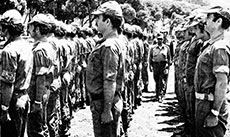
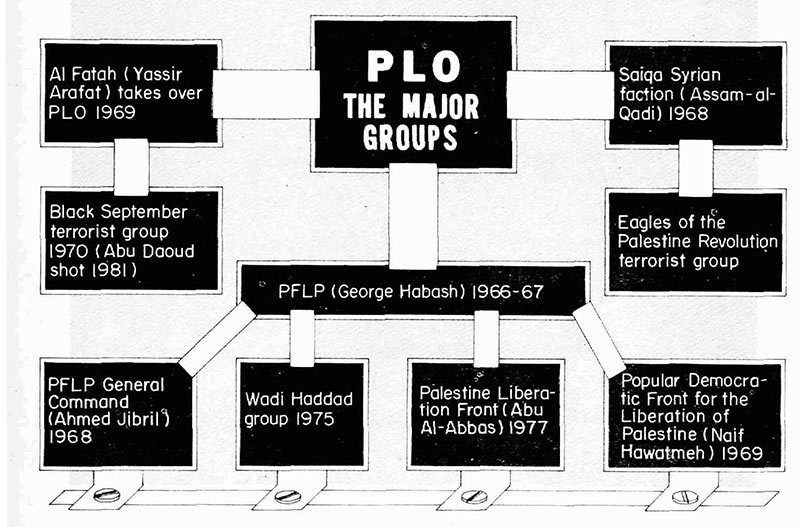
A plethora of unions and departments is controlled by the Executive Commit fee, but the limbs that hit the headlines most often are the military-the Palestine Liberation Army (PLA) and resistance setups ranging from the 'Fatah' movement and the Popular Front For The Liberation Of Palestine PFLP to thePalestine Popular Struggle Front (PPSF).
Of the four million exiles, 47,000 are grouped in the PLA, 12,000 belong to militia units, and 35,000 are trained as commandos and operate all over south Lebanon. 'Fatah,' which answers to Arafat, controls 80 per cent of these, with Dr George Habash's Leftist PFLP second in line.
That the PLO lays great store by its war machine is evident from the fact that the major share of the budget, which reportedly runs into millions of dollars, is used to buy arms and fuel the war effort directed against the Israelis. Recently, Correspondent Asoka Raina took a close look at two training camps in south Lebanon, where patriotic recruits are moulded into fervent guerrillas. His report:
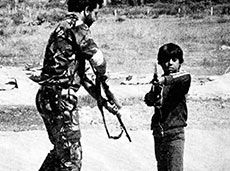
This nerve-racking but very effective test was just one of several that the boy, and a dozen other recruits watching him, would be subjected to in the coming weeks. The recruits would be learning their profession only 20 km from the border. The camp was built in the form of a 'T,' with barracks running along well-paved lanes. Along the perimeter, anti-aircraft guns reared their barrels into the sky, and not far away the warm waters of the Mediterranean Sea were ruffled by the wind.
In the air a few kilometres away Israeli Air Force F-16 reconnaissance aircraft hunted for the guerrillas, while PLO ack-ack stammered in response, manoeuvres such as bounding down a track onto a springboard made out of truck tires, leaping up into a perfect somersault, landing upright and shooting. After a few days, the fledgling guerrillas would be able to strip weapons and put them back together blindfolded, carry out simulated attacks on well-entrenched positions, learn to move with the quick reflexes which are the difference between life and death in a merciless land.
The girls also joined the boys during unarmed combat, and during the cross-country exercises, when the guerrillas, dressed in unisex battle-fatigues, crawled, stumbled, and ran over a rugged obstacle course to come to grips with an imaginary enemy.
The Israelis, ironically, often helped with the training: the camp and its inhabitants saw bombs drop every day, and Israeli attacks had once destroyed the camp partially. This contact with murderous reality was part of the toughening up process; as the camp commandant said: "The Palestinians now know what the Israeli bombs can do; now they are not afraid." Also, the training grounds were shifted to from place to place, when the Israeli artillery found their range, adding to the excitement.
The period of training varies-for the militia it is six months, for the regulars of the PLA it is two years of comprehensive instruction. Then the young men and women joined the veterans already manning the forward posts close to the border or the miltia patrols roaming the villages and towns of south Lebanon in Toyota trucks fixed with anti-aircraft recoilless guns.