
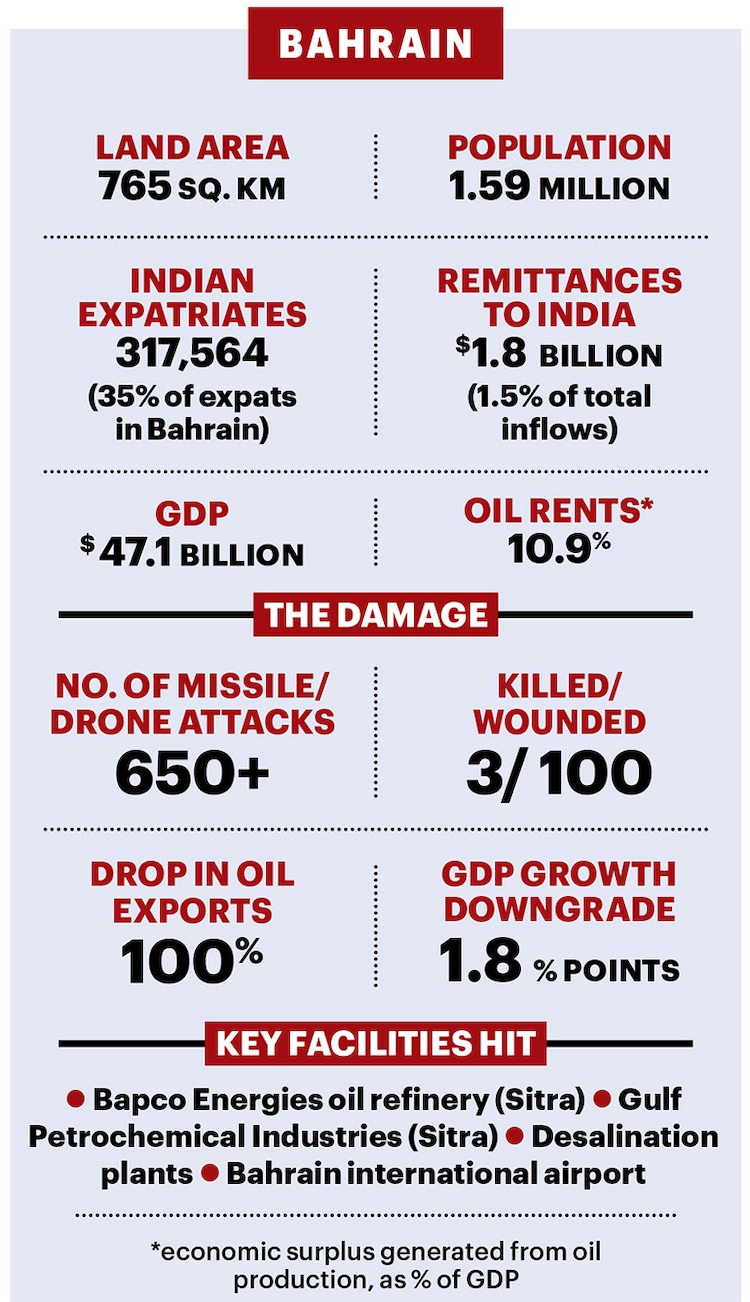
View from Bahrain | The capital damage
With risks exposed, investment flows, tourism and consumer confidence may come under strain even as fintech initiatives and a resilient industrial base are likely to drive recovery
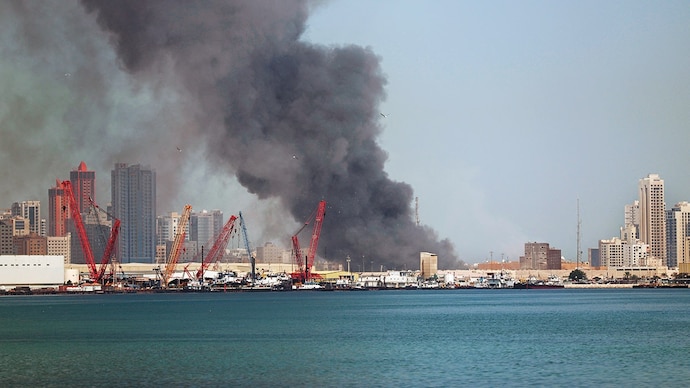
EYE OF THE STORM: Smoke rises after Iran carried out a missile strike on the US 5th Fleet headquarters in Manama, Feb. 28. (Photo: AFP)

ISSUE DATE: Apr 20, 2026 | UPDATED: Apr 14, 2026 15:03 IST
The Arabian Gulf has just emerged from one of its most precarious phases in decades, following a fragile ceasefire that has paused a dangerous cycle of escalation involving the US, Israel and Iran. While the guns have fallen temporarily silent, the realities of modern warfare have already left a deep imprint—bringing the consequences of conflict uncomfortably close to civilian life in countries long perceived as relatively insulated from direct confrontation. Bahrain is one such country, now navigating a complex mix of residual security concerns and longer-term economic uncertainty.
The announcement of a ceasefire has provided immediate relief. Yet, it does not erase the structural vulnerabilities exposed during the recent period of escalation. In Bahrain, as in parts of the wider Gulf, missile and drone activity extended beyond strictly military contexts. Even when unintended, the proximity of strikes to civilian zones, transport corridors and energy-related infrastructure created a climate of heightened anxiety. Residents adapted to alerts, disrupted routines and the psychological weight of living under the shadow of uncertainty.
From an economic standpoint, the impact of the recent conflict has been both tangible and anticipatory. Bahrain’s economy, which had been gradually recovering from the aftershocks of the COVID-19 pandemic while managing structural fiscal challenges, now faces renewed pressure. Growth projections have been revised downward as uncertainty weighed on investment flows, tourism and consumer confidence.
The tourism and hospitality sector has been among the hardest hit. Bahrain’s position as a regional destination—particularly for short-stay visitors from neighbouring countries—suffered as travel advisories and security concerns deterred movement. Hotels, restaurants and entertainment venues reported noticeable declines in activity. Similarly, logistics and transport experienced disruptions. The Gulf’s tightly interconnected maritime and air routes remain highly sensitive to instability. Even limited threats to shipping lanes or airspace led to rerouting, higher insurance premiums and delays. For Bahrain, whose economy relies significantly on its role as a regional hub, these disruptions carried both immediate costs and reputational risks.
The financial sector, a cornerstone of Bahrain’s economy, has demonstrated resilience but not immunity. While the Kingdom’s regulatory framework and institutional depth provide a degree of insulation, prolonged instability inevitably dampens investor sentiment. Capital tends to gravitate toward predictability, and in times of uncertainty, even fundamentally strong financial systems must contend with cautious market behaviour.
THE ROAD TO RECOVERY
Yet it would be incomplete to view the situation solely through the lens of vulnerability. Bahrain has, over the past decades, cultivated a notable degree of economic adaptability. The Kingdom’s experience in managing fiscal pressures, diversifying its economic base and leveraging regional partnerships may well prove to be critical assets in navigating the aftermath of the conflict.
Certain sectors are likely to demonstrate a capacity for recovery as stability gradually returns. Financial services, fintech and digital economy initiatives—areas where Bahrain has invested strategically—are less dependent on physical mobility and may rebound more quickly. Likewise, industrial sectors such as aluminium production, integrated into global supply chains, may experience temporary disruption but retain strong long-term fundamentals. The ceasefire, while fragile, opens a critical window for economic recalibration. For Bahrain, this is not merely a moment of recovery but also an opportunity to accelerate structural reforms and reposition itself within a post-conflict regional economy. Efforts to diversify revenue streams, enhance energy security and invest in resilient infrastructure are likely to gain renewed urgency.
An essential dimension of Bahrain’s socio-economic fabric—one that cannot be overlooked—is the presence of a large and dynamic expatriate workforce, including a significant Indian community. Indian nationals have long played a vital role in Bahrain’s development, contributing across sectors ranging from construction and services to healthcare and finance. The recent conflict has inevitably affected this community. However, Bahrain’s longstanding commitment to social stability and the rule of law helped mitigate the risks of large-scale disruption. Efforts to maintain essential services and economic continuity provided a degree of reassurance to expatriate populations.
The India–Bahrain relationship, built over centuries of trade, cultural exchange and people-to-people ties, remains a stabilising factor. Bilateral trade, while affected in the short term by logistical challenges, is underpinned by strong structural complementarities.
Looking ahead, the central question is not whether Bahrain will recover, but how it will position itself in the aftermath of the conflict. The trajectory will depend on several variables: the durability of the ceasefire, the broader regional security environment and the effectiveness of domestic policy responses.
There is reason for cautious optimism. Bahrain is not facing this challenge in isolation. As a member of the Gulf Cooperation Council (GCC), it benefits from a network of economic and political support that has historically played a crucial role in maintaining regional stability. Collective approaches to security and economic coordination may once again prove decisive.
At the same time, the lessons of the recent crisis are likely to shape future policy thinking. The need to balance openness with resilience, integration with self-reliance, and growth with stability will become more pronounced. For Bahrain, this balancing act is not new, but it has now acquired renewed urgency.
The ceasefire marks not an end, but a transition. The real test for Bahrain—and the wider Gulf—lies in how this pause is used: whether as a temporary relief before another cycle of tension, or as a foundation for a more stable and economically resilient future.
—Abdulnabi Alshoala is Chairman, Dar Al Bilad for Press Publishing and Distribution, and a former Cabinet Minister of State, Kingdom of Bahrain
- Ends