
View from Kuwait | Wanted: A new security architecture
Bader Mousa Al-Saif, Professor of History at Kuwait University and Fellow at Chatham House (UK) and the Arab Gulf States Institute (US) and previously deputy chief of staff to a former PM of Kuwait, speaks to India Today on how the Iran war has impacted Kuwait
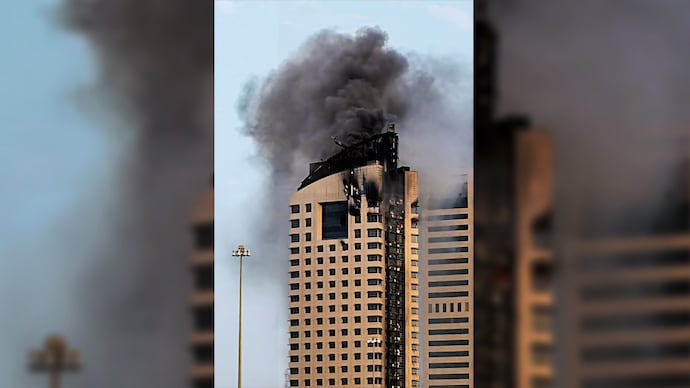
PLUMES OF WORRY: A highrise building hit in a drone attack in Kuwait City, Mar. 8. (Photo: AFP)

ISSUE DATE: Apr 20, 2026 | UPDATED: Apr 14, 2026 15:03 IST
Q. How serious has the impact of the Iran conflict been on Kuwait and the Gulf so far?
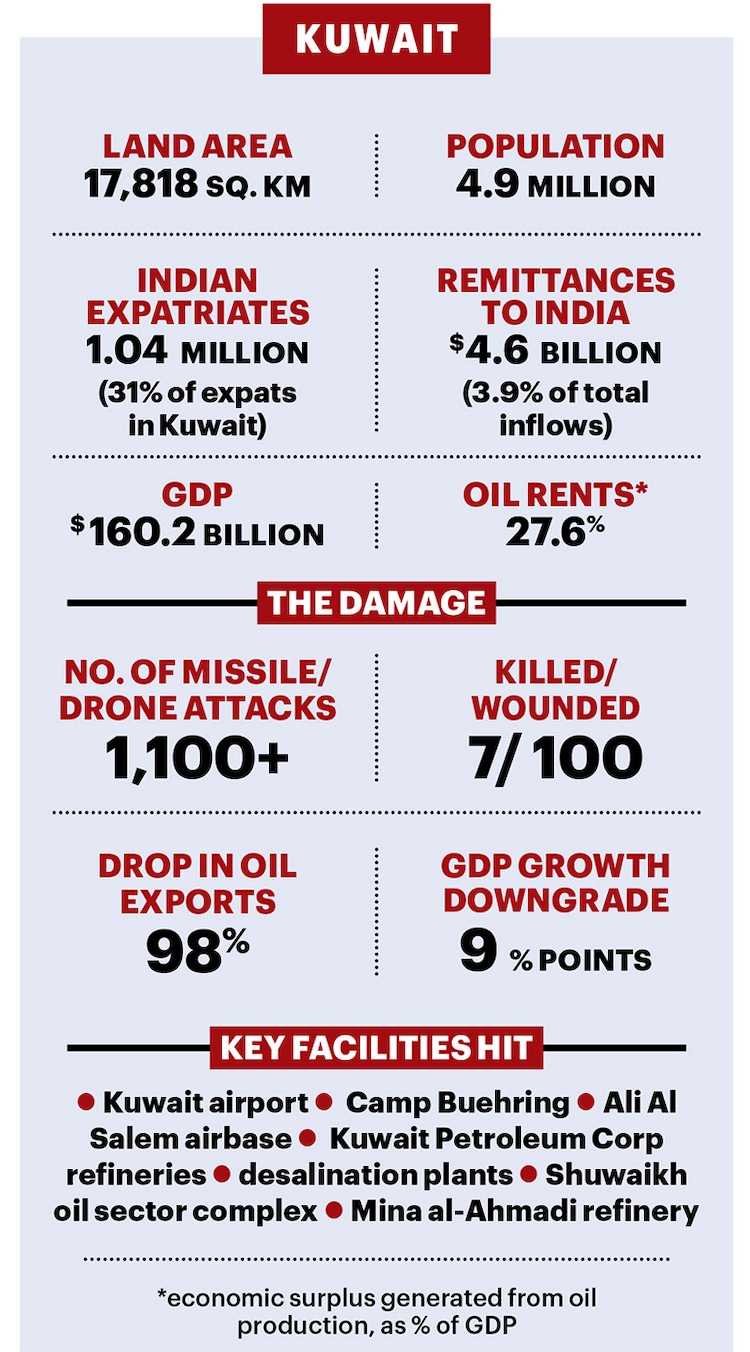
It’s too early to tell because the conflict has been ongoing for almost six weeks and we just arrived at a temporary (and one can claim, fragile) two-week ceasefire, so a full assessment isn’t possible yet. But the impact has been visible on several fronts: political, economic, social and psychological. Most clearly, on the economic front, with disruptions caused by the closure of the Strait of Hormuz and the dismantling of usual supply chains. Then there are direct attacks on critical infrastructure: oil and gas refineries, power plants, desalination plants, government buildings like the Kuwait Petroleum Corporation and ministries, and even residential areas.
All of the damage need to be tabulated comprehensively to estimate reconstruction needs. Numbers being discussed across the Gulf run into billions of dollars when combining the impact on multiple states, though again, it is early. The good news is that we have the financial capacity and institutional resilience to recover. Kuwait has faced worse during the Iraqi occupation in 1990–91 and earlier during the Iran–Iraq war (1980–88) when tanker warfare and attacks affected us. We recovered then, and we will recover again.
Q. Has this conflict derailed Kuwait’s growth plans, and how has the country responded so far—both militarily and economically?
The first priority has been defending the homeland, and in that regard, Kuwait has done a phenomenal job. The impact could have been worse, which speaks to the adeptness and resilience of the armed forces that courageously intercepted most of the 1,100-plus distinct attacks on Kuwait. Interception rates have been high, over 90 per cent, and daily life has largely continued as normal. Precautionary measures were taken early—shifting work and education online, reducing workforce presence and clearly communicating contingency plans. On growth plans, it is again too early to quantify the impact, but there will certainly be consequences. Priorities will shift, particularly toward strengthening defence and reevaluating our international investment footprint to better serve our national interests. At the same time, this moment validates earlier investments in defence partnerships.
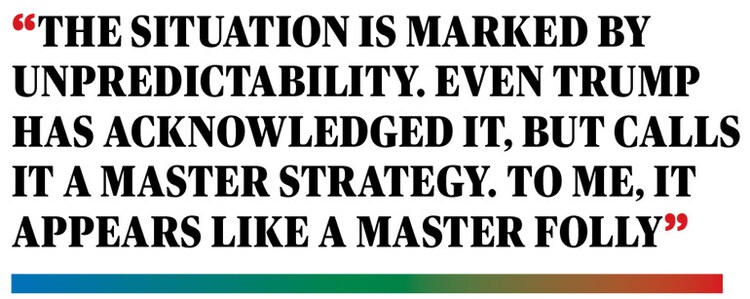
This is a turning point for the Gulf. It forces a rethink not just of security, but also of economic priorities and regional relationships—with Iran, with fellow Gulf states, and with external partners. It also pushes us toward a more collective regional approach, while engaging both global powers and emerging middle powers like India and Turkey. The situation is marked by unpredictability—especially from the US. Even President Trump has acknowledged this unpredictability, but calls it a master strategy. To me, it appears more like a master folly.
Q. Why do you call Trump’s strategy a master folly?
Because there is no clear, consistent objective. If you look at Israel, their objective is clear—they aim for regime disruption or change and to reshape the regional balance. But the US position has kept shifting. At first, it was about nuclear weapons. Then missiles were added. Then naval concerns. Then regime change. Then a retreat from that position. And then again, a return to nuclear concerns. War is not just about tactics—it requires a coherent strategy with a defined end goal. Even if the US claims success in damaging nuclear facilities, questions remain, such as the whereabouts of the enriched uranium. Meanwhile, Iran is calling not just for a ceasefire but for a permanent cessation, which requires deeper negotiations involving both regional and global actors. That impulse—seeking a long-term resolution—is the right one. We cannot continue with cycles of conflict.
Q. What would be an acceptable resolution to the conflict for Kuwait?
Kuwait understands its position as a small state in a difficult neighbourhood. Our guiding principle has always been de-escalation, peace and stability. We have experienced war repeatedly, so we know its cost. That is why any resolution must address root causes—not just freeze the situation temporarily. We need a 360-degree approach. This means understanding how Iran sees the world and, equally, ensuring they understand our perspective. Only through that mutual understanding can real compromises emerge.
There are key issues that must be addressed. These are: Iran’s involvement in the internal affairs of neighbouring states through proxies or militias. Then the need to ensure the civilian nature of nuclear programmes across the region. There should be transparency from all nuclear-capable states, including Israel. And we must ensure freedom of navigation, which has been threatened during this conflict. These are not minor issues—they go to the heart of regional stability. Ultimately, we need to move toward a new security architecture. This will not happen overnight, but it must begin with honest identification of problems, even if different countries define them differently. Only then can progress be made.
Q. What might this “new security architecture” that you talk about look like?
We are not looking to overturn existing partnerships overnight. That is not how Gulf states operate. The US remains an important partner, but there is a distinction between defence partnerships and security guarantees. The latter have become less reliable over time. Since the Joint Comprehensive Plan of Action (JCPOA) under President Obama to more recent incidents, there has been a perception of gaps in security guarantees.
This means two things: First, we need to diversify partnerships. Second, and more importantly, we need to build our own defence capabilities. There are strong examples in the region—Turkey, Iran, India, Pakistan—all developing indigenous defence industries. Warfare itself is evolving, and we must adapt. We are already seeing moves in this direction, especially by countries like the UAE and Saudi Arabia, which are investing heavily in local defence production. The Gulf has significant financial resources, including some of the world’s largest sovereign wealth funds. If these are directed toward advanced technologies—AI, defence systems and innovation—there is no reason why a substantial portion of capability cannot be developed locally. Self-sufficiency is ultimately the most reliable form of security.
- Ends