

View from UAE | Safe harbour in danger
With the pillars of the UAE's growth areas such as aviation, tourism and logistics taking hits, the stability it promised investors has been shaken
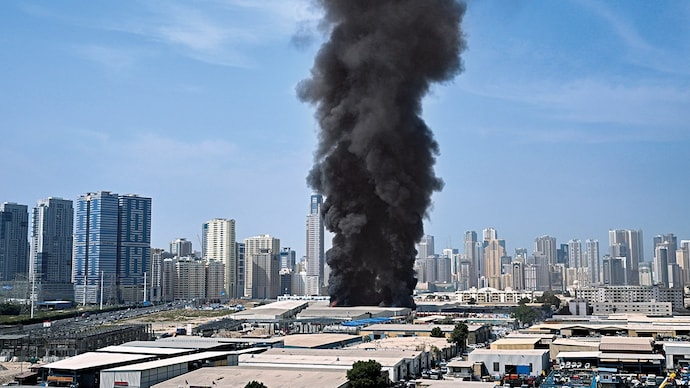
LINE OF FIRE: Attacked warehouse in Sharjah, United Arab Emirates, Mar. 1. (Photo: AP)

ISSUE DATE: Apr 20, 2026 | UPDATED: Apr 14, 2026 15:03 IST
The expected calm after the announcement of a two-week ceasefire appeared fragile in the United Arab Emirates. Minutes into the ceasefire, a pre-dawn strike hit the Habshan gas complex in the southwestern part of Abu Dhabi—the third attack on the site since March 19. The impact triggered a fire that was quickly contained, but not before three people—including two Emiratis and one Indian—were injured. For many, it was a reminder of how quickly the situation can change. In the Emirates’ first public response, Anwar Gargash, diplomatic advisor to UAE president Sheikh Mohamed bin Zayed Al Nahyan, said the country had “triumphed in a war we sincerely sought to avoid”, but cautioned that a ceasefire alone would not resolve the deeper risks driving instability in the region.
While the Dubai financial market reacted positively and jumped 6.7 per cent in early trade—its sharpest intraday gain in over six years—S. Babu, an Indian expatriate, standing on the balcony of his two-bedroom apartment in Dubai’s Mankhool, was not as sanguine. Just two weeks ago, he lost his job when his logistics firm cut staff as shipping routes through the Strait of Hormuz began to choke. Inside, his sons were on their laptops, attending virtual classes that have replaced school. His wife has stopped asking what comes next. “I’ve been here 17 years,” he says, gripping the railing. “My sons have grown up here. This apartment, their education, our life—it’s all tied to Dubai. You don’t just walk away from that.”
The 11 million residents of the UAE, a federation of seven emirates—Abu Dhabi, Dubai, Sharjah, Ajman, Umm Al Quwain, Ras Al Khaimah and Fujairah—share Babu’s predicament. As many as 89 per cent of the total population in the UAE are expatriates, with Indians accounting for four million, or 50 per cent, of them. The UAE now accounts for close to $30 billion, or 20 per cent, of India’s total foreign remittances of $130 billion annually. That’s why there was enormous shock and consternation in the UAE when the United States and Israel attacked Iran on February 28, threatening to destroy the safe harbour image that the federation enjoyed, attracting both expats and the world’s talent and investment.
THE ECONOMIC WOUNDS
Before the fragile truce took hold on April 8, Iranian forces were launching as many as 40-50 strikes a day on the UAE. Dubai International Airport had twice halted operations as debris from drone attacks littered runways. A five-star hotel on Palm Jumeirah was hit near its forecourt. Windows in towers along Sheikh Zayed Road shuddered with nearby intercepts. Fires broke out in apartments from Creek Harbour to Dubai Marina. In Abu Dhabi, Sharjah and Fujairah, falling debris ignited industrial sites, forcing shutdowns. Phone alerts cut through meetings and meals several times a day. Since the war began, UAE air defences have intercepted around 550 missiles and over 2,200 drones, the highest tally in the GCC (Gulf Cooperation Council). Authorities say 11 people have been killed and hundreds injured.
The impact is beginning to show in the numbers. Oil output, which averages around 3.4 million barrels a day, fell by more than 50 per cent at peak disruption because of both the closure of the Strait of Hormuz and Iran’s drone and missile attacks on the UAE’s infrastructure. Analysts have revised UAE growth forecasts for 2026 to between 1.5 and 2.5 per cent, down from earlier expectations of over 4 per cent. The Economist Intelligence Unit, for instance, cut its projection to 1.5 per cent from 4.2 per cent, citing disruptions to aviation, logistics, tourism and real estate, sectors that make up a large share of Dubai’s economy.
Among the hardest-hit sectors was aviation. At Dubai International, where planes once queued for take-off, passenger numbers have dropped by nearly a third in just four weeks. Cargo shipments have fallen as vessels avoid the Strait of Hormuz, adding days to delivery schedules, driving up insurance costs and squeezing margins. Nasir, an operations manager at the Sharjah-based ABC Cargo and Courier, says the impact is now reaching households. “Families ready to leave can’t ship their belongings home,” he says. “Containers are stuck at ports, and timelines are no longer reliable.”
Tourism, which welcomed a record 19.59 million international visitors to Dubai in 2025, is also under strain. Hotel occupancy in March fell into the low 60s in some areas, prompting rate cuts of 20-40 per cent at beachfront and city-centre properties. The Department of Economy and Tourism reported a 28 per cent drop in hotel revenue for the first quarter of 2026. Attractions are seeing smaller crowds, and some events are being scaled back, or moved online.
The real estate market reflects similar uncertainty. Developers have slowed new launches. Buyers are hesitating on off-plan purchases, even in prime areas. Transaction volumes in Dubai’s off-plan market fell 35 per cent in March, according to Dubai Land Department data. At the same time, opportunistic investors have begun snapping up properties at reduced prices. “Things slowed down for a bit,” says Rishika Mihani, CEO of Wolves International Real Estate. “Deals that were on hold are starting to move again, and buyers are coming back in.”

NAVIGATING THE WAR
Dubai has announced a Dh1 billion ($272 million) support package, effective April 1, offering fee deferrals, rental support and targeted relief for businesses in tourism, logistics and aviation. The Central Bank has stepped in with liquidity measures to keep credit flowing. Some companies have moved to reassure employees. Emaar, builder of Burj Khalifa and Dubai Mall, has pledged no layoffs. Indian billionaire Rizwan Sajan, founder of Danube Group, has said more than 6,000 employees will continue to receive salaries on time. Businesses in other sectors are also holding the line. Alsayegh Worldwide, a UAE-based creative agency, says it will not cut jobs or salaries.
But such assurances are not universal. Thousands of expatriates in affected sectors face frozen salaries and shrinking bonuses. Money transfers to India, Pakistan and the Philippines—lifelines for families—have begun to falter. Construction workers, already on edge, are feeling the impact as projects slow. Ram Khilawan, a construction worker from Bihar, scrolls through the WhatsApp messages on his phone. “My family sees explosions on Indian television and thinks all of Dubai is burning,” he says. “I keep telling them I’m safe.”
At the same time, UAE leaders have also appeared in public to project calm. Last month, President Al Nahyan and Dubai Crown Prince Sheikh Hamdan bin Mohammed were seen interacting with residents at Dubai Mall, while Vice President and Prime Minister Sheikh Mohammed bin Rashid Al Maktoum made a similar public appearance elsewhere. Billboards for the ‘Everyone is Emirati’ campaign emphasise unity and shared belonging. “Dubai is home now,” says Ejaz Ahmad, a tech professional from Hyderabad. “Every time an alert came or you heard a thud, it was unsettling, but there was no panic or fear. There’s no shortage of fuel or basic supplies. Back home, even essential things like LPG and fuel can become uncertain. I’m not packing up.” A British marketing consultant working in Media City is more direct. “Dubai gave us opportunities we couldn’t find elsewhere—career growth, safety, quality of life. Walking away now feels like starting from zero,” he says.
After the ceasefire was declared, UAE presidential advisor Gargash emphasised the need for a broader security framework, including safeguards for maritime navigation through the Strait of Hormuz. So far, the UAE has avoided direct military involvement while continuing to call for de-escalation and dialogue, and Gargash indicated that it is likely to continue on this path of restraint while relying on established security partnerships to maintain stability in a volatile region. At the same time, it is navigating a delicate balance. Its normalisation of ties with Israel under the Abraham Accords has brought economic and strategic gains but also requires careful handling in a region where public sentiment remains sensitive. The UAE’s approach is pragmatic: maintain ties, avoid escalation and keep channels open.
Back in Al Barsha, Babu watches the evening traffic thin. Dubai has weathered financial crises, a pandemic and regional tensions before. This time, the shock feels closer and less predictable. Insurance markets remain jittery, and long-term investors cautious. For now, most residents are staying put—waiting, watching and hoping the calm holds.
—Mazhar Farooqui is a Dubai-based journalist and author of 'The Maz Files: Scoops, Scams and Showdowns'
- Ends