
Explained: Why Nicolas Cage's Spider-Noir is distinct from Tom Holland's Spider-Man
Moody noir and superhero thrills have made Spider-Noir a global rage. In India, many fans of Tom Holland's Spider-Man era are yet to notice the phenomenal show.
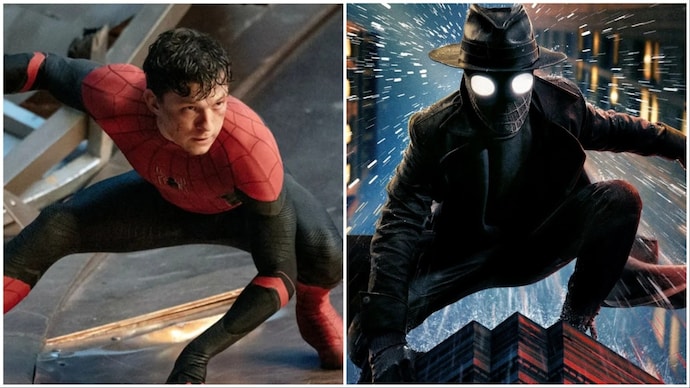

Imagine this classic noir template. The camera lazes into a smoky jazz club, it's around two in the morning. The singer has just left the stage and the room is awash in shadows. A detective in a crumpled trench coat sits alone in a corner, nursing an old wound and a new case. He seems disinterested in the job at hand, but there are bills to pay. Outside, rain lashes empty streets. Inside, the soul seeks purpose.
Now imagine the detective can crawl up walls and spin a web. That, in essence, is Nicolas Cage as Ben Reilly in Spider-Noir — unlike anything from the world of superheroes you've seen before.
A quick introduction: Cage's Reilly is a private investigator in New York of the 1930s. He is also a reluctant superhero – The Spider – one who belongs to the broader Marvel Multiverse and could pass off as an older, disillusioned Spider-Man. In the words of Spider-Noir co-showrunner Oren Uziel, Reilly is trying to move beyond his past, but it keeps returning "to haunt him" (the past here refers to Ruby, the woman Reilly loved and was shot by a criminal seeking revenge against him, on the night he planned to propose).
GLOBAL HIT, BUT IS IT A RAGE IN INDIA?
It's an enchanting world, moody and rich in atmospherics, and seamlessly blending noir nuances with superhero action. For maximum impact, the makers offer the show in Black and White or colour versions (while BW naturally ushers in noir vibes, don't gloss over the colour option – the retro-styled True-Hue Full Color format transports you to a bygone Hollywood era).
Impressively, at the time of writing, Spider-Noir is one of the most popular television shows across all streaming networks globally. Which brings up a basic question: Why hasn't the uniquely-crafted global hit caught on in India in the way genre hits such as Daredevil, The Penguin, The Punisher, WandaVision or Loki did? While hardcore fans of the Spider-Man Noir comicbook universe are hooked onto Nic Cage's show, The Spider could do with more aggressive awareness among the larger OTT audience of English content in India.
'SPIDER' ISSUE IN TOM HOLLAND ERA
To begin with, it seems like an outcome of the never-ending confusion among the larger audience about all things 'Spider'. Many among us see the word 'Spider' and assume what we're getting is a Spider-Man adventure. That's not at all the case here.
The prefix 'Spider' to the name of Cage's show comes into play in this context. For over two decades, cinema has conditioned Indian audiences to associate a 'Spider' web-slinger who has superpowers solely with Peter Parker: a wisecracking teenager, the bright New York skyline, colourful villains and a familiar coming-of-age journey.
Gen Z has mostly grown up associating Spider-Man with the spectacular hits of Tom Holland, but even if your initiation happened through the Tobey Maguire or the Andrew Garfield films, Spider-Man and his alter ego Peter Parker primarily exist in worlds driven by energy, humour and optimism.
Nicolas Cage as The Spider comes from an entirely different zone.
To begin with, Spider-Noir's reality is closer to classic detective fiction than superhero storytelling. The difference extends to Peter Parker and Ben Reilly as people, too. They may share certain DNA, but they are fundamentally different persons shaped by different worlds.
Peter Parker's New York is a city of possibility. Ben Reilly's New York is a city of acceptance. Parker swings above the streets, flaunting his web-slinging skills. Reilly wanders them, reluctant to use his powers. Parker believes he can save the world. Reilly is not entirely convinced the world deserves saving.
Watch Spider-Noir keeping this basic difference in mind, you'll discover a superhero world unlike any that grips you.
MANY SPIDEYS, MANY UNIVERSES
There's another point of confusion. Just where in the spider universe does Ben Reilly / The Spider fit in?
Commercially speaking, the spider world has had too many ownerships, and it is often difficult to keep track of which web-slinger belongs to which studio or production house. There's Columbia Pictures, there's Marvel Cinematic Universe (MCU), there's Sony's Spider-Man Universe (SSU), besides Sony Pictures Television and Amazon MGM Studios. It is something that's been in the making since Tobey Maguire squirted a web for the first time in his debut Spider-Man film of 2002.
It could all seem a bit baffling, which in turn tends to disinterest viewers. Let's digress a bit here to get the bigger Spider-Verse picture, to understand why Spider-Noir should not be confused with the other worlds of Spider-Man, especially the recent MCU.
Put simply, the three Spider-Man films starring Tobey Maguire (2002, 2004, 2007) were produced by Columbia Pictures and Laura Ziskin, in association with Marvel Enterprises. There was no MCU back then. Andrew Garfield's The Amazing Spider-Man films (2012, 2014) belong to Columbia Pictures, Marvel Entertainment and a cluster of producers including Ziskin. The common factor here is all these films were distributed worldwide by Sony (this last bit is vital to our story – it has a Spider-Noir connection, but more of that later).
The Spider-Man films within the MCU are really the ones that star Tom Holland – Spider-Man: Homecoming (2017), Spider-Man: Far From Home (2019), Spider-Man: No Way Home (2021) and the upcoming Spider-Man: Brand New Day, scheduled to release on July 31, 2026. All these films are part of MCU's overall Avengers saga.
SPIDER-NOIR AND EARLY FILMS
Fans who logged in to watch Nicolas Cage's Spider-Noir looking for traces of (and characters from) the Avengers universe, or connections with Tom Holland's Spider-Man world, were naturally let down, for there are none.
Spider-Noir is not a part of the MCU. It is a property that belongs to Sony and has been pushed as a "separate Sony Spider-Man Universe project", though not part of the main SSU storyline.
Which brings us to the Sony connection that binds the show with the early Spider-Man films, especially Maguire's. On the show, you spot Jack Huston as Sandman, or Flint Marko, the tragic super-villain we first saw in 2007's Spider-Man 3. There's Daily Bugle editor Robbie Robertson (played here by Lamorne Morris), too – he was Spider-Man's ally in the Maguire films.
In short, the best way to savour Spider-Noir is to treat the show as its own alternate universe, even if you spot a character or two from the old Spider-Man films.
STAGGERED DROP A BETTER IDEA?
Meanwhile, there's a lot of talk on Reddit over whether a staggered release pattern – of dropping weekly episodes – would have helped build hype about Spider-Noir. Fans have cited the example of Daredevil: Born Again, the Charlie Cox show that maintained a staggered release pattern across two seasons. You could watch the episodes once a week if you wish – the intoxicating mix of noir magic and superhero rage hits you slowly, after all.
Spider-Noir is visually the most distinct superhero series in years, amped by Nicolas Cage's winning act. In India, the series deserves more than a niche conversation, just as in the rest of the world.