
At 94, director Singeetham Srinivasa Rao remains Indian cinema's great experimenter
At 94, filmmaker Singeetham Srinivasa Rao is bringing Sing Geetham to screen after carrying the idea for nearly four decades. The project underlines his long-running habit of testing cinema's limits rather than following formula.
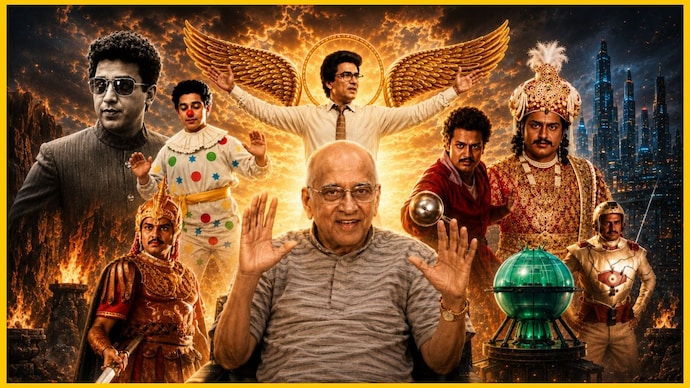

Forty years ago, Singeetham Srinivasa Rao stumbled upon a question that refused to leave him alone. This was not unusual. Many such questions had already turned into films. One of them had produced a mainstream movie without dialogue, a silent comedy that many considered impossible until it became Pushpaka Vimana, one of the most celebrated experiments in Indian cinema. Others had led him into science fiction, folklore, animation and genres Telugu cinema rarely ventured into at the time.
But one idea never made it to the screen. If a film could exist without dialogue, why couldn't it exist entirely through music?
Most filmmakers would have moved on. Singeetham didn't. He carried the thought with him for nearly four decades, waiting for the moment when it could finally become a film. That film is Sing Geetham. At 94, Singeetham returns with perhaps the longest-gestating idea of his career. Yet the significance of the project lies not in its age, but in what it reveals about the filmmaker behind it. Because Sing Geetham is not a late-career detour. It is the clearest expression yet of a creative philosophy that has defined his entire life.
The filmmaker who never believed in formulas
Most successful filmmakers eventually discover a formula and spend years refining it. Cinema rewards familiarity. Audiences often seek it. Industries are built around it. Singeetham Srinivasa Rao spent his career moving in the opposite direction. His filmography feels less like a collection of movies and more like a catalogue of possibilities. Every time cinema seemed to settle into a pattern, he appeared interested in testing its limits.
With Mayuri (1984), he explored resilience through the story of a dancer who fought her way back after losing a leg. With Pushpaka Vimana (1987), he proved that visual storytelling alone could sustain a feature film. With Aditya 369 (1991), he took Telugu cinema into science fiction years before the genre became commercially viable. Bhairava Dweepam revived fantasy on a scale few were attempting, while his later work embraced animation long before most filmmakers of his generation were willing to engage with the medium.
The films differed wildly in tone, genre and audience. The common thread was never subject matter. It was curiosity. Where others saw boundaries, Singeetham saw invitations.
A question forty years in the making
The seed for Sing Geetham emerged during creative discussions with actor-filmmaker Kamal Haasan, one of the most important collaborators of his career. Those conversations often revolved around possibilities rather than projects. What could cinema do that it had not already done? What conventions could be removed? What assumptions could be challenged? One of those explorations eventually became Pushpaka Vimana. Another led to a different question.
If dialogue could disappear, could songs take over the entire responsibility of storytelling? The idea remained unfinished for decades. Not because it lacked conviction, but because some creative questions demand extraordinary patience. Through changing technologies, changing audiences and changing industry trends, Singeetham never abandoned it. That persistence may be as remarkable as the experiment itself.
Risk is in Singeetham's DNA
On paper, Sing Geetham is an extraordinarily risky proposition. Indian cinema has always embraced music, but songs traditionally coexist with dialogue. They enhance emotion, punctuate drama and provide spectacle. They rarely carry the entire narrative burden. A true musical, where songs become the primary language of storytelling, remains an uncommon form in Indian cinema. The challenge is even greater today. Modern filmmaking increasingly favours speed. Attention spans are perceived to be shrinking. Songs are shorter than they once were. Some films avoid them altogether. The dominant industry instinct is to simplify, accelerate and reduce.
Singeetham's response has been to move in the opposite direction. At a moment when filmmakers are trimming songs, he is releasing a film built entirely around them. That decision does not feel nostalgic. It feels characteristically defiant.
Ninety-four years young and still passionate
There is an obvious version of this story. A 94-year-old filmmaker is still directing. Still imagining new forms. Still stepping onto sets with ideas that younger filmmakers might hesitate to attempt.
Those facts are remarkable. But they are not the most interesting part of the story. What makes Singeetham unique is not that he is still working at 94. It is that he remains creatively restless at 94.
Many artists continue producing work late into their careers. Far fewer continue questioning the fundamentals of their medium. Fewer still remain willing to risk failure in pursuit of an idea that may not fit prevailing trends. That willingness has defined Singeetham for more than six decades. Perhaps that is why Sing Geetham feels less like a comeback, a farewell or a victory lap. It feels like the latest chapter in a career built on curiosity.
For forty years, one question stayed with him. Most people would eventually stop asking. Singeetham Srinivasa Rao never did. And that may be the secret behind every film he has made. Whenever cinema appeared to reach a boundary, he looked at it and asked the same simple question: Why not?