
Mammootty to Mohanlal: South cinema's OGs who refuse to slow down
Veteran actors in South cinema are defying retirement rumours by consistently delivering diverse and content-driven films. Their collaborations across generations keep the industry vibrant and audiences engaged.
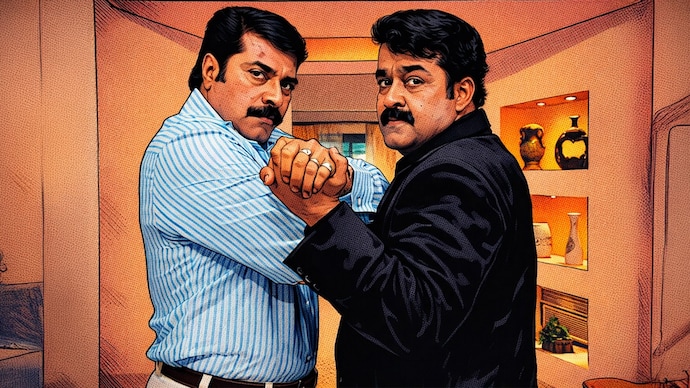

In the post-credit scene of Pathaan, Shah Rukh Khan’s Pathaan and Salman Khan’s Tiger joke about retirement. “It’s been 30 years maybe we should stop,” Pathaan says, before both quickly realising that there’s no one quite ready to replace them. That line plays out as humour in the film, but look at what is happening in Indian cinema today, particularly in the South, and it begins to feel less like a joke and more like a reality.
Because if anything, the legends are not slowing down, they are accelerating.
Take Mammootty. Even as he prepares for Patriot alongside Mohanlal, his line-up stretches across genres, scales and collaborators. From working with auteurs like Adoor Gopalakrishnan to teaming up with younger filmmakers like Nithish Sahadev and Khalid Rahman, his slate is not just about the number of films, it’s the variety in them. Projects like Mattancherry Mafia, potential sequels like Kannur Squad 2 or CBI 6, and collaborations with actors across generations point to a clear intent: keep moving, keep experimenting.
Mohanlal mirrors that energy. With multiple projects lined up with directors ranging from Priyadarshan and Sathyan Anthikad to Dileesh Pothan, Jude Anthany Joseph and Jeethu Joseph, his approach is not about slowing down or choosing “safe” roles. It is about range. From large-scale films to rooted narratives, from police roles to emotional dramas, the diversity in his line-up stands out.
And this is not limited to Malayalam cinema.
In Tamil, Rajinikanth continues to collaborate with younger filmmakers like Nelson Dilipkumar and Lokesh Kanagaraj, delivering films like Jailer while building anticipation for upcoming projects. Kamal Haasan, with Vikram, showed how reinvention with the right director can redefine a career even decades later.
In Telugu, Chiranjeevi continues to experiment with directors like Anil Ravipudi, while Nandamuri Balakrishna stays firmly within his space yet consistently delivers numbers.
Which brings us to the key question: what are these veterans doing differently?
Balance between legacy and new-age filmmaking
One of the biggest differences is their willingness to collaborate across generations.
Mammootty moving between Adoor Gopalakrishnan and Khalid Rahman is not random, it shows a clear approach to the kind of films he wants to do. Similarly, Mohanlal working with both Priyadarshan and Tharun Moorthy reflects a conscious balance between familiarity and freshness.
This allows them to stay relevant without chasing trends.
Openness to experimentation
When most actors are trying to mount whatever is trending, veteran stars are not playing safe – they are exploring, and more importantly, enjoying the process. And that reflects in their performances.
Mammootty’s choices in films like Kaathal: The Core and Bramayugam show a willingness to step into unconventional spaces. Mohanlal’s line-up, from Empuraan to more grounded narratives, reflects similar flexibility. Kamal Haasan’s Vikram and Rajinikanth’s Jailer are strong examples of how reinvention works when actors are open to shifting their image.
And this is not new for them. They have been doing this for years, which is exactly why they understand its value - and now, if anything, they are pushing it even further.
Freedom from the pan-India burden
This is perhaps the most crucial factor.
Many younger actors today are caught in the cycle of building “pan-India” films – large-scale projects that take years to mount and even longer to release. While Malayalam cinema has largely resisted this, the trend is visible across industries, and once it sets in, it becomes difficult to step away from it.
Veteran actors are not restricted by that.
They can move between big films, mid-scale projects, and content-driven cinema and strike a solid balance. This flexibility allows them to stay visible and relevant consistently, rather than disappearing for years between releases.
Volume without compromise
What really stands out is the sheer volume—and the consistency within it.
Mohanlal alone has had a packed 2025 with L2: Empuraan, Thudarum, Hridayapoorvam and Vrusshabha, along with appearances in Kannappa and Bha Bha Ba. And that momentum continues into 2026 with Drishyam 3, Patriot, cameos in Jailer 2, Khalifa, Kathanar, and full-fledged projects like L366, L367 and Ram. This is not just a busy phase, it is sustained output across scales, industries and roles.
Mammootty has been even more relentless. In 2025 alone, he moved between Dominic and the Ladies’ Purse, Bazooka and Kalamkaval, while also producing and experimenting. And the line-up doesn’t slow down - Patriot, Padayaatra, the Nithish Sahadev project, Mattancherry Mafia, along with multiple collaborations in different stages of production. This is in addition to the range he has already shown in recent years with films like Kaathal: The Core and Bramayugam.
Even Rajinikanth, while more measured, maintains consistency with Jailer, Coolie, and Jailer 2, ensuring he remains theatrically relevant every year without long gaps.
This is where the difference lies.
Not being burdened by image, expectations, or the need to mount only “event films” allows them to move quickly. They are not locked into a single project for years. They collaborate, complete, and move on. So it’s not just volume; It’s volume with range.
And that is something the current system does not always allow younger stars to do.
Why this matters for the industry
This is not just about individual careers. It is about the ecosystem.
Frequent releases, especially mid-scale and content-driven films, are what bring audiences back to theatres regularly. Not every film needs to be a two-year project. Not every film needs to carry the burden of being a “pan-India event.”
Veteran actors, knowingly or unknowingly, are sustaining that balance. They are ensuring that cinema does not become a space of only big events, but also of consistent storytelling.
At a time when the industry is obsessed with scale, time and reach, it is the veterans who are moving faster, experimenting more, and delivering consistently.
Maybe that line from Pathaan was never just a joke. Because right now, it really does feel like they looked around, saw no one ready to take over and decided to keep going.