
Michael review: Jaafar Jackson embodies MJ in a soulful but sanitised biopic
Michael, starring Jaafar Jackson, is a dazzling spectacle that celebrates the legend while sidestepping the man – hitting the high notes but muting the icon's most difficult truths.
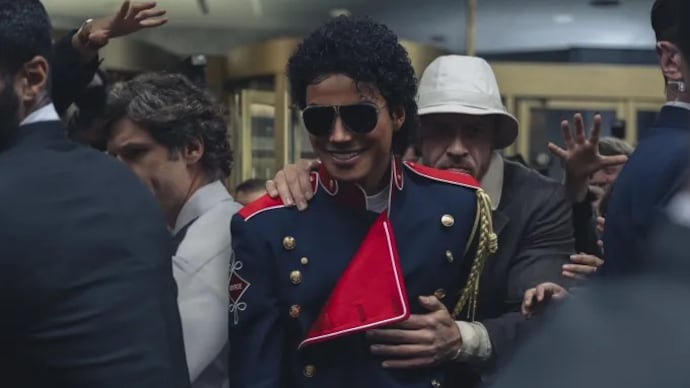

There’s a moment early in Michael-- the biopic based on pop legend Michael Jackson (played by Jaafar Jackson) aka MJ--when a young MJ looks less like a child and more like a vessel who is absorbing pressure, expectation, and eventually, adulation. It sets the tone for what unfolds over the next two hours, a carefully curated memory of a man who changed pop culture forever.
Walking into the film, it’s hard to ignore the uneven lens through which Michael Jackson has long been viewed. For some, his genius never quite eclipsed the discomfort around his scale as a Black global icon. But before anything else, the film makes one thing clear: Jackson remains one of the most defining pop artists of the 20th century.
Long before the internet reshaped celebrity, he was already operating on a scale few could comprehend, setting benchmarks in record sales, stadium tours, and global fandom. The numbers still hold. From his song Thriller’s enduring dominance to the unprecedented reach of his concerts, Jackson wasn’t just part of the music industry; he was driving it. Even with a career later shadowed by controversy and serious allegations, that legacy hasn’t shifted. Michael recognises this and leans into his musical impact without hesitation.
Directed by Antoine Fuqua, Michael is as much about remembering as it is about selective forgetting. It traces Jackson’s journey from his childhood in Gary, Indiana, to the dizzying heights of the Bad tour in 1988. By ending there, the film deliberately avoids the darker chapters with no mention of the allegations, no deep dive into his changing appearance, and only a fleeting hint toward his dependence on pain medication.
One such moment briefly acknowledges the aftermath of the 1984 Pepsi commercial accident, an incident widely considered a turning point in Jackson’s life. The film shows him complaining about feeling numb and drowsy from medication, but it stops short of exploring it. It’s a choice that feels less like oversight and more like postponement, especially with a sequel all but confirmed in the closing moments.
At its emotional core, the film anchors itself in a singular conflict: Michael’s quest for freedom from his father, Joseph Jackson. Played with chilling precision by Colman Domingo, Joseph is the film’s undisputed antagonist. Gruelling rehearsals, verbal humiliation, and physical abuse define his parenting style, reducing childhood to a transactional phase in the making of a star.
This dynamic becomes the driving force behind one of the film’s most symbolic arcs, the creation of Neverland. Not merely a whimsical estate, but a psychological refuge, an attempt to reclaim a stolen childhood. It’s here that Michael finds his most poignant note, the tragedy of a man who had everything, except a childhood.
The early portions, featuring the rise of The Jackson 5, are among the film’s strongest. Young Michael, played with remarkable warmth by Juliano Krue Valdi, captures the innocence that the adult version spends the rest of the film trying to recover. When the narrative transitions to Jaafar, son of Jermaine Jackson and MJ’s nephew, in the lead role, the transformation is uncanny. It’s not emulation alone; it’s muscle memory, lineage, and lived proximity coming together.
Jaafar’s performance is, without exaggeration, the film’s biggest triumph. Whether it’s the tilt of the head, the hesitant smile, or the explosive precision of his dance moves, he doesn’t just play Michael, he channels him. In recreated performances of Billie Jean, Beat It, and Human Nature, the line between actor and icon blurs almost completely. Give him an Oscar already.
The film also touches upon the key figures who shaped Jackson’s career. Berry Gordy and Quincy Jones appear as guiding forces, surrogate father figures who recognise and nurture his genius. Yet, these relationships remain largely functional, never fully explored beyond their contribution to his success.
And that’s perhaps where Michael feels like it is withholding exploration beyond the surface. It isn’t interested in complexity. The narrative consistently frames Michael as the misunderstood prodigy, the eternal victim of circumstance.
Fuqua, known for his stylistic flair, opts for a surprisingly subdued approach. The camera rarely intrudes, the editing stays invisible, and the storytelling remains linear. It’s a conscious decision to let the music and performance take centre stage. And to be fair, when the music hits, the film soars.
There’s undeniable exhilaration in watching the recreation of Thriller. Jackson’s insistence on full-body choreography, his understanding of the camera, and his ability to transform a song into a cinematic event are all captured with reverence. These moments remind you why he wasn’t just a pop star, but a cultural phenomenon who redefined the possibilities of music videos.
The film also subtly acknowledges his impact beyond music. Breaking racial barriers on MTV, globalising pop culture, and turning performance into spectacle are achievements that don’t need heavy exposition. They’re embedded in the narrative, visible in the crowds, the hysteria, the scale.
Yet, the film’s insistence on innocence creates a certain flattening. By the time it reaches 1988, the world around Michael feels incomplete, almost too clean. The absence of any mention of controversy is apparent. But more than anything, it feels deliberate. By ending where it does, Michael positions itself as the first chapter of a larger story. The closing hints make it clear: the difficult conversations around the allegations, the public scrutiny, and the unraveling, are being deferred. Whether the sequel will confront these aspects with honesty remains to be seen.
For now, what we have is a film that chooses celebration over confrontation. It’s not objective, nor does it try to be. It’s a family-endorsed, estate-backed narrative that leans into nostalgia and spectacle.
And yet, it works, mostly! Because when the lights dim and the music takes over, it’s hard not to be swept up. The film reminds you of the sheer force of Michael Jackson’s artistry, his voice, his movement, his ability to command a stage and unite millions, if only for a moment.
In the end, Michael is less a biography and more a time capsule. It captures the rise, the brilliance, and the mythology, while leaving the contradictions for another day.
The question is not whether the film tells the whole story. It doesn’t. The real question is whether the next one will.
Michael is set to release in India on April 24, 2026.