
12 years of Modi's Viksit Bharat: My 14 days inside the New India
As Narendra Modi became the longest-serving elected Prime Minister, India Today's Rohit Sharma recounts witnessing India's transformation during his two-week visit, highlighting rapid infrastructure expansion, widespread digital adoption through UPI, growing middle-class ambition, political dynamism and rising global influence.
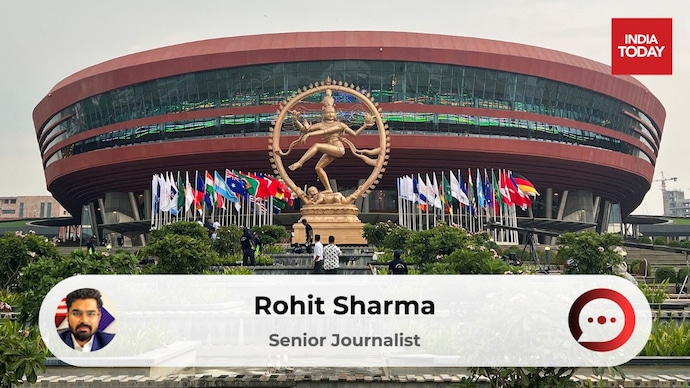

When you spend your days analysing geopolitical shifts and policy from a desk in Washington DC, it becomes dangerously easy to reduce nations to white papers, trade statistics and dry diplomatic talking points. But touching down in New Delhi last month for a breathless, two-week deployment to cover Secretary Marco Rubio’s official visit shattered that clinical distance the moment I left the airport. While the high-stakes security dialogues and closed-door bilateral meetings were the official anchor of my trip, the real, undeniable story was playing out entirely outside the briefing rooms.
Having left India in the late 2000s, stepping back onto the streets today is an exercise in profound disorientation. The country of my memory – a nation of immense potential perpetually hindered by its own grinding bureaucracy – has been overwritten by a nation moving at a breakneck, unrelenting speed. The transformation I witnessed on the ground is not merely a temporary economic boom. It is a complete metamorphosis into what is now ubiquitous in the national lexicon: Viksit Bharat, or a Developed India. This is no longer just a slick political slogan; it is a living, breathing project unfolding rapidly across a subcontinent.
THE MODI FACTOR AND A HISTORIC MILESTONE
You simply cannot contextualise this metamorphosis without acknowledging the political gravity of this exact moment. On June 10, 2026, the country hit an undeniable, historic milestone: 4,399 days. Narendra Modi officially surpassed Jawaharlal Nehru’s record to become India’s longest continuously serving elected Prime Minister.
But the "Modi factor" extends far beyond mere electoral longevity or his 12 years of completion at the helm. When he assumed office in 2014, defining himself as the Pradhan Sevak (Chief Servant), it fundamentally rewired the national consciousness. It shifted the Indian expectation of power from a privileged, distant entitlement to an active, delivery-based mechanism. Over these 12 years, the governance model aggressively moved the needle from bureaucratic red tape to a red carpet of execution. By placing welfare, digital inclusion, and unapologetic national pride at the centre of the agenda, this 12-year continuum has lifted hundreds of millions out of poverty and forged a unified, fiercely ambitious national identity.
THE SHIFTING POLITICAL TECTONIC PLATES
Western tropes about India are not just tired; they are fundamentally obsolete. This is a democracy that is as loud, messy and competitive as it is massive, and the political tectonic plates are shifting in real time.
In the span of just a few weeks during the recent elections, the landscape was completely redefined. We watched the ruling BJP finally breach the long-held fortress of West Bengal, defeating Mamata Banerjee and marking a historic realignment in a state defined for decades by absolute regional strongholds.
Simultaneously, we saw a South Indian cinematic superstar seamlessly pivot from the silver screen to the Chief Minister’s seat on his very first attempt and witnessed grassroots, highly meme-literate, Cockroach Janta Party protesting at Delhi’s Jantar Mantar. The political theatre here is ferociously alive, proving that the Indian voter is demanding, unpredictable, and entirely engaged in shaping the nation’s trajectory.
CONCRETE AND STEEL: THE INFRASTRUCURE REVOLUTION
Beyond the ballot box, the most visceral shock for a returning NRI is the sheer physical transformation of the country. The glaring infrastructure deficit that once defined the Indian experience is being aggressively erased.
In the 2000s, road travel between tier-two cities was an arduous, bone-rattling endurance test. Today, you glide across multi-lane, access-controlled expressways that rival anything in the American Midwest. The physical arteries of the nation have been completely bypassed, rebuilt and modernised. The aviation sector tells the exact same story. Navigating Indian airports used to be an exercise in extreme patience; now, you walk into gleaming, hyper-modern terminals that process tens of millions of passengers with startling efficiency. Then there is the railway revolution.
The rollout of the Vande Bharat express trains has completely redefined overland travel, turning gruelling overnight journeys into sleek, high-speed daytime commutes. It is a massive, highly coordinated effort of pouring concrete and laying steel that is physically stitching the country together, driving economic integration at a scale that is incredibly hard to comprehend until you travel across it.
THE FRICTIONLESS DIGITAL NERVOUS SYSTEM
If physical infrastructure is the new skeleton of Viksit Bharat, the digital public infrastructure is its central nervous system. If you have not been back to the motherland recently, you simply cannot comprehend how the Unified Payments Interface (UPI) has rewritten the fundamental rules of commerce.
The cash-heavy, friction-filled economy I remember from my youth has completely vanished. It has been replaced by an invisible, ubiquitous digital network. From high-end boutiques in metropolitan luxury malls to the street vendor selling roasted corn on a dusty corner, every single transaction flows instantly through QR codes. Pulling out a leather wallet with foreign credit cards suddenly feels archaic, almost cumbersome. By leapfrogging legacy banking systems, India has built a digital ecosystem that formalises the unorganised sector, brings millions into the banking fold overnight, and makes Western financial systems feel sluggish in comparison.
UNMATCHED HUSTLE AND THE DEMOGRAPHIC DIVIDEND
Yet, steel, concrete, and code are only part of the equation. The true engine driving this metamorphosis is the people. There is an aggressive, unapologetic confidence here that you rarely see in older, more established capitals. Against all historical odds, the demographic dividend is visibly flexing its muscles.
During my trip, I spent time with a state employee who spends his weekends driving an Uber. He isn't doing it merely to survive; he is doing it to comfortably float an exorbitant private school fee for his son. And he isn't just hoping for a better future, he is actively engineering it, making absolutely sure his kid is mastering machine learning and artificial intelligence outside of standard school hours. That level of calculated ambition, that sheer refusal to settle for mediocrity, is the new baseline of the Indian middle class. They are no longer waiting for opportunities; they are manufacturing them from scratch.
THE GEOPOLITICAL AWAKENING
This domestic confidence has naturally bled into a massive geopolitical awakening. The average middle-class Indian is infinitely more plugged into the global frequency than they were a decade ago. It feels remarkably similar to the unstoppable momentum of the China story we watched unfold years back. The citizens driving this economic engine may not be analysing the nuances of the recent presidential summits in Beijing, but they know exactly what is happening in the world, and more importantly, they know their own leverage.
They are acutely aware that the centre of global gravity is shifting eastward. They understand that international supply chains are realigning, that global powers are aggressively courting New Delhi, and that the world needs India just as much as India needs the world. The India of the 2000s was a country patiently waiting for its moment on the global stage. The India of today, surging toward the reality of Viksit Bharat, has firmly decided that the moment has already arrived.