
BJP's success in Assam provides a template for political domination
The BJP in Assam achieved phenomenal electoral success in Assam in just a decade. The way it was achieved — from Hindutva to development to co-optation — provide a template for achieving political domination.
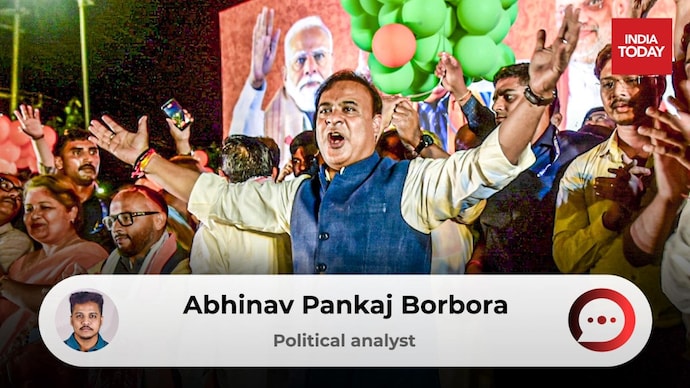

The Bharatiya Janata Party (BJP) has once again returned to power in Assam. And it has done so with a much bigger mandate than before. While the BJP-led NDA won 102 seats, the saffron party contributed 82. The Congress, the state's principal opposition party, could win just 19 seats.
This victory carries much significance for the BJP. It is so for three reasons. Firstly, it is the first time that the BJP has managed to secure a majority on its own. Secondly, the party has become Assam's first non-congress party to win three elections consecutively. And, this, in-turn has made Assam just the fifth state where it has been able to win a hat-trick.
All three achievements testify that Assam has now joined the ranks of traditional BJP strongholds like Gujarat and Madhya Pradesh. From being a marginal player in state politics, the party rose to this position in just a decade. So, what template has the BJP followed in Assam to achieve political dominance of this kind?
Its first feature involves crafty ideological manoeuvring. The BJP entered Assam by attracting people to an apparently innocuous version of Hindutva politics that took up some of their long-standing cultural issues like illegal immigration, protection of language and so on. To be sure, it subtly brushed them with communal undertones. Given that many of these concerns were part of the core agenda of Assamese sub-nationalist politics, a lot of people easily got drawn towards them and thus began the drift towards Hindutva.
As more and more people got comfortable with the ideology, the party began introducing the more hard-line aspects of its ideology to a society that had by then become much more receptive.
In its second term, these ranged from the closure of madrassas, communally targeted evictions, to even a policy that enabled indigenous people to obtain gun licences if they are facing "demographic challenges". The result has been a steady but more thoroughgoing Hindu polarisation. Over the last three elections, the BJP's share of Hindu-dominated seats has therefore only gone on increasing.
This broad majoritarian constituency has been further nourished in two ways. The BJP has pursued a developmental approach that has high visibility. Bridges over the Brahmaputra, a new airport terminal in Guwahati, and the setting up of a semiconductor industry are spectacles that the party frequently cites as evidence of what it has done in Assam. For a region that has long complained of backwardness, these "symbols" of development have gone a long way in creating an impression among many that the BJP has done more work than its predecessors.
At the same time, by making public recruitment relatively transparent, improving the ease with which people can engage with the bureaucracy through e-governance expansion and procedural changes, as well as by weaving an expansive net of welfare deliveries, the BJP succeeded in appealing to people at a more personal level as well.
Schemes like CM's Atmanirbhar Asom Abhiyan 2.0 (2023), that provides financial assistance to unemployed youth for setting up businesses to Swahid Kushal Konwar Sarbajanin Briddha Pension Asoni (2018) under which senior citizens get financial assistance suggest an effort to draw goodwill from a cross-section. Much effort, it should be noted, has gone into developing a favourable women's constituency through a number of cash transfer schemes.
If Orunudoi (2020) was the gamechanger in the 2021 election, a newer version of it, along with schemes like Lakhpati Baideo(2024) and Mukhyamantri Mahila Udyamita Abhiyan (2024) have since then helped to further consolidate women voters behind the party. Apparently, the latter scheme had even inspired the Bihar government to come up with something similar on the eve of the 2025 Assembly election.
Side by side, the BJP has also resorted to large-scale co-optation of its rivals in Assam. The BJP's organisational prowess is fabled. But Assam shows how organisational strength could be rapidly developed by importing leaders and members in bulk from other parties when a traditional cadre is not adequately available. The electoral triumph in 2016, encouraged the BJP to try out the strategy in other Northeast states like Manipur and Tripura where, just like in Assam, the BJP has a very small traditional cadre.
While switches by recognised faces like Himanta Biswa Sarma or Bhupen Borah make headlines, in reality countless others, right up to the grassroots, have changed sides and swelled the ranks of the party in the state over the last decade. In fact, the party has co-opted without hesitation from all sides, like the Left-leaning tribal party Autonomous State Demand Committee, Muslim-centric forces like All India United Democratic Front and, of course, the Congress.
So, while the party switchers augmented the BJP's popular base in quick time, their continuous outflow has also severely blunted the opposition. Except for Gaurav Gogoi and a few others, most of the front-ranking Congress leaders of Assam are now with the BJP, thus serving their own turfs to the latter on a platter. What this has done is effectively shielded the BJP from external challenges. This is also why, despite the opposition raising some valid questions about corruption, misgovernance and communalism, its impact at the constituency level has been minimal across multiple elections.
In fact, today when most observers are complimenting Himanta Biswa Sarma for steering the party to a historic victory, it is important to recognise that behind him lies this strategy of co-optation. Assam's BJP not just benefited from Sarma's political acumen, but through him and other switches, the party could inherit even newer leaders and members as well as valuable financial, intellectual and media networks that helped it emerge as a force to reckon with.
When it comes to alliances, the way the BJP has dealt with them is notable. It has demonstrated both loyalty and pragmatism while dealing with its partners. On one hand, it has faithfully maintained ties with long-time ally, Asom Gana Parishad (AGP), resisting the temptation of expanding further by eating into what remains of its Hindu base. After all, the former still has a symbolic appeal among the Assamese which the BJP tries to leverage by keeping it alongside.
At the same time, when the star of its other ally in the Bodo region, the United People's Party Liberal began falling, it quickly forged a pre-poll coalition with its rival, Bodoland People's Front (BPF). In spite of this, the UPPL, which contested elections separately, was also successfully persuaded by the BJP to remain in the NDA by supporting its Rajya Sabha bid.
Due to the reasons discussed so far, the BJP has managed to build an impressive social coalition in Assam, which is perhaps also the most important feature of its template. If successive election results are to go by, the party has managed to build a strong base among hill tribes like Karbis and Dimasas, plain tribes like Bodos, Rabhas and Misingsas as well as other groups like Ahoms, Morans, Muttocks and the numerically significant tea tribes.
For a party that was once considered to be at odds with the state's ethno-tribal landscape, it amounts to a big leap. Collectively, these disparate social groups reinforce Hindu consolidation from the other end.
What these features reveal is that while they have individually contributed to bolstering the BJP in Assam, each of them also gets interlocked with one another. Both the party's strength, as well as the difficulty of mounting a successful challenge in the state, arise due to this. In the days to come, if the opposition wants to reclaim lost ground, then it would have to evolve a politics that is able to counter the BJP simultaneously on several fronts that have been discussed here.
(The writer is an independent political analyst and has studied elections in Assam over the last decade. He was previously associated with the Delhi Assembly Research Centre and the Centre for the Study of Developing Societies, Delhi. He holds a postgraduate degree from the Centre for Political Studies, Jawaharlal Nehru University and is interested in political theory and Indian politics.)