
The paper that broke a million dreams
How easy is it to become a paper setter for the NTA? What does the NTA's own framework for question paper development say? How are experts invited, and what are the basic eligibility standards for empanelling them?
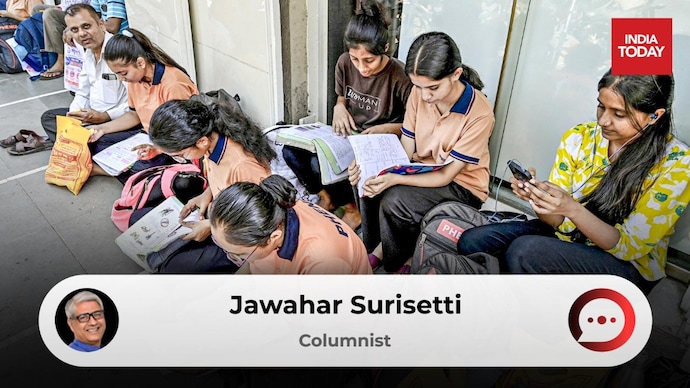

Every year, millions of young Indians wake up before sunrise. They sit under dim tube lights, surrounded by dog-eared textbooks and handwritten notes. They skip weddings. They give up friendships. They study through fever, through grief, through power cuts and summer heat. They do all of this for one single morning — the morning of the exam.
And somewhere, in an air-conditioned room they will never see, someone is deciding whether that morning will change their life — or destroy it.
This is the story of how India's biggest exams are made. And how that system, designed with great care and great intention, has been cracking under the weight of human greed.
WHO GETS TO WRITE THE PAPER?
You might imagine that a professor sitting quietly in a university office one day receives a call from the National Testing Agency. You would not be entirely wrong — but the reality is far more selective.
The NTA does not invite just anyone. To even be considered as a paper setter, you need years behind you. At least ten to fifteen years of teaching at the highest levels — IITs, AIIMS, Central Universities, NCERT. You need to be a person of standing, of reputation, of trust.
Before you touch a single question, you must sign an affidavit. A legal promise. You swear that no one in your family is writing the exam. You swear you have no connection to any coaching centre. You swear, essentially, that you are clean.
This sounds reassuring. It is meant to. But a signature is only as strong as the conscience behind it.
HOW THE PAPER IS BUILT
The NTA uses a system designed to protect everyone — including itself. No single person writes an entire paper. Instead, hundreds of verified experts across the country are each asked to contribute a few questions — small pieces of a larger puzzle that no one can see in full.
A professor in Chennai might write ten questions on electrostatics. A scientist in Lucknow might submit questions on cell biology. None of them know which questions will actually make it to the final exam. The idea is beautifully simple: if no one sees the whole picture, no one can leak the whole picture.
Then comes the Moderation Committee — a quiet, powerful group of senior subject specialists who sift through every submitted question. They check for errors, for ambiguity, for fairness. They assign each question a difficulty level. They are the gatekeepers of quality.
And then — the lockdown.
THE ROOM WITH NO WINDOWS
When the paper is close to ready, something extraordinary happens. The final paper setters, moderators, and translators are taken to a secure facility. A room — or a series of rooms — cut off entirely from the outside world.
Their phones are taken away. Their smartwatches. Their laptops. Every device that could carry a whisper of information to the outside.
The room has no transparent windows. Network signals are jammed. The computers inside cannot connect to the internet. In that sealed, silent space, the final paper takes its shape — assembled, verified, translated into thirteen languages, and locked away.
It sounds like something from a spy film. In a sense, it is. Because the NTA knows — it has always known — that what is inside that room is worth crores of rupees to the right criminals.
WHERE THE DREAM DIES
And yet. Despite all of this — the vetting, the affidavits, the isolation, the jammers, the air-gapped computers — the leaks happened. The CBI investigations began. Cancellations followed. And millions of students who had done nothing wrong were told to come back and try again.
How?
The first wound is one of trust. Some of those empanelled professors — the very people who signed those affidavits — quietly passed questions to coaching networks. Not in obvious ways. They dressed the stolen questions up as "highly probable topics" or "guess papers." Students paid thousands for these materials, not knowing they were buying something that was never meant to exist outside that sealed room.
The second wound is structural. Translators — who convert the paper into regional languages — often work closest to the exam date. They handle the most complete version of the paper, under the greatest time pressure, with the least amount of oversight. Organised syndicates have learned to target this moment. It is the softest point in a chain that is supposed to have no soft points.
And the third wound — perhaps the deepest — is that the NTA simply does not have permanent staff for this. The UPSC, India's most respected examination body, has its own sovereign, permanent cadre of paper setters. People who have given their careers to secrecy. People who are institutionally accountable.
The NTA borrows. It deputes. It contracts. And when you borrow integrity rather than build it, you leave gaps that greed is very happy to fill.
WHAT IT COSTS
Let us be clear about what is lost when an exam paper leaks.
A girl in a small town in Bihar who studied for two years loses more than a rank. She loses the belief that effort matters. She loses the faith that the system sees her.
A family that took a loan to send their son to coaching classes loses more than money. They lose the story they told themselves — that sacrifice leads to reward.
A nation that pins its future on merit loses something harder to measure: the credibility of the very system that is supposed to select its best minds.
The NTA's framework, in theory, is sophisticated. In practice, it has shown us something uncomfortable: that no system, however carefully designed, can survive without the human commitment to honour it.
The questions were locked in a room with no windows.
But they found a way out.
And a million dreams — built in the dark, by the light of a single study lamp — quietly collapsed.
Reform is not optional. It is urgent. Because somewhere right now, another student is studying. And they deserve better than this.