
In Vijay as CM, Tamil Nadu gets a young CEO - The future is here
With a blazer replacing the traditional white-and-white, files signed on stage moments after taking oath, and a governance-first message delivered with cinematic confidence, Vijay's first day as Chief Minister broke sharply from Tamil Nadu's familiar political grammar. What unfolded in Chennai was not merely a transfer of power, but the unveiling of a new political template.
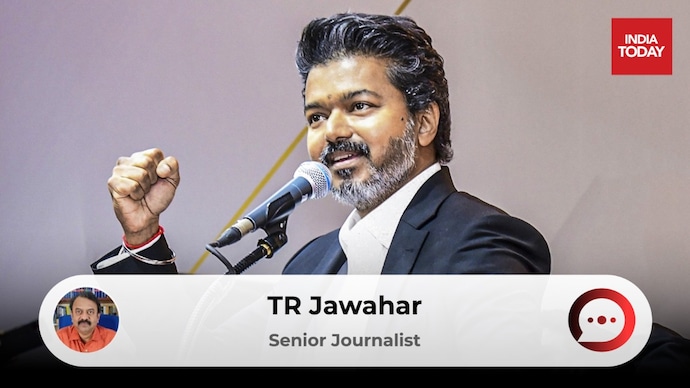

Tamil Nadu did not just witness a swearing-in on Sunday; it watched a scene shift. A Chief Minister in a blazer, not the traditional white-and-white; a leader who paused for a selfie before power had fully settled on his shoulders; files signed not in the quiet anonymity of secretariat corridors but on a table placed right on the oath stage; an immediate declaration of work, urgency, and intent. The visuals themselves told the story even as the speech was ending. This was not continuity. This was a clean, almost cinematic break.
In a state long accustomed to the cadence of Dravidian rhetoric, formal oratory and carefully choreographed symbolism, Vijay’s entry into office felt like a deliberate disruption. The tone was informal yet assured, the language colloquial yet connective, the delivery closer to a campaign conversation than a constitutional recital. It was as if the distance between the poll platform and the seat of power had been consciously collapsed.
The optics were not accidental. They were the opening statement.
FROM MANDATE TO MANAGEMENT
Five days after his party emerged as the single largest force on May 4, Vijay has taken charge as Chief Minister, not as a cautious coalition builder but as a leader moving at full clip. Despite relying on outside support — after frustrating delays and frequent stops — he has projected unmistakable confidence, signalling that the mandate, though numerically short, is politically sufficient.
Tamil Nadu has, for the first time in nearly six decades, moved beyond the Dravidian framework of governance. This is not merely a change of government. It is a change of grammar. Vijay does not inherit a movement; he inaugurates one. He is not the custodian of an ideological legacy; he is its contemporary author.
That distinction is critical.
ANTHEMS & ALIGNMENT: A SUBTLE SIGNAL
One of the quieter yet telling moments of the ceremony lay in its soundscape. The singing of all three — Vande Mataram, Jana Gana Mana, and Tamil Thai Vazhthu — rendered both at the beginning and the close — both at the beginning and at the close of the event, reflected what may now be seen as an evolving bureaucratic protocol, particularly after recent central advisories earlier this year on ceremonial observance. (TVK later distanced itself from the sequence, putting onus for the order of rendition on the Centre as it triggered an uproar.)
Yet, beyond protocol, the sequencing carried its own resonance.
In Tamil Nadu, Vande Mataram has not been an uncontroversial inclusion in official functions over the past few years. It has figured, at times, in the broader friction between Raj Bhavan and the elected government, becoming less a song and more a symbol in the federal tug-of-war. Its presence, without fuss or friction, and alongside both the national anthem and the Tamil invocation, was notable.
There was no overemphasis, no rhetorical framing, no attempt to draw attention to it. And perhaps that is precisely where its significance lies.
By allowing all three to coexist within the ceremony, Vijay appeared to position himself not within the binaries of recent contention, but slightly above them. It conveyed accommodation without assertion, inclusion without insistence. In a state deeply rooted in linguistic pride, yet firmly within the national fold, such gestures carry layered meaning.
Curiously, while West Bengal's recent swearing-in reportedly omitted the full protocol, Vijay’s compliance suggests he is outwitting the BJP at its own game. He is signalling to the Centre that the "Vande Mataram whip" can be used by him too, effectively outmanoeuvring the saffron narrative by embracing a nationalistic alignment that the Dravidian old guard instinctively resisted.
Whether this evolves into a broader recalibration of Centre-state optics remains to be seen. For now, it stands as a quiet, subtle note in an otherwise assertive political overture.
CASUAL CADENCE, CALCULATED CLARITY
Vijay’s address after taking oath was revealing in both content and craft. There was no attempt at classical Tamil flourish, no deliberate invocation of Dravidian ideological vocabulary, no extended rhetorical passages designed to echo legacy. Instead, he spoke in the language of the present — conversational Tamil, interspersed with a smattering of familiar English phrases, fluid, informal and accessible.
This was not dilution. It was calibration.
He was speaking to the audience that brought him here — a generation that consumes politics differently, that responds to clarity over complexity, that values connection over construction. The speech retained his campaign rhythm, seamlessly extending the tone of his electoral engagement into the domain of governance.
Yet, beneath the informality lay carefully placed signals.
Without naming the DMK, he addressed key grievances that had gathered over the past term — women’s safety, the growing anxiety around narcotics, governance opacity, everyday discomfort with administrative distance. Each point was delivered without overt attack, but with enough emphasis to underline the contrast. It was critique without confrontation, messaging without mention.
The subtext was sharp even when the tone was soft.
I AM THE CENTRE: ASSERTION WITHOUT INHERITANCE
At one level, there was an unmistakable assertion of centrality. Vijay positioned himself, quite clearly, as the pivot of the new order. There were echoes, perhaps, of an earlier era where leadership was personalised, but the context is different.
Jayalalithaa, for all her authority and intrinsic intelligence, inherited and reshaped an existing structure. Vijay begins without that inheritance. He is the first-generation leader of a party that is not rooted in the Dravidian movement. In that sense, when he signals that he is the centre, it is both a declaration and a necessity.
The system, for now, revolves around him. That brings both strength and strain.
THE FIRST ACTS: SPEED AS SIGNAL
If the speech set the tone, the actions reinforced it. The decision to sign initial files on the stage itself, immediately after taking oath, was more than symbolic. It was a message of immediacy — governance will not wait for ceremony.
His visit to the secretariat, marked by a conscious choice to take the stairs rather than the lift, may appear minor, but in politics, gestures carry weight. It conveyed urgency, youthfulness, an impatience with inertia. The visual of a Chief Minister moving swiftly, physically and metaphorically, aligns with the narrative he has built — that of a system that must get to work “right now”.
The appointment of an interim Speaker, among other important official postings, and immediate procedural initiatives indicate that the administrative machinery is being set in motion without delay. The early hours of a government often define its rhythm. Vijay appears intent on setting a brisk pace, a tempo that mirrors the expectations that brought him here.
THE WHITE PAPER: A CALCULATED REVEAL
Perhaps the most significant announcement is the proposed white paper on Tamil Nadu’s finances. This is not merely a document; it is a strategic instrument.
By signalling the release of a comprehensive financial assessment, Vijay is doing three things at once. First, he is preparing the ground for difficult decisions. Second, he is framing the narrative around fiscal reality rather than inherited promise. Third, he is placing the previous regime under retrospective scrutiny without direct confrontation.
The allusion to the state’s financial health was subtle but unmistakable. His reference to the Rs 10 lakh crore debt along with a sarcastic aside that ‘Only when I start digging will I get to know what’s what and the real damage,’ was a ringing conviction of the earlier regime’s profligacy and the ICU status of the treasury.
And with that, he has cleverly and convincingly secured a hedge for his own assurances. It was a straightforward appeal for time, patience and understanding — an early attempt to align public expectation with administrative reality. With that he has engineered a clear shift from promise-heavy politics to explanation-led governance, at least in intent, silencing skeptics for now.
CLEAN GOVERNANCE: PROMISE & PRESSURE
Among the most striking assurances was his declaration on public funds. He spoke with unusual clarity: that he would not touch people’s money, that he has no need to do so, and that he will not allow others to do so either. The emphasis on transparency, openness and the absence of clandestine processes is both reassuring and ambitious.
It is also, in political terms, a high bar.
Tamil Nadu’s governance ecosystem has evolved over decades with layers of intermediaries, entrenched interests and informal networks. To promise clean governance is one thing. To operationalise it is another. The strength of this assurance lies in its simplicity; its challenge lies in its execution.
For now, it resonates strongly with a public that has voted, in part, for a change in tone, texture and trust.
THE MINISTRY: FRESH FACES, FAMILIAR QUESTIONS
The ministry's composition reflects an attempt at balance: youth, professionals, new entrants, loyalty, alongside a measured inclusion of experience. The emphasis appears to be on projecting freshness without abandoning functionality.
Yet this is also where scrutiny will intensify. The expectation that the new government will avoid recycling entrenched intermediaries is already present in public discourse. Vijay’s choices will be read not just for competence, but for credibility.
After the break, form and function beckon now.
The visual and stylistic break from the past is unmistakable. From attire to tone, from gesture to pace, Vijay has marked his arrival as distinct. But governance is not sustained by optics alone.
The real shift will be measured in institutional behaviour — how files move, how decisions are taken, how quickly promises translate into policy, how effectively an entrenched administration aligns with the new leadership’s tempo.
The initial signals suggest energy. The question is whether that energy can be embedded into systems.
HOPE AS CURRENCY
If there is one word that captures the mood on the day of oath, it is hope.
More than promises, Vijay has offered possibility. More than programmes, he has delivered perception. For millions, this is not just a change of Chief Minister; it is the arrival of a new order, a break from familiarity, a sense that something different may finally take shape.
Hope is a powerful political currency. It can sustain patience, absorb delay, and soften early missteps. But it also carries expectation. The same public that invests belief will, in time, seek return.
THE WEIGHT OF FIRSTS
Vijay carries multiple firsts. The first non-Dravidian party government in decades. The first leader of his formation. The first to convert cinematic capital into a standalone political mandate without inherited ideological scaffolding.
Each “first” adds weight.
There is comfort in his confidence, but there is also concentration of responsibility. When a system revolves around one individual, success is amplified — and so is scrutiny.
BETWEEN APPLAUSE & ADMINISTRATION
Tamil Nadu has embraced its new Chief Minister with warmth and anticipation. The applause is real, the approval evident, the acceptance widespread. The transition from screen to Secretariat, once again, has been executed with remarkable speed.
But governance begins where applause fades.
Vijay has, in his first few hours, indicated that he understands the scale of the task. The white paper, the emphasis on transparency, the early administrative moves, the calibrated speech — all suggest awareness.
The question now is of endurance.
THE FUTURE, NOW PRESENT
For now, Tamil Nadu stands at an inflection point. The old order has receded. The new has arrived, not tentatively, but assertively. The state has not merely elected a Chief Minister; it has embraced a moment.
A young CEO, as one can describe him, has taken charge of a complex, demanding enterprise called governance.
Vijay thanking the children of the state was not just an acknowledgement of reality: the infant brigade that built unshakeable bridges within families in his favour. But it is also significant in another respect. As more cross the 18-year threshold, Vijay is all set to reap the electoral dividend of incremental demographics. The young Thalapathy carries the aspirations of this entire generation on his shoulders as he marches forward through the millennium.
The future, indeed, is here, in many ways.