
Bengali Shaadi Mein Abdulla Deewana
The despondency of the Non-Resident Bengalis or NRBs doesn't get reflected in the celebrations in West Bengal. The state no longer sticks out like a special sore thumb.

A Haridas Pall of gloom has descended over the first-floor home of Deepjoy Datta in Delhi’s Chittaranjan Park. He is Deepsorrow Datta today a la Duggal Saab. Datta, born and raised in Kolkata, has a high-paying job in the public relations industry. A week after the results in Bengal, he is still struggling to comprehend what has happened. He has been deriding colleagues from BJP-ruled states for their political choices. Proudly proclaiming how his home state had the spine erect enough to resist the saffron wave sweeping India. Telling friends that Bengalis were a different species. He clearly was.
The species live in South Delhi's Chittaranjan Park, in South Bombay's Nepean Sea Road flats, in Bangalore's Indiranagar cafes, in London's Southall-adjacent apartments, and in New Jersey, where every other man is an engineer who went to Jadavpur and has a strong opinion about Ritwik Ghatak. They are the Non-Resident Bengalis, the NRBs, and for years they have performed a sacred duty: to carry Bengal's soul so that Bengal itself did not have to.
Bengal, you see, is not merely a state. It is a civilisational project. It is Tagore, Bose, and Ray. It is adda and mishti doi, and the correct pronunciation of Kolkata. It is a left-liberal cultural heft that has kept the Bengali NRB warm through many a Delhi winter, many a Bangalore barbecue, many a seminar on subaltern consciousness at Jawaharlal Nehru University. Bengal, for the NRB, is the ancestral homeland of their self-image. And, now, that Bengal has voted BJP.
Two hundred and seven seats. The BJP has captured power in Bengal for the first time in history, winning 207 of the 293 seats that went to poll. The people of the state, tired of 15 years of misrule, syndicate raj, corruption, and the TMC's special talent for making political violence feel like a cultural tradition, went and did the unspeakable: They chose an alternative.
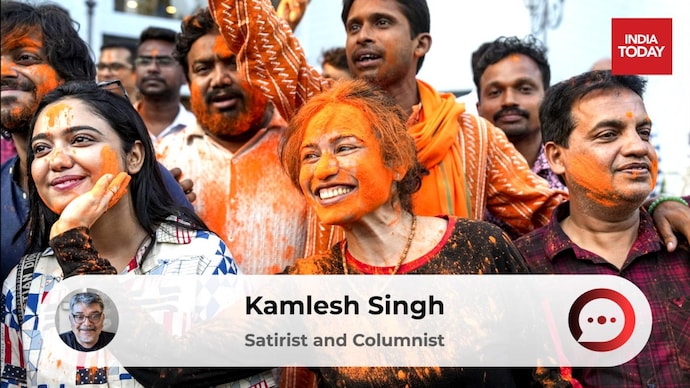
And Bengal celebrated. That is what the NRB has not been able to process, the image that will not leave, the affront that no amount of Gramsci (coming to that later) can soothe. In Midnapore, Bankura, and Birbhum, in the mofussil towns where the party flag changes only when the syndicate changes, people came out on the streets as if the rains had finally arrived after a long drought.
In urban centres, with new booths set up in high-rises and housing complexes where residents, especially the elderly, had previously been locked in by TMC-linked mobs on polling day. In the districts, women who had voted in silence for years, terrified of booth violence, walked out with inked fingers and wide smiles and did not lower their eyes.
The celebration was not the choreographed, bus-loaded spectacle of a party machinery at work. It was something older and more inconvenient. It was relief. In Hooghly and Howrah, sweets were distributed outside tea stalls, not by the party, but by people who simply had some surplus joy and nowhere particular to put it. A housewife in Bardhaman, who had watched her husband lose a government tender for three consecutive years because he refused to pay the cut money, sat in her courtyard and wept quietly. Not from grief. The NRB would not understand the distinction.
The NRB has not recovered.
On social media, the eminent Bengali intelligentsia has been performing a grief so baroque it deserves its own Rabindra Sangeet. Poets have posted photographs of Tagore. Filmmakers have posted quotes about democracy dying in darkness, without apparent awareness that darkness requires at least one bulb to have been lit. Retired professors have composed long threads about the erosion of Bengal's composite culture, threads that read beautifully and reference the Baul tradition.
One celebrated one posted a single line in Bengali, something to the effect that she could no longer recognise the land of her birth, and received 17,000 likes from people who also cannot recognise the land of her birth because they have not visited it in eight years. Journalists called this election a "litmus test of whether we have fallen below the minimum threshold of electoral integrity", a statement that circulated widely and was retweeted with great feeling by people who did not ask where this threshold had been when ballot boxes were being dumped in ponds during TMC panchayat elections. A lawyer posted about the foundational pillars of democracy being attacked.
The NRB has a pillow to rest on. SIR. The Special Intensive Revision of voter rolls deleted names, disrupted rolls, and placed the burden of proving voting eligibility on citizens themselves. This is a legitimate grievance. It deserves serious scrutiny. But the NRB has taken a legitimate grievance and constructed from it an impenetrable fortress of self-reassurance, inside which the actual voters of Bengal need not be consulted. The people did not choose. They were chosen against. Big difference.
What the NRB cannot quite bring themselves to say is that even accounting for every deleted voter, every disputed roll, every CAPF deployment the NRB has strong feelings about, that is an electorate that wanted to be heard. The people of Bengal came out in historic numbers. Then they voted the BJP. This is the data the NRB has filed "Stolen". The verdict can be questioned. The mandate is clear. To everybody but the NRB.
On the other hand, the people who actually lost, TMC leaders and candidates in Bengal, are citing reasons that are not part of the plan. IPAC's loyalty or lack thereof, Abhishek Banerjee's total control, RG Kar and Sandeshkhali, Muslim vote split, and so on.
Meanwhile, in Chittaranjan Park, Datta told his Tambram neighbour, he told his Punjabi landlord, he told the Market No. 1 fishmonger, who did not care. Didi could never lose. And now Didi has lost. Spectacularly. Almost poetically. With the kind of comprehensive arithmetic that does not leave much room for narrative consolation.
He is not speaking to his relatives in Howrah. Their betrayal is unforgivable. They did this. The brothers and sisters back home, tired of something as petty as everyday life, went and voted for their own selfish interest instead of the self-respect of a chhele living alone in the big, bad world of Delhi. Utterly selfish. Jaghanno kaaj.
The left-liberal Bengali's relationship with actual Bengali voters has always been complicated by proximity. Too close and the voters become inconvenient. They want jobs, they want roads, they want to not be beaten up for doing the wrong party. Working for the party is doing the party, in Bengal. The Bengal Bengalis have material concerns. The NRB's concerns are civilisational.
The tragedy, if we must use the word, is structural. The NRB Bengali needed Bengal to be many things: the last fortress of the secular idea, the cultural counterweight to Hindutva, the proof that sophistication and the left's leftover could still win. Bengal was asked to carry this ideological load while also being governed by a party that had, over 15 years, perfected the art of governance-as-patronage. The voters were expected to hold the NRB's sense of identity together even as their own lives frayed quietly at the edges. It was, when you think about it, quite a lot to ask of a state.
Mamata's words were a consolation. Stolen. Looted. Immoral. These are words that preserve the world as it was on the third of May, before the counting began and ruined everything.
But 93 percent voted. And 207 seats went saffron. And somewhere in Birbhum or Bankura or Burdwan, some ordinary Bengali, ground down by years of cut money and party muscle and the TMC's sublime indifference to the difference between governance and loyalty, did the sums available to them on a ballot paper and made a choice.
That choice is inconvenient. It does not fit the Habitat Center's habits. It does not rhyme with Renaissance.
The NRB will recover. They always do. Over the next few weeks, there will be long essays in prestige publications about what this really means for Indian democracy, what it means for federalism, and what it means for Tagore's idea of India. The essays will be beautifully written. It will not speak to the voter in Birbhum. The voter in Birbhum does not need to be spoken to. The voter in Birbhum has already spoken. The NRB was not listening.
(Kamlesh Singh, a columnist and satirist, is Tau of the popular Teen Taal podcast)