
Electric UAV by Deepinder Goyal's company flies after crash on first attempt
The aircraft, designed using a cutting-edge blown wing concept, aims to combine the efficiency of fixed-wing aircraft with the accessibility of helicopters.
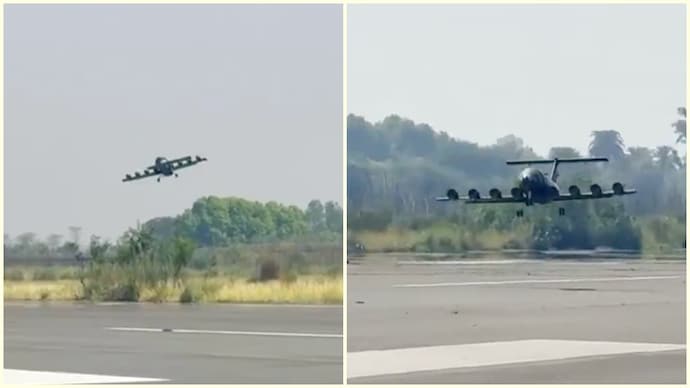

Zomato founder Deepinder Goyal has announced a major milestone for his aviation venture, Lat Aerospace, after the successful test flight of its technology demonstrator, Lat One v0.2.
The aircraft, designed using a cutting-edge blown wing concept, aims to combine the efficiency of fixed-wing aircraft with the accessibility of helicopters.
This approach enables ultra-short takeoff and landing (uSTOL), allowing aircraft to operate from compact spaces without the need for long runways.
Sharing details of the test, Goyal said the v0.2 prototype successfully completed its full mission profile, a significant step forward from the earlier v0.1 version, which had achieved uSTOL capability but crashed shortly after takeoff.
The crash, he noted, was anticipated as part of the experimental process.
The latest prototype not only remained airborne for over six minutes but also demonstrated strong performance across multiple parameters. The aircraft exceeded its predicted cruise speed, flying comfortably at 33 metres per second against an expected range of 30-32 mps.
Engineers also reported no thermal issues despite testing under harsh afternoon conditions.
A key highlight of the flight was the validation of the blown wing technology in real-world conditions. This aerodynamic concept uses airflow over the wings to increase lift at low speeds, enabling shorter takeoffs and landings, a feature that could transform regional and urban air mobility.

Equally important was the successful validation of the aircraft’s closed-loop control systems, which allow it to autonomously adjust and stabilize during flight.
The prototype’s quick-detach wings also proved durable, holding firm during aggressive manoeuvres.
The aircraft executed a smooth landing and was deemed ready for subsequent flights, showing the robustness of its design.
However, Goyal emphasised that the most satisfying outcome was the near-perfect alignment between theoretical models and real-world results.
Data from computational fluid dynamics (CFD) studies, aerodynamic simulations, software-in-the-loop (SIL) testing, and actual flight logs closely matched, a rare and significant achievement in early-stage aerospace development.
“That’s what real engineering looks like,” he said, praising his team’s efforts.
While the successful test marks a crucial step forward, Goyal acknowledged that significant work remains.